
Every few months someone posts a screenshot like Stripe dashboard, a PayPal balance. Revenue numbers big enough to make you stop scrolling. The caption is usually something like “how I made $X using AI” and the comments are full of people asking how they can do the same thing.
What almost nobody posts is the part that came before the screenshot. The years of freelance work that built the client relationships, the newsletter audience that took eighteen months to grow. The specific industry knowledge that made their AI-assisted product worth buying in the first place. The screenshot is real but the story underneath it is just incomplete.
I am not writing this to be cynical about AI income. I genuinely think there are more practical ways to earn money online with AI involved than there have ever been before. But I also think the gap between what most content promises and what actually works is large enough to be harmful, because it sends people down paths that waste months before they figure out the landscape.
So here is what I actually know, from years of working as a freelancer, watching what works for people I know and thinking carefully about where AI creates real leverage versus where it just creates the feeling of progress.
The most important thing I can tell you is this: AI has never paid anyone’s rent by itself, it is a tool.
McKinsey estimates AI could add up to $4.4 trillion in annual value to the global economy. The question is not whether the opportunity is real. It is understanding which part of that opportunity is accessible to you specifically and how.
Tools need people who know how to use them on problems worth solving. Once you internalize that, the rest of this gets much clearer.
Where AI Actually Changes the Income Equation
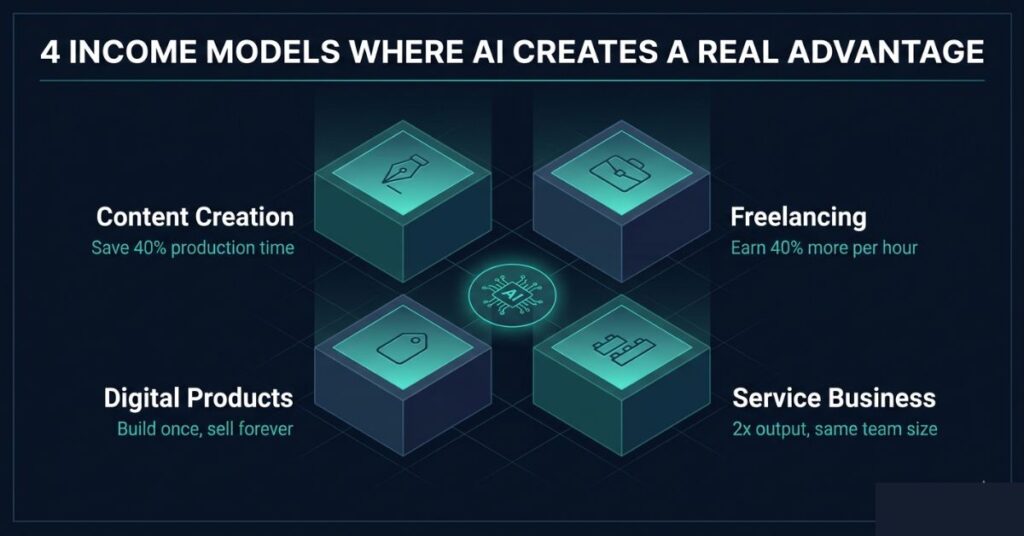
Not every online income model benefits equally from AI. Some are genuinely transformed by it. Some are barely touched. A few have actually gotten harder because AI flooded the space with cheap, indistinguishable output and made it more difficult for anyone to stand out.
Here is my honest read of which models are worth your attention.
Content creation and publishing
The most obvious one and, because of that, the most misunderstood. Yes, AI can write. The problem is that knowing AI can write and knowing how to use that capability profitably are completely different things.
What AI cannot do in content work is know your audience, hold a genuine perspective or build the kind of trust that makes someone read everything you publish and tell their colleagues about you. These things come from a person, from consistent voice, from earned authority in a subject. No model generates them.
What AI can do is handle the parts of content work that consume time without requiring judgment. Synthesising research from multiple sources. Generating three headline options when you only need one good one. Writing the first structural draft of an article that you then rewrite with your actual voice. Creating social captions adapted from a longer piece. Drafting email sequences from a core message you wrote yourself.
The content creators making serious money in 2026 are not using AI to write everything and publish it at scale. That strategy worked for about eighteen months before platforms and audiences developed a reliable feel for what it produces. The ones doing well are using AI to compress the mechanical work in their process so they can spend more time on the parts that actually require them.
Freelancing
This is the one I know most directly, and my honest view is that AI has been better for skilled freelancers than almost anyone predicted and worse for unskilled freelancers than most want to admit.
For someone who is genuinely good at what they do, AI changes the capacity equation in a meaningful way. A copywriter who could produce three strong pieces a week can now produce five, with the fifth being as strong as the first because AI is handling the outline, the research synthesis and the initial structural draft. A content strategist who used to spend two hours building a competitive landscape document before a client call can now do it in thirty five minutes and walk into the call with better coverage than before.
The income implication of this is not just “earn the same with less work,” though that is a valid choice. It is also “take on the projects you used to turn down because the time cost was too high” and “charge more because your output quality has improved in ways clients notice.”
But for someone who entered freelancing hoping AI would compensate for skills they had not developed, the situation is harder. Clients who are paying for expertise can tell when the work is generic. They may not be able to articulate that it was AI-generated, but they can tell it does not have the specific insight they were paying for. Losing clients for reasons you do not fully understand is a demoralising way to learn this.
Digital products
Templates, guides, toolkits, Notion dashboards, spreadsheet systems, short courses, email sequences. Products you build once and sell repeatedly. AI has made creating these meaningfully faster, which has both lowered the barrier to entry and raised the bar for what earns.
Here is the honest tension in this space right now. The ease of creation has flooded the market with average products. A generic productivity template or a vague guide to freelancing is not going to sell because there are already thousands of them. What sells is a product specific enough to feel like it was built for a particular type of person dealing with a particular kind of problem.
AI can help you build the product. It cannot help you understand the audience. That understanding still comes from being close to the problem, from having dealt with it yourself or from spending serious time in communities where people who have it talk about it openly. The insight comes first. The product follows.
Service businesses and agencies
The people I have watched benefit most quietly from AI are running small agencies or productised service businesses. Not because AI improves the front-end work they deliver to clients, but because it compresses the operational overhead that used to absorb a significant portion of their time and margin.
Proposal generation from a standard brief. Client reports built from raw data. Research compiled across multiple sources before a strategy call. Onboarding documentation for new clients. Content repurposed across formats from a single source. These are tasks that used to take hours per client per week and now take significantly less. That saved time either goes back to the owner as profit or gets redirected toward serving more clients at the same staffing level.
A small agency that uses AI well across its operations is not a more impressive creative agency. It is a more profitable one, which is the thing that actually keeps the lights on.
What the People Making Real Money Are Actually Doing
I want to name this clearly because the gap between the public narrative around AI income and what is actually happening is large and worth closing.
The social media version is all screenshots and vague attribution. “Built this with AI.” “Made this using ChatGPT.” What that usually means, if you dig into it honestly, is that someone with an existing skill, an existing relationship base or an existing audience used AI as a production tool within a business that was already working or would have worked eventually anyway.
The AI did not create the business. It accelerated or extended something that was already viable.
Here are the four patterns I actually see producing consistent income.
The accelerated freelancer. Someone with three or more years of experience in a service category uses AI to handle the parts of their work that do not require their specific expertise. They take on more clients than before, or deliver better work than before, or both. The additional margin funds the development of something more passive, usually a newsletter, a course or a productized version of the service they already deliver.
Freelancers who niche down earn significantly more from AI-assisted work than generalists, because the efficiency gains from AI are multiplied by the premium rates that specialist positioning supports.
The workflow seller. Someone in a specific industry, not a generic content creator, builds a documented AI-assisted system for a problem that industry deals with repeatedly. A specific workflow for how a property management company handles tenant communications. A researched system for how a legal firm processes initial case documents. These are worth real money to the right buyers because they are specific, tested and save immediate time. They are not prompt lists. They are systems.
The niche publisher. A person with genuine subject matter expertise builds a content site in a specific domain, uses AI to support the research and structural work but writes everything personally, and builds an audience over one to two years. Monetisation comes from advertising once traffic warrants it, from their own digital products or from a consulting offer attached to the site. The AI makes the production sustainable. The expertise makes the content worth reading.
The service packager. A skilled freelancer takes something they deliver manually, identifies which parts AI can handle at equivalent quality and restructures the whole thing as a fixed-price productised service. The client pays for a defined outcome. The AI is in the background of the workflow. The packager earns more per hour than they did as a traditional freelancer because the production overhead dropped without the client-facing quality dropping.
What all four have in common is competence applied before AI is introduced. Every single one of them would have been possible without AI. AI made them more efficient, more scalable or more profitable. That is the honest version of how this works.
A Practical Starting Framework
If you want to know where to actually begin rather than just understand the landscape, here is how I would think through it.
If you have not yet earned anything online, getting your first $100 online before building AI into the workflow gives you the practical context that makes AI genuinely useful rather than theoretical.”
Start from existing knowledge, not from a list of AI tools.
The fastest path to income with AI is not finding the best AI tool. It is identifying what you already know, who that knowledge could help and where AI reduces the friction of delivering that help. If you have three years of project management experience, you understand project management problems in a way someone learning from scratch genuinely does not. AI helps you package and deliver what you know, faster. It does not generate the knowledge itself.
Find the specific friction in work you understand.
Go through whatever you currently do or want to do and identify the specific steps that consume time without requiring your judgment. Not the thinking parts. The formatting, the research synthesis, the first structural pass, the repetitive documentation. These are where AI creates leverage without creating risk. The judgment-heavy parts stay with you. The mechanical parts get handed off.
Pick one income model and commit to it long enough to learn from it.
The pull toward doing several things at once is strong and almost always counterproductive. A content site, a freelance service, a digital product and an agency are each a real business. Pursuing all four simultaneously means you are running four businesses poorly instead of one business properly. Pick one that connects to existing knowledge and capability. Go deep enough to learn what works before you add anything else.
Validate before you automate anything.
This is the one most people skip and most people regret skipping. Before you build any AI-assisted workflow, confirm that someone will pay for what comes out of it. Sell one manually. Deliver one project without the automated system. Find out whether the output is actually valuable to the person receiving it before you invest time in making the production more efficient. Automating a product nobody wants is just a faster way to produce something nobody wants.
The AI Tools That Are Actually Worth Your Time
Rather than cataloguing every option, which would be outdated before you finish reading, I want to focus on the categories with proven relevance to income and say something honest about each.
Language models for thinking and writing
ChatGPT, Claude and Gemini are the main options and all three are capable enough for the income applications most people actually have. The choice between them matters far less than how you use whichever one you pick. A well-framed, context-rich prompt to any of them will outperform a lazy prompt to the best model available. The tool is the smallest variable.
There is a specific problem AI writing tools create for content creators that is almost never discussed in the promotional content around them, this article covers it honestly.
Transcription tools
Otter.ai and Fireflies are the most used. For anyone delivering services that involve client calls, these are an immediate and unglamorous improvement. You stop trying to write notes while also listening to the person talking. The transcript exists afterward. Reports, follow-ups and action items are faster to produce because you have a record of what was actually said. Small thing. Genuine time saving.
Image and visual generation
Midjourney and Adobe Firefly are the most capable options for commercial use. The income applications are real for people who create content, sell digital products or produce visual assets for clients. The caveat that does not get said enough: these tools produce their best work when the person directing them has visual literacy. If you cannot evaluate what comes back, you cannot improve on it, which means you are dependent on the first generation being good enough. That is a fragile workflow.
Automation tools
Make and Zapier connect AI to the rest of your business. This is where efficiency gains become systematic rather than requiring your attention every time. An automated workflow that processes a client intake form, generates a customised brief document and sends a templated onboarding email is worth building once if you run that process frequently enough. The investment of time in setting it up pays back quickly for high-volume repetitive processes. It is overkill for anything you do twice a month.
Building a personal AI workflow that makes the efficiency gains systematic rather than occasional is the step that separates people who benefit from AI consistently from those who benefit occasionally.
The False Productivity Problem Nobody Talks About Honestly
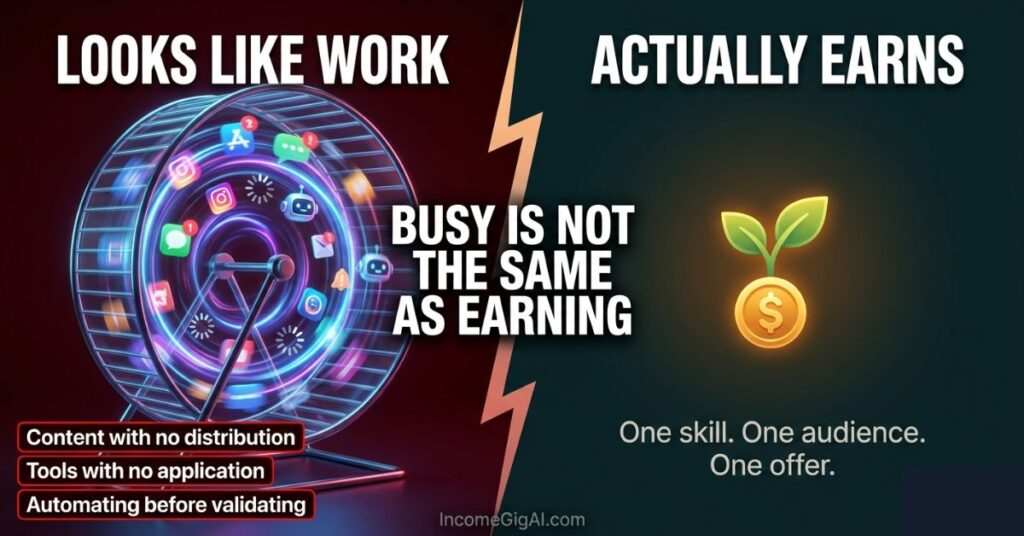
I think this is the most important section in this article, and it is the one most content about AI income carefully avoids.
AI creates a specific kind of busyness that feels exactly like real work. You can spend an entire afternoon generating, refining, organising and reviewing AI outputs and arrive at the end of it feeling genuinely productive. Whether you produced anything of value during that time is a completely separate question and one that is easy to not ask.
Three specific traps.
Content production without a distribution plan. Generating fifty blog posts in a week feels like building a content business. Publishing fifty blog posts that nobody reads is not a business. It is a folder of files. The parts of content income that are actually difficult, building an audience, earning trust, getting people to find you and return, are slow and largely manual regardless of how fast you produce the content. AI accelerates the wrong part of the problem and the right part stays exactly as hard.
Tool acquisition instead of application. There is a recognisable pattern of spending weeks researching, testing and setting up AI tools without actually deploying them in a context that earns money. The research phase feels productive. The setup phase feels productive. The learning feels like progress. None of it is income. At some point the tools have to get used on something real, for someone who would pay for the result. That step is where most people stall.
Automating before validating. Building a sophisticated AI workflow for a product or service before confirming that anyone wants what the workflow produces is a very efficient way to waste several months. The automation should come after the validation, not before it. Validate the idea manually. Confirm that people will pay. Then build the system that lets you deliver it more efficiently at scale.
Honest Timeline Expectations
I am going to be direct here because I think vague or implausibly optimistic timelines cause real harm. They make people feel like failures when they are actually just on a normal trajectory.
If you have existing skills and knowledge in a domain and you apply AI as a production tool within a service or content model you already understand, a realistic timeline to your first meaningful income is two to four months. Not passive income. Not enough to quit anything. But real money, from a real person, who found genuine value in what you delivered.
If you are starting without established skills, the timeline is longer because you have to develop the underlying capability before AI can meaningfully extend it. Six months to a year to get a skill to a marketable level. Then two to four months to earn something real from it. AI does not compress the skill development phase. It compresses the production phase after the skill exists.
Income that is stable enough to be a primary or significant secondary source typically takes a year to two years of consistent work, regardless of how sophisticated your AI setup is. The people with shorter timelines almost always have prior relevant experience, prior relationships or prior audiences they are not counting in the story they tell publicly.
The Right Question to Be Asking
Most people come to this topic asking which AI tools make money. That question leads to subscription sign-ups, tool comparisons and eventually a desktop full of apps that individually impress but collectively produce nothing.
The question worth asking is more specific and more demanding: what concrete value can I deliver to a specific type of person, and where in the process of delivering that value does AI help me do it better or more sustainably?
That question requires you to know something. To have something to offer. To understand a problem well enough to solve it for someone who has it. AI then becomes part of how you solve it more reliably, not the reason you can solve it at all.
The opportunity is genuinely real. It just belongs to people who bring something to it.
Frequently Asked Questions
Do I need technical skills to use AI for making money online?
Genuinely no. The tools most practically relevant to income generation, language models, transcription tools and basic automation platforms, were built for non-technical users and are accessible without coding knowledge. What matters more than technical skill is domain knowledge and judgment. Knowing how to frame a problem, evaluate an output and decide when to push back on what AI produces is more valuable than knowing how any of it works under the hood. That is the honest answer, not the flattering one.
Can someone with no existing skills make money using AI?
This is the question most people actually want answered, and the honest answer is harder than most content admits. AI amplifies what you already have. Without existing knowledge in a specific domain, the output you produce with AI will look like what anyone else produces with the same prompt and the same tool, because you have nothing specific to add. The more direct path is developing a real skill first, even if it takes several months, and then using AI to make that skill more productive and more scalable. The skill creates the differentiation. AI increases the output.
Is selling AI-generated content still a viable income model?
In its raw form, almost certainly not. The market for unedited, generic AI content has been deteriorating consistently since early 2024 as clients, platforms and audiences developed better instincts for identifying it. What remains viable is AI-assisted content, where the person brings knowledge, voice, judgment and editorial direction, and AI handles the structural and mechanical production. The human contribution is not optional decoration. It is the thing that makes the content worth anything.
What is the most realistic starting point for a complete beginner?
A freelance service in a category where you have some genuine competence, with AI used to improve efficiency rather than replace expertise. The reason this works better than trying to start with a content site or a digital product is that it gets you in direct conversation with real people who either find value in what you deliver or do not, and that feedback is immediate and unmistakable. Building a content site or a digital product in isolation means you can go months without finding out whether what you are producing is worth anything to anyone.
For a broader look at verified AI income paths with documented timelines, Shopify’s guide to making money with AI covers several models worth reading alongside this one.
How do I decide which AI tools are worth paying for?
Use free tiers until they become a genuine bottleneck, then pay for one thing at a time. Most people find that two paid tools cover the majority of what they need: a capable language model for thinking and writing, and one domain-specific tool for whatever their particular workflow requires. The tendency to collect subscriptions before validating that you will actually use them regularly is expensive and does not lead anywhere useful. Pay for things that are already part of your workflow. Do not pay for things you are hoping to build a workflow around.

Johnson Alaekezie is a freelancer and digital content creator with several years of experience working across writing, content strategy, and digital services. He founded IncomeGigAI to share honest, practical information about building income online without the hype that dominates most of this space. Johnson has worked with clients in the US, UK and beyond, and writes from direct experience rather than theory. He is based in Nigeria and covers the digital income topics he has personally navigated as a working freelancer.