
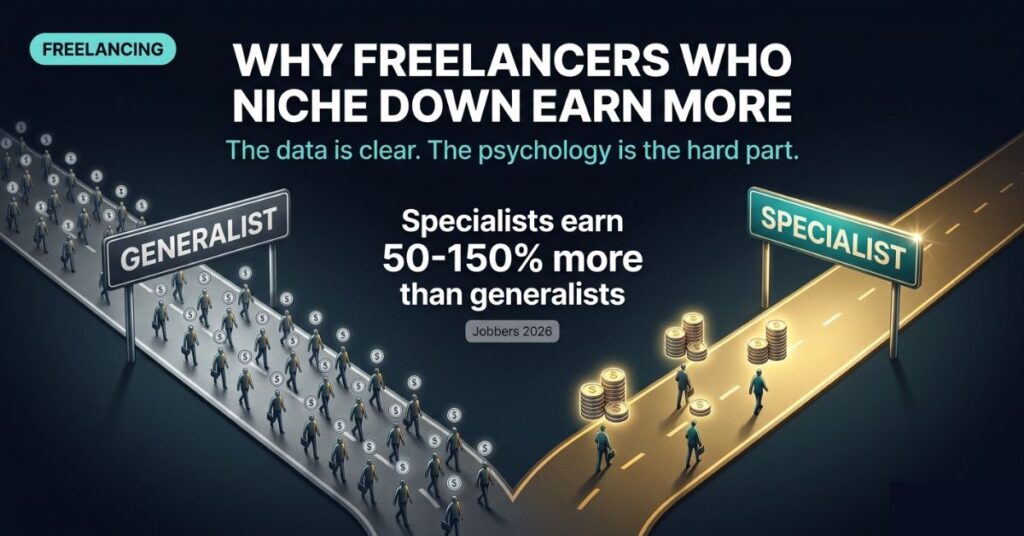
For the first three years of my freelancing career I had a quiet rule: never say no to a paying client.
It felt like wisdom at the time. I was a content writer working across technology, retail, hospitality, finance and whatever else arrived in my inbox that week, I told myself this was resilience. That a freelancer with diverse experience was a freelancer who could weather anything. That specializing was something you did once you had enough clients to afford turning some away.
What I did not understand then, and what took embarrassingly long to see clearly, is that the logic was backwards. I was not building resilience by staying general, I was building a ceiling.
The clients paying the highest rates were not paying for range. They were paying for precision. For someone who already lived inside their world, who understood the language without being taught it, who had read enough of what their competitors were publishing to know what would actually stand out. The generalist arriving with broad experience was asking those clients to do imagination work. To picture how skills developed elsewhere might translate to their specific problem. Most of them did not bother. They moved to someone for whom the translation was already done.
That is the thing nobody tells you about being a generalist, you do not get rejected you just quietly stop getting chosen.
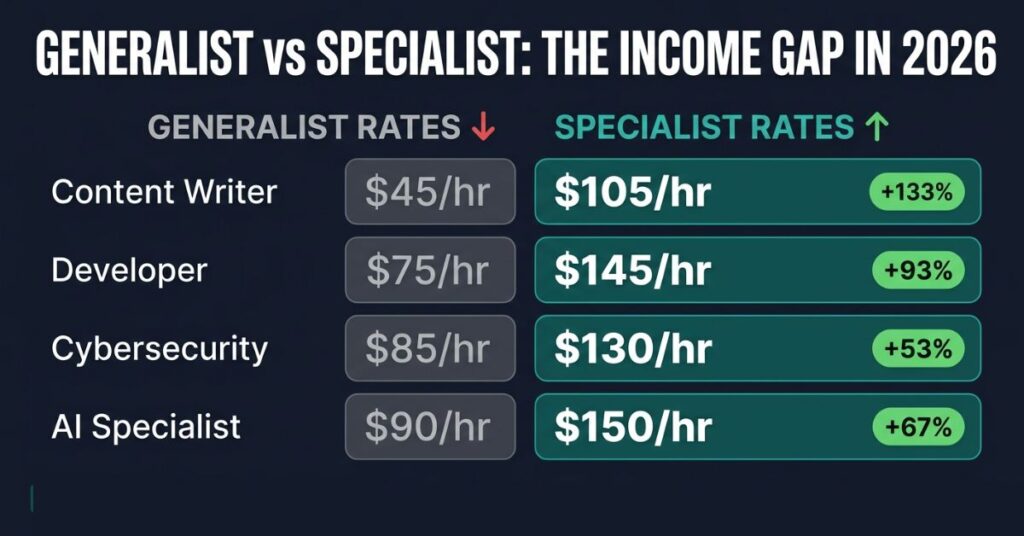
The data in 2026 is unambiguous about what this costs. Niche specialists earn between 50% and 150% more than generalists in comparable fields, according to the Jobbers Freelance Benchmark Report published in April 2026. A general content writer charges around $45 per hour. A financial writer charges $105. A general developer earns $75. A blockchain specialist earns $145. The income gap is not about talent. It is about automatic relevance. Being the person a specific type of client reaches for without deliberation.
That is the real value of a niche not expertise in the abstract. The instant signal that you are already the right person.
The Psychological Trap of Staying General
The reason most freelancers stay general is not laziness and it is not ignorance. The niching advice is everywhere. Most freelancers who have been in the game for more than a year have heard it multiple times.
The reason is something more specific. Staying general feels like strategy. It feels like risk management. The narrative is coherent: serve more industries, take more types of projects, depend on no single sector, remain available for whatever comes. That sounds rational because part of it is true.
What it leaves out is what generalizing costs on the other side of the transaction. When a potential client is looking for help, they are almost never looking for someone who can help with a broad range of things.
Upwork’s Future Work Index found that 68% of clients prefer niche expertise when hiring freelancers and value communication skills as highly as technical ones. The generalist is not losing on communication. They are losing on the specificity signal before the conversation even begins. They are looking for someone who already understands their specific situation.
A marketing manager at a B2B SaaS company searching for a writer does not want range. They want someone who knows what a product-led growth strategy looks like from the inside, who understands why a case study for a procurement tool needs to be built differently from one for a consumer app, who has read enough SaaS blogs to know which angles have been done to death and which have not been tried.
When a generalist shows up for that brief, they create friction. The client has to do the work of imagining how skills built elsewhere apply here. Whether the transfer will hold. Whether the learning curve will be visible in the output is uncertainty. And clients with genuine choices do not sit with uncertainty, they move on.
The generalist does not get a rejection email. They just do not hear back. The project goes somewhere else and there is no feedback, no signal, no data. Just a quiet month that gets attributed to slow seasons or the economy or bad luck.
This invisibility is what makes generalizing feel safe. The losses do not register as losses, they register as absence and absence is easy to explain away.
What the 2026 Market Has Done to the Middle
The freelance market in 2026 has divided in a way that removes the comfortable middle ground that generalists used to occupy.
At the commodity end, AI tools have absorbed most of the demand that used to sustain generalist freelancers. Basic blog posts written to minimal specification. Entry-level social media content. Simple graphic assets. Templated email sequences. Routine data organization. The clients who used to hire generalist freelancers for this work can now produce it faster, cheaper and without the management overhead of a contractor. That work has not disappeared but it has moved and where it moved was not toward human freelancers.
At the specialist end something entirely different is happening. The freelance writing market reached $7.6 billion in 2025 and is on track to reach $13.8 billion by 2033. In the same period, commodity writing projects on Upwork fell 32% year over year in 2025, the single largest decline of any category on the platform, both statistics are accurate simultaneously. The market for generic writing contracted sharply while the market for specialist writing expanded.
Medical writers charging $60 to $150 per hour are not more talented writers than capable generalists. They are writers who made a deliberate decision to go deep into one domain and then made that depth legible to the clients who need it most urgently. Fintech writers earning $0.95 per word made the same kind of decision. The craft is similar but the positioning is completely different.
The same split runs through every freelance skill category. AI integration specialists command $150 per hour against $90 for general developers. Cybersecurity and compliance specialists earn 40% to 60% above standard software developer rates, with a documented global skills shortage exceeding 4 million professionals. The Jobbers Global Hourly Rate Index, published in April 2026, found that intersection specialists, those who combine deep expertise in one technical area with working knowledge of an adjacent domain, earn 90% to 150% above generalist rates in the same broad field.
The market is not punishing generalists for doing bad work. It is paying significantly less for undifferentiated work and a lot of generalist work is undifferentiated by definition.
Why Niching Feels Like Shrinking
I want to spend some time on this because I think it is the crux of why intelligent, capable freelancers stay general when the evidence for specialising is so clear.
When you commit to a niche you are not just choosing a focus. You are simultaneously saying that you are not the right person for everything outside it. A content strategist for B2B SaaS companies is not available for the healthcare brief. Not positioned for the retail project. Not the right fit for the financial services company that needs general communications support. In the moment of committing, all of those feel like doors closing.
The doors that open are invisible at that point. You cannot see the SaaS clients who will find you immediately relevant, the referrals that travel through specialist networks once you have a reputation in one, the rate increases that become possible when you are no longer competing on price with everyone who can produce adequate general content.
You can only see what you are giving up, the gain is hypothetical and the loss feels concrete.
There is also a sunk cost dimension that nobody talks about honestly. Most freelancers who have been working for a few years have invested time in building and marketing a broad set of skills. Narrowing means that some of that investment becomes less visible in how you present yourself. That investment does not disappear. It becomes context. A financial writer who spent four years covering technology across multiple industries understands the intersection of fintech in a way that someone who went directly into financial writing does not. That background is genuinely valuable inside the niche. The problem is that it does not feel valuable in the moment of giving up the technology clients to pursue the financial ones.
What most freelancers need is not more evidence that niching works. They have that. What they need is an honest acknowledgment that the transition is uncomfortable in a specific and predictable way, and that the discomfort is not a signal that the decision is wrong.
The Niches Earning the Most Right Now
Not all niches are equal and giving specific data about where the market is paying the most is more useful than telling you that any niche beats none.
The highest earning freelance niches in 2026 share a consistent set of characteristics. They involve work that AI cannot fully replicate because it requires verified expertise, regulatory accountability or domain judgment that cannot be generated from training data alone. They serve clients whose purchasing decisions are driven by compliance, revenue or legal exposure rather than preference, which means budget tends to be present and price sensitivity tends to be lower. And they are growing rather than stable.
In writing and content, the premium positions in 2026 are healthcare and medical writing where rates run $60 to $150 per hour, financial and investment content where strong writers earn $0.95 per word or more, B2B SaaS and technology where the growth of the sector has outpaced the supply of writers who genuinely understand it and ESG and sustainability reporting where new regulatory disclosure requirements have created urgent demand that the supply of qualified writers has not yet met.
In development and technical work, the premium positions are AI and machine learning implementation at $120 to $200 per hour for senior specialists, blockchain and Web3 development where rates run $145 per hour against $75 for general developers, cybersecurity and compliance where the talent shortage is structural and rates reflect it and accessibility compliance which is underserved relative to growing regulatory requirements in the US, UK and EU.
For designers, conversion rate optimisation with a documented track record, UX for regulated industries and motion design for digital products are the positions commanding the clearest premiums above generalist rates.
The pattern is consistent across all of them: technical or regulatory complexity that creates a meaningful barrier to entry, a client base making purchase decisions on business outcomes rather than personal preference and a market that is actively growing rather than saturated.
How Narrow Is Too Narrow
Most niching advice treats this as binary. Pick a niche and go deep. The reality is more textured and getting the calibration wrong in either direction is a real cost.
A niche too narrow creates a different set of problems from staying general. The client pool shrinks to the point where you cannot find enough work within it, referral networks cannot develop because the community is too small, and being known as a specialist in that space earns you a reputation that does not translate anywhere useful if the demand shifts.
The Jobbers Freelance Skills Demand Index suggests a useful viability test: a working niche should have somewhere between 10,000 and 100,000 potential clients globally. Enough demand that finding clients is a realistic ongoing activity. Specific enough that competition is meaningfully lower than in a broader category.
“WordPress development for dental practices in the American Midwest” is too narrow. The client pool is small, geographic proximity adds complexity and the niche does not generate the kind of referral network that sustains a freelance business. “WordPress development for healthcare practices” is workable. The client pool is large, the community is connected, the regulatory environment creates specific shared needs that make specialist positioning genuinely valuable and the referral networks within healthcare are strong.
A practical test before committing to a niche: search LinkedIn for the job title of your ideal client and see how many results appear. Look at the professional associations in the industry and assess how active their communities are. Search for freelancers already working in that niche and see whether there are enough to suggest real demand without so many that the market is already crowded. These are imperfect signals but they are better than deciding based on intuition alone.
The Practical Transition
The advice to “just pick a niche” is about as useful as “just get more clients.” Both are correct in the abstract. Neither helps you do anything on a Tuesday afternoon.
Here is how I would approach the actual transition if I were doing it now.
Start with an audit of your existing work rather than a fresh search for what sounds profitable. Look at every client you have served and every industry you have worked in. Ask where you already have context that would take a newcomer months to develop. Where did you find yourself actually understanding the client’s problem rather than researching enough to simulate understanding? That genuine comprehension is the raw material of a working niche. It is also your evidence when you present yourself as a specialist. You are not claiming expertise you have borrowed from a course. You are describing knowledge you built through direct work.
Then test that context against where money flows. Not every domain you understand is one where clients spend significantly on the services you offer. The intersection of what you already know deeply and where businesses demonstrably pay premium rates for specialist help is your starting point.
Once you have identified a direction, change your visible positioning before you change your client list. Update how you describe yourself on any platform where potential clients might find you. Reframe your portfolio to emphasize the most relevant work in the niche. Write about the niche publicly if you have a blog or a newsletter or a LinkedIn presence. Engage genuinely in the communities where your ideal clients gather, contributing before you are trying to sell anything.
Getting freelance clients without relying on platforms is the parallel move worth building during this transition period. Referrals, LinkedIn and direct outreach create the pipeline that makes platform dependence optional.
The incoming work will not change immediately. The transition period typically runs three to six months. During that time, volume of enquiries usually drops before quality improves, because you are now less relevant to a broader group before you have built enough visibility with the specific group you are targeting. Most people interpret the drop in volume as evidence the niche is not working. It is usually evidence the transition is working exactly as it normally does.
The T-Shaped Model and Why It Matters
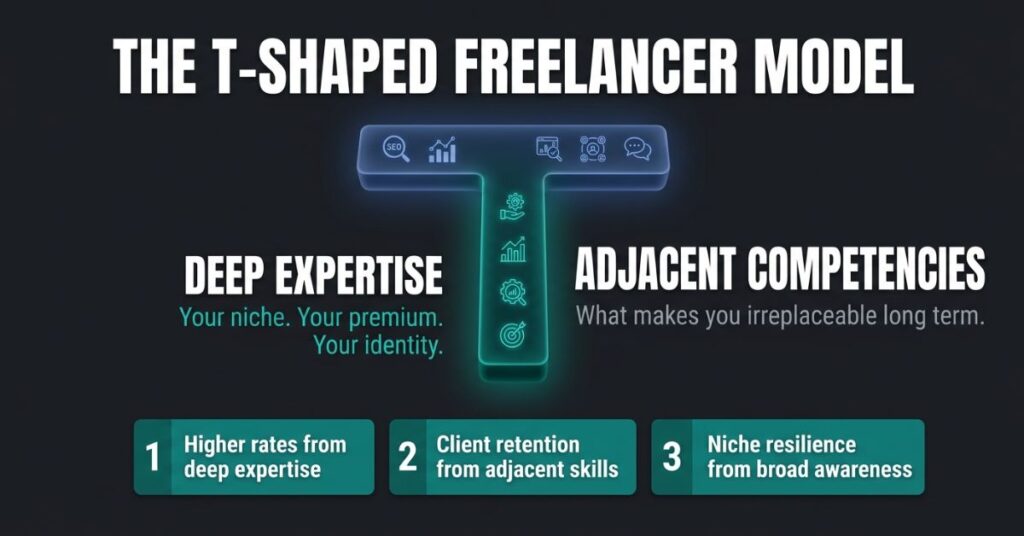
The frame that has been most useful for freelancers I know who have gone through this successfully is the T-shape.
The vertical bar of the T is deep expertise in one specific domain. This is the niche. The area where you have demonstrably more knowledge and track record than most people offering comparable services. This is what gets you hired in the first place and what justifies a rate above the generalist floor.
The horizontal bar is functional competency across a range of adjacent areas. Not deep expertise. Enough understanding to see how your specialism connects to the other things your clients care about and to be useful in conversations that extend beyond the core work.
AI tools that multiply the output of a niche specialist without diluting the specialization are worth understanding as part of the T-shaped model. They sit in the horizontal bar, extending capability without replacing the core expertise.
A financial writer who understands SEO well enough to structure content for search, who has enough familiarity with email marketing to adapt content across formats and who understands the basics of how content relates to the sales funnel is more valuable to a fintech client than a financial writer who only writes. The vertical expertise is what generates the initial hire while the horizontal competency is what generates the long-term relationship and the referrals.
The T-shape protects against the main risk of niching too narrowly. If the core niche shifts or a client needs something adjacent to the core work, the horizontal bar provides a bridge. You are not so specialised that a change in your primary market leaves you stranded.
Frequently Asked Questions
Do I have to immediately stop taking non-niche work when I decide to specialize?
No. The transition is almost always gradual. What changes first is your visible positioning, how you describe yourself, what your portfolio emphasises, the language you use in outreach and on your profiles. The actual client roster shifts more slowly, as niche work comes in and general work either continues or phases out naturally. Abruptly refusing all non-niche work before you have reliable income from the niche is financially unnecessary and strategically premature. The visible positioning change is the decision. The client list change is the outcome that follows it.
How do I choose between multiple niches I could plausibly work in?
Apply three tests. First, where do you have the deepest existing knowledge and the strongest existing work samples? Second, where does the market demonstrably pay a premium for specialist help rather than just preferring it? Third, where can you see yourself spending significant time and staying genuinely engaged over years rather than months? The niche that scores well on all three is worth committing to. The niche that scores well on one or two but poorly on the third will usually fail because the quality of your work in it will not sustain the specialist reputation you need to build.
What if my niche becomes less relevant because of AI or market shifts?
This is a real risk and worth factoring into the niche you choose. The niches most resilient to AI displacement are those where the work requires verified expertise, regulatory accountability or domain judgment that cannot be generated from training data. Medical writing, financial content, legal documentation and compliance work all fall into this category. Platform-specific technical skills tied to a single vendor or technology are more fragile. The T-shape model also provides protection: if your core niche shifts, your adjacent competencies give you a path to a neighbouring niche without starting over.
How do I find clients in a niche I am just entering?
Your first clients in a new niche almost always come from relationships rather than from your repositioned presence. Look at your existing and past clients and ask whether any of them or anyone in their networks operates in the space you are moving into. One warm introduction into a new niche does more work than three months of cold outreach to people who have never heard of you. Alongside that, spend regular time in the communities where your ideal clients gather, LinkedIn groups, industry associations, Slack communities, niche forums. Contribute to those communities before you try to sell anything in them. The specialist reputation you need gets built in the places where your ideal clients are already talking to each other.
Is there a point in a freelance career where niching becomes less important?
The opposite tends to be true. Early in a career, some breadth is necessary because you are still discovering where your strongest work lives and which types of problems you find most engaging. That exploration is genuinely useful. The mistake is treating the exploration phase as permanent. Once you have enough experience to see where your work is consistently strongest and where the client relationships are most productive, the strategic value of committing to a niche increases rather than decreases. The freelancers building the most sustainable and highest-earning careers in 2026 are almost universally specialists. The ones still competing primarily on price are almost universally not.

Johnson Alaekezie is a freelancer and digital content creator with several years of experience working across writing, content strategy, and digital services. He founded IncomeGigAI to share honest, practical information about building income online without the hype that dominates most of this space. Johnson has worked with clients in the US, UK and beyond, and writes from direct experience rather than theory. He is based in Nigeria and covers the digital income topics he has personally navigated as a working freelancer.