
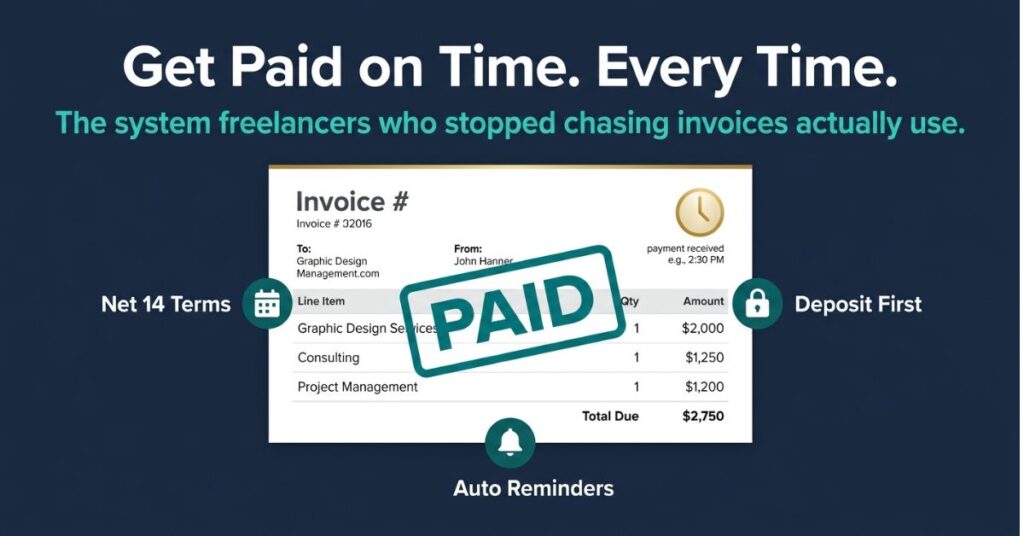
I chased an invoice for four months once. A client paid $850 for a logo and brand guide I delivered on time and got approved within a week. Then nothing afterward, I emailed, polite reminder, still no response. Emailed again two weeks later, slightly less polite but heard nothing. By month three I was annoyed enough that I called the number on his website and a different person picked up and told me he had sold the business.
I got paid eventually. Half of it, after a lot of back and forth with the new owner who felt no obligation to honour an invoice from before his time.
That was early in my freelancing career and it is the kind of experience that changes how you operate. Not because it was the worst thing that ever happened, it was not but because it made me realize I had no system. No deposit policy, no late fee clause and no follow-up process. I had just done the work and sent the invoice and hoped for the best, which is how most freelancers start and how most payment problems begin.
Payment Terms
Payment terms need to be agreed in writing before a single hour of work starts. Not discussed on a call and not assumed. Written into the contract or project agreement the client signs.
That means stating clearly: when payment is due, what happens if it is late and which currency and payment method you accept. I know this sounds obvious but I skipped this for my first eighteen months of freelancing and it cost me in ways that were entirely preventable.
A consultant I know puts one line in bold at the top of every contract: “Payment due within 14 days of invoice date. Work on future projects will not begin until outstanding invoices are settled.” She told me that one sentence, visible and unambiguous, cut her average payment delay from around three weeks to under ten days. Clients who might otherwise let an invoice drift down their to-do list see it as a real deadline because it was presented as one from the start.
On late fees: I use 1.5 percent per month on overdue balances, I rarely have to enforce it. The fact that it exists in writing seems to be enough to move most invoices up the priority list when a client is juggling several. A late fee changes the psychology of an invoice in a way that polite language alone does not.
The same principle that makes payment terms work, agreement in writing before the relationship begins is what makes rate increases land without friction, which is a separate conversation worth having.
Deposits
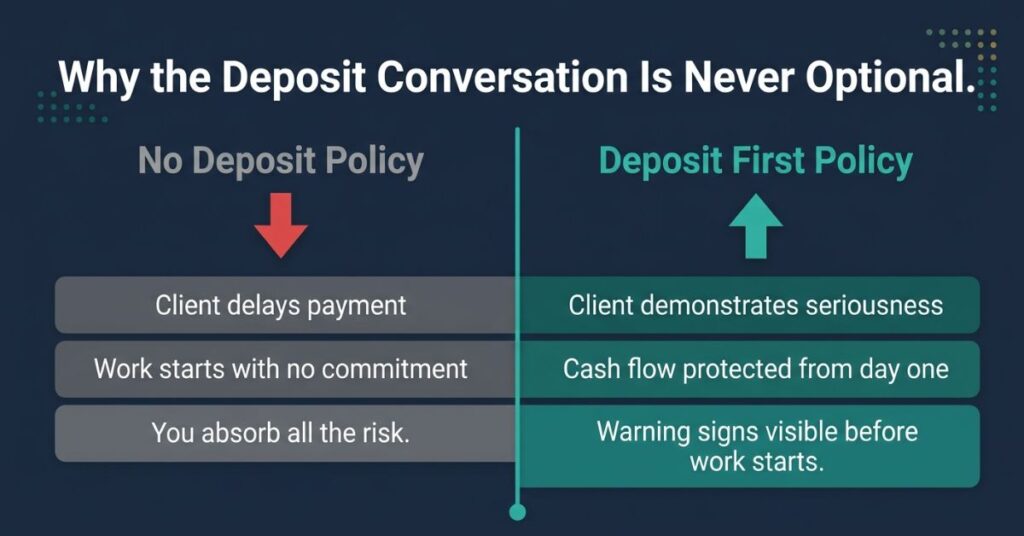
For any new client, especially one without an established relationship or referral history I can check, a deposit before work begins is non-negotiable for me now. Fifty percent upfront is standard. For larger projects I prefer a third on signing, a third at the midpoint and the final third on delivery.
A client who pays a deposit has demonstrated something real, they are serious enough to commit money before seeing the finished work and their account actually has funds in it. Someone who resists a deposit, who has a reason why it cannot happen this time, who wants to get started now and sort out the payment details later, that resistance tells you something. Knowing what to charge before that conversation happens is a separate but connected problem. If you are still figuring that out, our guide on raising freelance rates without losing clients covers the framing and timing in detail.
I did not take it seriously when I was starting out, I do now.
Freelancers in high-demand skill categories have more leverage in deposit conversations than those in crowded markets, our breakdown of which skills are actually growing in 2026 is a relevant context.
A freelance web developer I know has a strict rule: no deposit, no kickoff call scheduled, no work starts, nothing. He told me he used to make exceptions for clients who seemed nice or came with a good referral. Every single exception in his first two years ended in a payment problem, every one. He stopped making exceptions and his late payment rate has dropped to almost nothing.
The Invoice
A confusing invoice delays payment even from clients who fully intend to pay. I learned this the hard way when a client told me three weeks after I sent an invoice that they had been waiting on a breakdown before their accounts person would process it. I had sent a single line amount with no detail. They had not mentioned it, I had assumed silence meant the invoice was in the queue.
A good invoice has the payment due date visible at the top, not buried. A clear breakdown of what each charge covers. Your payment details directly on the document itself not in a separate email someone has to search for. And an invoice number which sounds minor but some accounts departments literally cannot process a payment without one. I have had invoices sit unpaid simply because nobody on the client side knew how to file it without a reference number.
I switched from plain-text email invoices to a proper invoicing tool about three years in. My average payment time improved noticeably. Not because the software is magic but because a professional invoice with a clear due date, automatic reminders and a one-click payment link removes the small frictions that give a busy client a reason to put it off one more day.
Following Up
Most freelancers follow up too late or not at all because chasing money feels awkward. I understand that. It felt awkward to me for years. The issue is that the client is not feeling awkward on their end, they are just busy and the invoice is sitting in a pile.
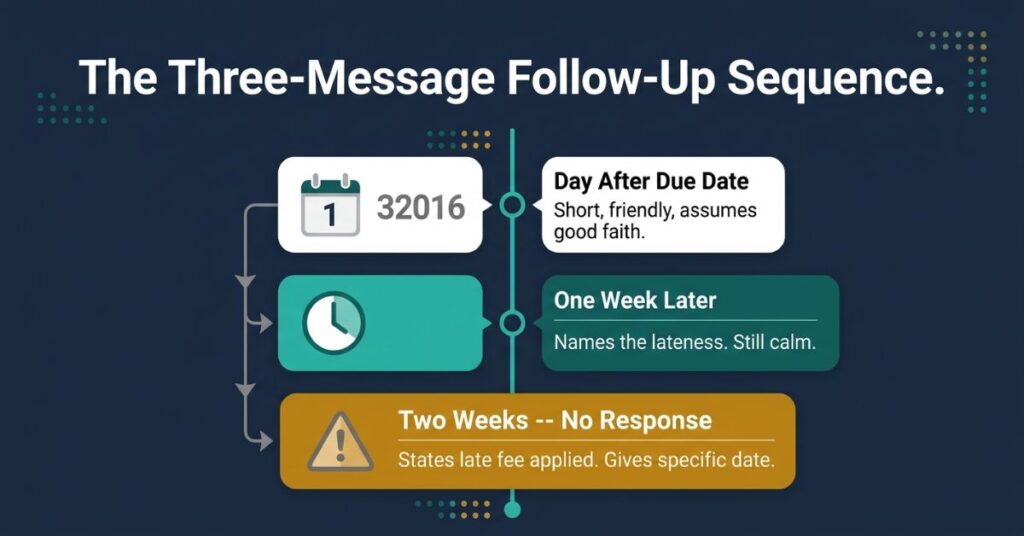
The sequence I use now:
Day after the due date, short and friendly: “Hi, just flagging that invoice [number] was due yesterday I wanted to check it has not slipped through. Let me know if you need anything from me to process it.” No accusation. Assumes the most likely explanation, which is that it got missed in the inbox.
One week later with no response, slightly more direct: “Following up again on invoice [number], now a week overdue. Could you let me know the status? Happy to resend if the original got lost.” This one names the lateness explicitly. Still polite, still assumes there is an explanation, but makes clear I am tracking it.
Two weeks with no response, the tone changes: “This invoice is now two weeks overdue and I have not had a response to my previous messages. Per our agreement, a late fee of (amount) now applies. Please confirm a payment date by (specific date).” Not aggressive. Just specific and concrete about what is happening and what needs to happen next.
A freelance copywriter I spoke to told me the hardest message to send is the second one not the third. The first is easy because it assumes innocence. The third is somehow easier because at that point you are just enforcing agreed terms. The second sits in the uncomfortable middle where you are not sure yet whether this is an oversight or the beginning of a real problem. She used to skip it and jump straight from the first to something angrier at three weeks. Now she sends the second on schedule and says most issues resolve before she ever needs the third.
When a Client Goes Quiet
Sometimes no follow-up gets a response. The client is just gone.
Before escalating, I do a quick check of their website, LinkedIn and social media. Has the business changed hands, has the person I worked with left the company or has something visible happened that explains the silence. I wish I had done this with the $850 client, I would have noticed the business had been sold a month earlier and could have approached the new owner immediately instead of emailing an inbox nobody was reading.
If everything looks normal, I escalate the contact method. Email is easy to ignore, a phone call is not. If I do not have a number, LinkedIn direct messages or whatever platform we originally connected on often breaks through when email has stopped working. People who are avoiding an invoice email will sometimes still answer a call because it feels less avoidable in the moment.
If multiple contact channels produce nothing over another week or two, I send a formal final notice. This states the total amount owed, references the original agreement and invoice number, gives a specific final date for payment and states what happens if that date passes without payment. Calm and factual. This message often gets read even when earlier ones were ignored because the shift in tone signals that the situation has moved into different territory.
Small Claims
For invoices the informal process cannot resolve, small claims court is more accessible than most freelancers realize. In the US the threshold varies by state but is often between $5,000 and $10,000. In the UK the Money Claim Online service covers similar amounts. Filing fees are modest, usually under $100 and a lawyer is not required.
The US Courts website has a locator to find the relevant court and filing process for your specific state.
I have not filed a claim myself but I know two freelancers who have. Both said the same thing: the client settled before the court date after receiving formal notice that a claim had actually been filed. The act of filing changes things. An invoice that has been ignored for months becomes a legal matter with a scheduled date attached and most clients who were avoiding payment out of disorganization or low-grade avoidance find that sufficiently motivating to call and settle within days of being served.
This is not a step to reach for on every late invoice. It is for situations where good faith attempts have been genuinely exhausted and the amount is large enough to justify the process. But knowing it exists and knowing it is actually accessible changes how powerless a drawn-out chase has to feel.
Prevention
The cheapest payment problem is the one you never have.
Screening clients before taking them on is part of the job. A client who is vague about budget, who resists a deposit, who wants to discuss payment details later, who communicates unprofessionally from the first message, these are signals. Most experienced freelancers I know have a real instinct for this. Almost all of them ignored that instinct at least once and regretted it.
Automated reminders remove the emotional weight of having to decide to chase someone. Most invoicing tools, including free ones, let you set automatic follow-ups at intervals you choose. The first reminder goes out without you having to summon the will to send it, which is the part that delays most people.
And working with clients who pay reliably, then finding reasons to keep doing more with them rather than constantly taking on new clients whose payment behavior is unknown, stabilizes cash flow more than any other single thing I have changed about how I work. Replacing one unreliable client with one reliable one at the same rate is not just a financial improvement. It changes how a month of work feels from beginning to end.
Frequently Asked Questions
A long-term client who always pays on time has gone quiet on a recent invoice. How do I handle it differently than a new client?
Start with genuine curiosity rather than pressure. Reach out directly ideally by phone or a personal message rather than a formal follow-up email and ask if everything is okay. Long-term clients who break a consistent payment pattern almost always have a reason. A cash flow problem, a change in their business situation, a personal difficulty. Understanding what has changed lets you respond appropriately rather than applying the same escalation sequence you would use with a stranger. You might agree a short payment extension, split the invoice across two payments or pause the formal process while they sort something out. The relationship is worth more than the single invoice and the conversation usually goes better than the silence that preceded it.
What invoicing tool do you actually use?
I have used Wave, which is free and functional, and more recently FreshBooks. If you want to go further and use AI to analyse your numbers, forecast cash flow, and understand which clients are actually profitable, we covered that specifically in our guide to AI tools for freelance financial decisions. Both generate professional invoices, support automatic reminders, and let you track which invoices have been opened. Knowing a client has opened your invoice and still not paid is different information from not knowing, and it changes how you follow up. For anyone starting out, Wave handles everything described in this article at no cost. The paid tools are worth it once you are managing more than five or six active clients simultaneously and want the reporting and time-tracking features.
My client is a large company and their payment terms are net 60 as standard. Do I have to accept that?
Not always, large companies have standard payment terms but those terms are sometimes negotiable for smaller suppliers, especially in the early stages of a relationship. It is worth asking directly whether net 30 is possible, framing it as a small business cash flow consideration. Some will accommodate it while some will not. If they will not, you have a few options: price your work higher to account for the longer payment cycle, factor the wait into your cash flow planning from the start or use invoice financing services like Fundbox or similar tools that advance you a percentage of the invoice immediately in exchange for a small fee. Accepting net 60 as a surprise when you were expecting net 14 is the problem. Knowing it upfront and pricing accordingly is a business decision.
Should I put my late fee policy on the invoice itself or just in the contract?
Both, ideally. In the contract so it is agreed before work starts. On the invoice as a reminder so it is visible at the moment of payment. Something like “Late payment fee of 1.5 percent per month applies to balances unpaid after (due date)” in small text at the bottom of the invoice is enough. Clients who were going to pay on time will not notice it. Clients who are tempted to delay will see it and make a different calculation than they would have otherwise.
What records should I keep in case a payment dispute escalates?
Keep everything in writing from the start. The original project agreement or contract, all emails discussing the scope and payment terms, the invoice with the sent timestamp, read receipts if your email client provides them, and records of every follow-up attempt including dates and content. If the situation ever reaches small claims court, a clear paper trail showing the agreement, the delivery, the invoice and the unanswered follow-up attempts is what wins the case. Screenshots of relevant messages, saved email threads, and a simple log of contact attempts with dates is enough. The habit of keeping this does not take long and has saved me from ambiguity in smaller disputes more than once.

Johnson Alaekezie is a freelancer and digital content creator with several years of experience working across writing, content strategy, and digital services. He founded IncomeGigAI to share honest, practical information about building income online without the hype that dominates most of this space. Johnson has worked with clients in the US, UK and beyond, and writes from direct experience rather than theory. He is based in Nigeria and covers the digital income topics he has personally navigated as a working freelancer.
Pingback: Joss