
The first time I charged a US client the same rate I charged a local client, a friend who had been freelancing longer than me laughed. Not unkindly, he just said: you know they would have paid twice that without blinking.
I did not know that because nobody had told me. I had been applying one rate to everyone regardless of where they were based, which felt fair at the time and was actually leaving a significant amount of money on the table every single month.
Geo-based pricing is one of the most practical and underused strategies in freelancing. It is also one of the most uncomfortable to talk about openly, because it sounds like you are charging different people different amounts for the same work. And before I get into how it works, I want to explain why that is not only acceptable but genuinely appropriate.
The Case for Location-Based Pricing
A content strategist based in London charging a startup in San Francisco the same rate she charges a small business in Lagos would be leaving real money on the table in one direction and pricing herself out of a viable market in the other, both at the same time.
Rates follow purchasing power and market norms not just the quality of the work. A US tech startup has a completely different budget expectation for freelance work than a small business in Southeast Asia. Neither is wrong, they are operating in different economic contexts with different cost structures, different revenue potentials and different benchmarks for what professional services cost.
The World Bank publishes purchasing power parity data by country that puts the scale of these differences into clear context if you want to see the underlying numbers.
Lawyers, consultants and agencies have priced differently by market for decades. Netflix charges more in the US than in India for the same subscription. Professional services firms quote differently for projects in London versus projects in Lagos. None of this is considered unfair because everyone understands that markets differ. The same logic applies to freelancing, even though most freelancers are never told this explicitly and spend years applying one flat rate to every inquiry regardless of where it comes from.
US Clients: What the Market Actually Pays
The United States is the highest-paying freelance market in the world for most skill categories. This is not opinion, Upwork’s earnings data, the Jobbers Freelance Skills Index and multiple industry salary surveys consistently show US clients paying 30 to 70 percent more for equivalent work than UK clients and often two to three times more than European or Australian clients for the same deliverable.
Why? A few reasons that compound.
US companies, particularly startups and mid-size businesses are accustomed to paying agency rates for specialist work. The benchmark for what a good freelance content strategist, developer, designer or consultant costs comes from what agencies charge and US agency rates are high. When a business owner in Texas decides to hire a freelance copywriter instead of an agency, their mental anchor for what that should cost is somewhere between what they know junior agency staff cost and what they would pay a salaried employee. Both of those numbers are higher than most freelancers from outside the US would assume.
US clients also tend to care less about hourly rates and more about outcomes. A US startup founder who believes a well-written landing page will improve their conversion rate by even a small percentage will pay several thousand dollars for it without agonizing over the hourly rate implied. The question is whether the outcome is worth it. If you can make the case that it is, the budget conversation is often easier than you would expect.
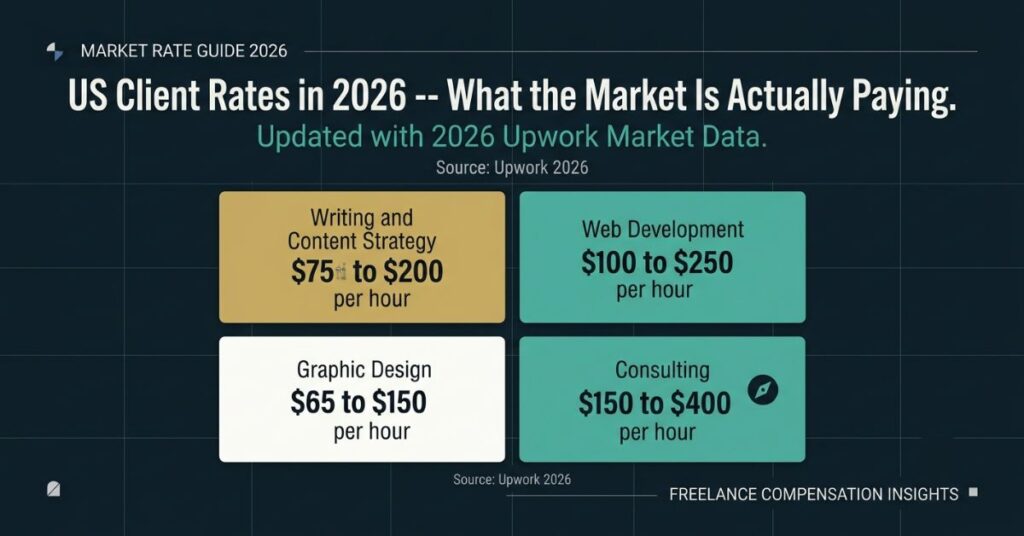
Practical rate ranges for US clients in 2026, based on Upwork marketplace data and the Jobbers index:
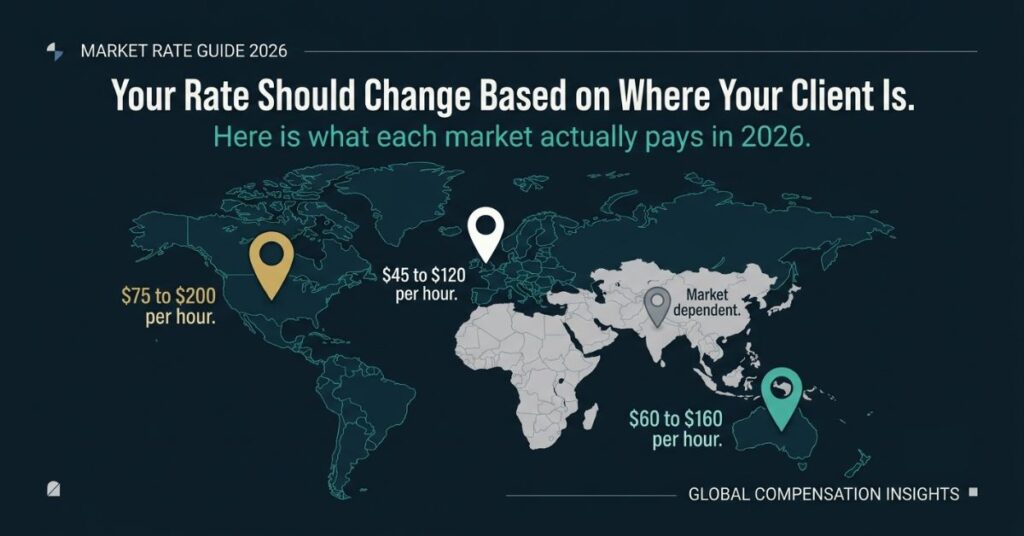
Freelance writing and content strategy: $75 to $200 per hour or $500 to $3,000 per project depending on scope and specialism.
Web development and engineering: $100 to $250 per hour. AI integration specialists are currently billing $120 to $200 per hour at the median.
Graphic design and brand work: $65 to $150 per hour. Logo and brand identity projects range from $800 to $5,000 depending on scope and track record.
Consulting and strategy work: $150 to $400 per hour for experienced practitioners. Some niche consultants operate above this range.
These come from Upwork marketplace earnings data and the Jobbers 2026 index. If your current rates for US clients are below these ranges, there is almost certainly room to move.
UK Clients: Solid Market, Different Expectations
The UK is a strong freelance market with real demand across most skill categories but the rate expectations are meaningfully different from the US and worth understanding before you quote.
UK clients are generally more rate-conscious than US clients, more likely to negotiate on price and more likely to ask for a detailed breakdown of what is included in a project fee. This is not a criticism. It reflects a different business culture and a different economic context. UK companies, particularly small and medium businesses, operate on tighter margins than their US counterparts in many sectors and that shows up in how they approach freelance budgets.
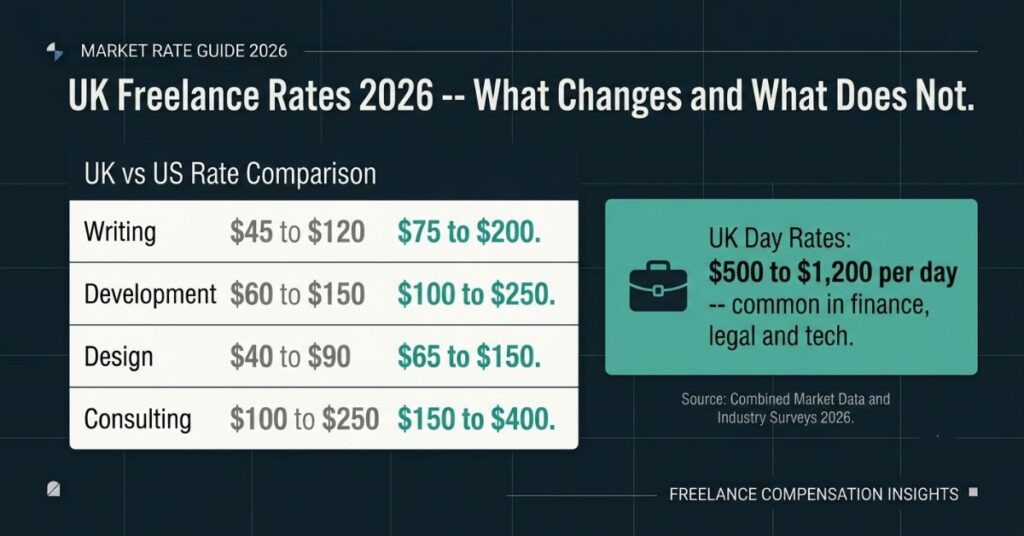
UK market rates in 2026:
Freelance writing and content: $45 to $120 per hour or roughly equivalent in GBP at current exchange rates. Content strategy work for larger UK brands can go higher but the mid-market sits meaningfully below US equivalents.
Web development: $60 to $150 per hour. Senior developers and those with specialist skills such as AI integration bill higher.
Graphic design: $40 to $90 per hour. Brand identity projects range from $500 to $2,500 for most independent clients.
Consulting: $100 to $250 per hour. Executive-level consultants and those with specific industry credentials command more.
One thing worth knowing about UK clients specifically: day rates are common in a way they are not in most other markets. Many UK businesses, particularly in finance, legal and tech are accustomed to booking freelancers on a day rate basis rather than an hourly or project rate. Day rates for experienced specialists typically run between $500 and $1,200. If you are pitching to UK corporate clients, framing your rate as a day rate rather than an hourly rate can make the conversation more comfortable for them even if the effective hourly rate is the same.
Australian and Canadian Clients: Underestimated Markets
Both Australia and Canada are frequently overlooked by freelancers based in Africa, Asia and Eastern Europe and that is a mistake worth correcting.
Australian clients pay at rates that sit roughly between UK and US levels. The Australian tech and startup sector in particular has grown significantly over the past five years and pays well for specialist freelance work. Rates for development, design and content strategy with Australian clients typically run $60 to $160 per hour depending on the category and the client type. The corporate and government sectors in Australia are also active buyers of freelance expertise and are known for paying reliably.
Reliable payment is worth more than it sounds if you have ever chased an invoice for months, our guide to getting paid on time covers the system that prevents most of those situations.
Canadian clients follow a similar pattern to Australian clients in most skill categories, with rates typically ranging from $55 to $140 per hour. Canadian clients in the tech sector, particularly in Toronto and Vancouver, are often paying at rates that approach US levels for specialised work. Canadian clients are also well-regarded by freelancers for communication clarity and reliability of payment.
Both markets have one practical advantage worth noting: time zone overlap is more manageable for freelancers in Europe and Africa than working with US clients, without the rate sacrifice that UK clients sometimes involve.
European Clients: Wide Range, Know Before You Quote
Europe is not one market. The rate differences between a client in Germany and a client in Romania or between a client in the Netherlands and one in Greece, are significant enough that treating European clients as a single category would lead you to badly underprice or overprice routinely.
Western European clients, primarily Germany, Netherlands, Switzerland, France and the Scandinavian countries, pay at rates broadly comparable to UK clients and sometimes approaching US rates for specialist technical work. German clients in particular are known in the freelancing community for being meticulous, detail-oriented and reliable payers who expect a high standard of professionalism in return. Swiss clients often pay above the Western European average given the cost structure of their market.
Southern and Eastern European clients, broadly speaking, operate at significantly lower rate expectations. This is not a problem if you are approaching those markets intentionally. A freelancer building a practice serving Romanian or Polish clients will set rates accordingly. It becomes a problem if you are quoting a Romanian client using your German client rate and wondering why you are not getting hired.
Before quoting a European client, know specifically which country they are based in and what the typical professional services rates in that country look like. A quick search for freelance market rates in a specific country takes ten minutes and prevents the kind of misalignment that wastes everyone’s time.
Clients in Asia, Africa and Latin America
Most clients based in developing markets cannot pay US or UK rates. Not because they do not value good work but because the economics of their businesses simply do not support those rate levels. A startup in Nigeria, a small business in India or a company in Brazil is operating in a cost and revenue environment that does not produce the margins that would make US-level freelance rates viable for most projects.
I have seen freelancers get this wrong in both directions and it costs them in different ways.
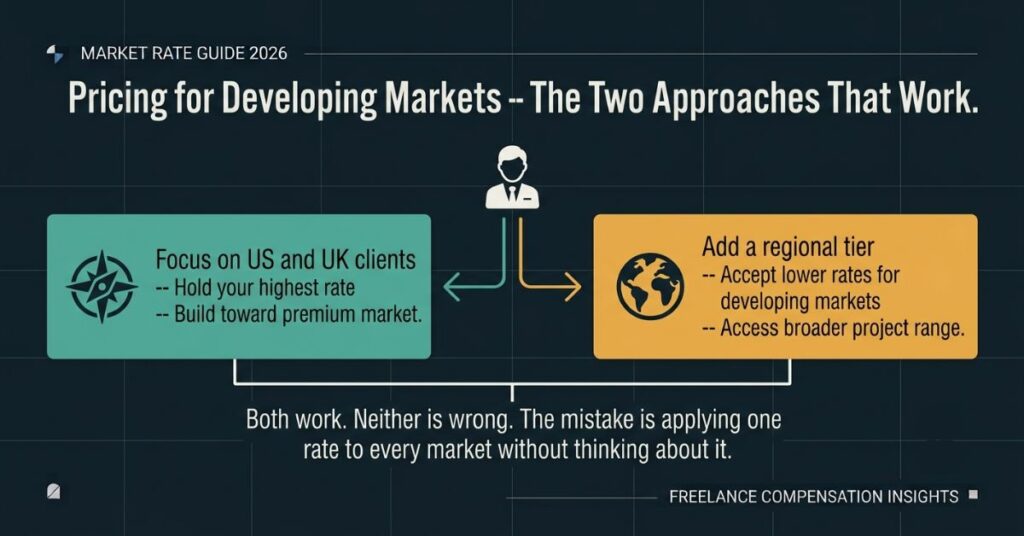
Applying US rates to Nigerian clients and then being confused about why you cannot fill your roster is one mistake. Applying local market rates to US clients and collecting a fraction of what they would comfortably pay is the other. Both happen constantly and both are avoidable once you are thinking about pricing by market rather than applying one number to everyone.
You have a real choice here. Hold your US or UK rate and work almost exclusively with clients from those markets, which is the highest-earning approach and entirely valid. Or maintain a second rate tier for clients in lower-purchasing-power markets, which broadens the range of clients you can work with and sometimes opens up interesting projects you would not otherwise access. Some freelancers keep a formal regional pricing structure in their head without advertising it publicly. Others quote based on the client’s context and budget rather than a fixed rate. Both approaches work if they are applied with intention rather than by accident.
How to Find Out Where a Client Is Based and What to Do With It
Most of the time it is obvious through the client’s email domain, the currency they mention, the business name, the time zone they suggest for calls. You do not usually need to ask.
When it is not obvious, asking is fine. Something like “just to make sure I am quoting in the right currency, are you based in the US?” is a completely normal professional question and most clients answer it without a second thought.
What you do with the information depends on your approach. If you have different rate tiers, you apply the appropriate one. If you have a single rate, you now have context for whether there is room to push higher or whether you need to decide if the engagement makes sense at the client’s likely budget level.
One practical thing worth doing if you are actively trying to shift your client base toward higher-paying markets: look at where your current clients are coming from and whether that matches where you want to be working. If most of your clients are in markets that pay below what you want to earn, the solution is not to raise rates with those clients and hope for the best. It is to actively market yourself in the higher-paying markets while maintaining current work during the transition.
Frequently Asked Questions
How do I raise my rate for US clients without losing the ones I already have?
Apply the new rate to new US clients first. Existing clients on lower rates can be moved up gradually over time using the same approach covered in our freelance rates article: advance notice, framing the increase around the evolved relationship, and a specific date rather than a vague “soon.” New clients have no anchor to your old rate and will accept the higher number as standard.
What if a US client finds out I charged a different client in another country less?
In practice this rarely comes up because clients do not typically compare invoices with each other. If it did come up, the honest answer is that your rates reflect market norms in the client’s location, which is the same logic any professional services firm uses. Most clients, particularly US clients who understand how global markets work, accept this without issue.
I am based in a lower-cost country myself. Does that affect what I can charge US clients?
Your location is relevant to your cost of living but it is not relevant to your rate. What matters is the quality of your work and what the market you are selling into pays for that quality. A developer in Lagos delivering the same quality of work as a developer in London is not obligated to charge less because their cost of living is lower. The rate reflects the market on the buying side, not the seller’s home country. Underpricing yourself because of where you live is one of the most common and most costly mistakes freelancers from lower-cost countries make when working with US and UK clients.
How do I handle the currency conversion practically?
Invoice in the client’s local currency or in USD as a neutral international standard depending on what makes sense for the relationship. Tools like Wise handle currency conversion at close to market rate with low fees, significantly better than most bank transfers for international payments. Payoneer and Stripe are also widely used for cross-border freelance payments. Whatever tool you use, check the effective exchange rate and fees before quoting to make sure the amount you receive after conversion matches what you intended to charge.

Johnson Alaekezie is a freelancer and digital content creator with several years of experience working across writing, content strategy, and digital services. He founded IncomeGigAI to share honest, practical information about building income online without the hype that dominates most of this space. Johnson has worked with clients in the US, UK and beyond, and writes from direct experience rather than theory. He is based in Nigeria and covers the digital income topics he has personally navigated as a working freelancer.