
A client cancelled a project on me fourteen days in. I had done two weeks of research, written a full strategy document, built out a content calendar and was three days from delivering the first draft of the anchor article. He sent an email saying the company had decided to pause all content work indefinitely.
I had no kill fee clause in the contract and I had barely a contract. What I had was an email chain with a scope of work attached, no payment terms, no revision limits, no cancellation clause. I had delivered two weeks of work and I got paid for none of it.
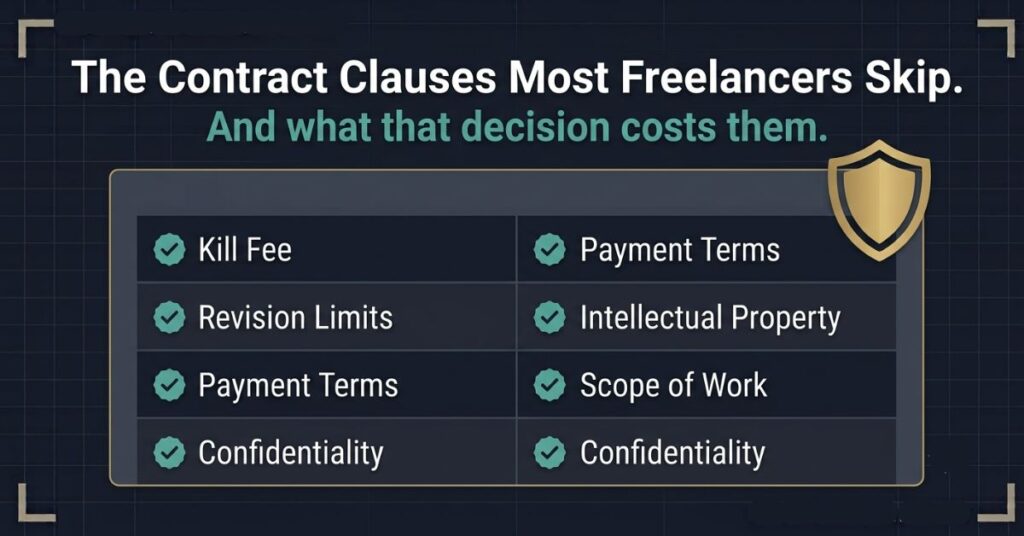
That was four years ago, I have not worked without a proper contract since. And every contract I send now has clauses that most freelancers, especially those just starting out, either do not know exist or feel too uncomfortable to include.
The Kill Fee Clause
A kill fee is compensation you receive when a client cancels a project after work has begun. It protects you from the situation I described, doing significant work and receiving nothing because the client changed their mind.
Kill fees are standard in agency work, journalism and publishing. Most freelancers operating independently never think to add them, which is exactly why the people who do have them tend to keep quiet about it. It is not a secret weapon, it is just something the industry has used for decades that somehow never made it into the freelance beginner playbook.
The standard kill fee sits between 25 and 50 percent of the total project fee, payable if the client cancels after work has started. Some freelancers use a sliding scale such as 25 percent if cancelled in the first week, 50 percent if cancelled after the midpoint, 100 percent if the deliverable has already been submitted and the client simply decides not to use it.
The clause I currently use are:
Kill Fee Clause:
In the event that the Client cancels this project after work has commenced, a cancellation fee will apply as follows: 25 percent of the total project fee if cancelled within the first five business days of the project start date; 50 percent of the total project fee if cancelled after five business days but before final delivery; 100 percent of the total project fee if the final deliverable has been submitted and the Client chooses not to use it. This cancellation fee is due and payable within 14 days of the cancellation notice.
Two things to notice about this language. It specifies business days rather than calendar days, which matters for projects with natural weekend breaks. It also covers the situation where the client receives the work and simply declines to use it, which is a real and common situation for freelancers in writing, design and strategy work.
Some clients push back on kill fees. The response I use: “This is standard industry practice for project-based work. It protects both of us, it means I can commit fully to your project from day one without worrying about what happens if circumstances change on your end.”
That framing is accurate not just strategic. A client who knows a kill fee applies is also a client who thinks more carefully before cancelling, which protects them from making impulsive decisions they might later regret. I have had clients thank me for including it after a project was nearly cancelled for reasons that turned out to be temporary.
Revision Limits
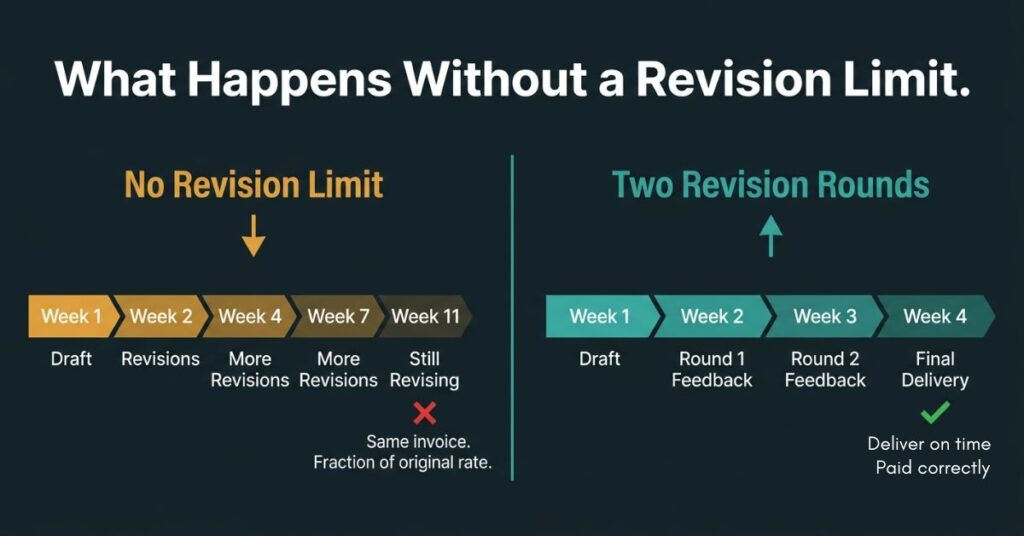
Without a revision limit, a client can request changes indefinitely. There is no natural stopping point. “Just one more small thing” becomes a project that runs three times as long as the original scope, and the freelancer is paid for the original scope regardless.
I know a freelance designer who spent eleven weeks on what was supposed to be a four-week brand identity project. The contract had no revision limit, each round of feedback produced new changes. The final invoice was the same as the original quote. She calculated afterwards that her effective hourly rate on that project was under $9.
Setting the right rate in the first place and protecting it through the project are two sides of the same problem, our freelance rates guide covers the first part.
The fix is simple and non-confrontational. You define rounds of revisions in the contract and specify what happens when those rounds are exhausted.
Revision Limit Clause:
This project includes two rounds of revisions. A revision round is defined as one consolidated set of feedback submitted by the Client following delivery of a draft. Revisions requested outside of this scope, including additional rounds of changes or alterations to content or direction that was previously approved, will be billed at (hourly rate) per hour. Additional revision hours will be invoiced separately and are due within 14 days of the invoice date.
The definition of what counts as a revision round is important. “One consolidated set of feedback” prevents the situation where a client submits small pieces of feedback one at a time, each one technically a separate revision that resets the clock. You get one batch. If they split their feedback into fifteen emails over two weeks, that still counts as one round.
The phrase “alterations to content or direction that was previously approved” closes a gap that catches many freelancers off guard. A client who approved a strategic direction in week one and then decides to change that direction in week four is not requesting a revision. They are requesting new work. This language makes that explicit.
Some clients ask for three rounds instead of two, that is negotiable. What is not negotiable is having some number in the contract before the project begins.
Payment Terms and Late Fees
Most freelancers include a payment due date on their invoices while only few include it in the contract itself. Fewer still include a late fee.
The contract is where payment terms become enforceable. An invoice tells the client what you are owed and when. A contract clause tells them what happens if they do not pay it. When a client disputes whether they are obligated to pay by a certain date, the invoice is not the document that settles it.
The clause I use:
Payment Terms Clause:
Invoices are due and payable within 14 days of the invoice date unless otherwise agreed in writing. Invoices unpaid after 14 days will accrue a late fee of 1.5 percent per month on the outstanding balance, applied from the first day past due. Work on future projects will not commence until all outstanding invoices are settled in full.
The 14-day standard becomes enforceable because it is in the contract not just on the invoice. The late fee accrues automatically, which changes the calculation for clients who were considering waiting another thirty days before paying. The work stoppage clause is the most effective of the three because it connects the late payment to a consequence the client actually cares about, which is the project not moving forward. The contract clause sets the terms. The follow-up process is what enforces them, our guide to getting paid on time covers the exact sequence that works.
The 1.5 percent monthly figure is modest enough that it does not feel punitive but significant enough to be worth mentioning when you send a reminder. “As per our agreement, a late fee of 1.5 percent per month has now begun accruing on the outstanding balance” is a sentence that moves invoices up the priority queue faster than almost any other follow-up approach.
Intellectual Property and Usage Rights
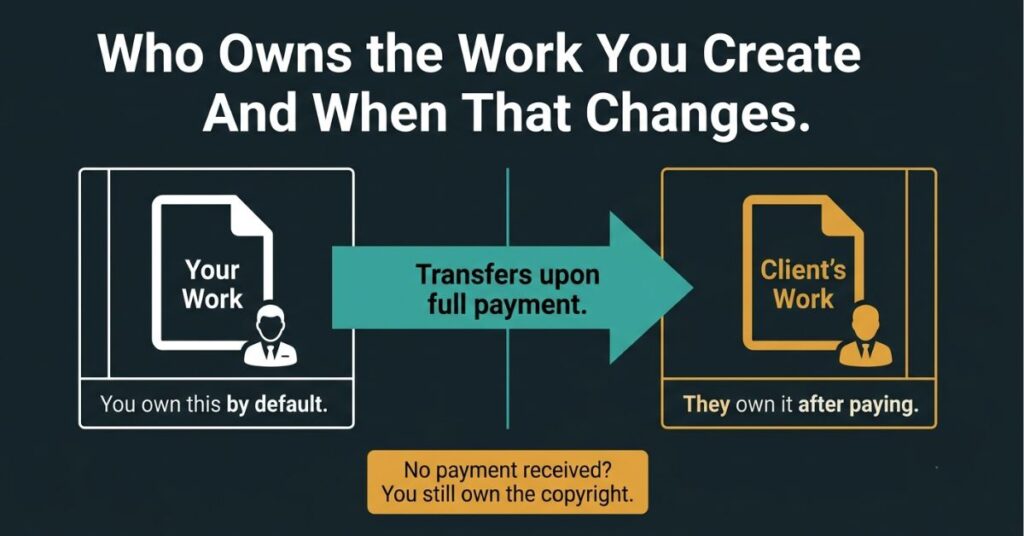
This clause is the one most beginner freelancers skip entirely, often because they do not realise they own the copyright to their work by default in most jurisdictions until they sign it over.
In most countries, including the US and UK, the creator of an original work owns the copyright automatically. The US Copyright Office publishes clear guidance on how work for hire arrangements affect copyright ownership, which is worth understanding before you sign anything assigning your rights. When you write a blog post, design a logo, or build a website for a client, you own that work until you assign the rights to them. Most clients assume they own the work once they pay for it. Legally, they often do not unless the contract says so.
This matters in two situations. First, if a client uses your work beyond the scope they paid for. A social media graphic designed for Instagram gets repurposed as a billboard without additional compensation. A blog post written for one website gets republished on five other sites in the same network. Second, if you want to include the work in your portfolio or use it as a sample. Without a clause that grants you this right, a client can technically prevent you from referencing the work publicly.
Intellectual Property Clause:
Upon receipt of full payment, the Client is granted a non-exclusive, perpetual license to use the deliverables for the purposes specified in this agreement. Full copyright and intellectual property rights transfer to the Client upon receipt of full payment in cleared funds. The Freelancer retains the right to include the work in their professional portfolio and to reference the Client relationship in professional contexts unless the Client requests otherwise in writing.
The phrase “upon receipt of full payment in cleared funds” is important. It means the copyright does not transfer until the client has actually paid. If they use the work before paying and then dispute the invoice, you retain the copyright on work they are already using, which gives you significant leverage.
The portfolio rights clause protects your ability to show the work to future clients. Most clients accept this without objection. Occasionally a client with confidentiality concerns will ask for this to be removed or modified, which is a legitimate request worth negotiating rather than refusing.
Scope of Work Definition
A contract without a clearly defined scope of work is almost impossible to enforce. When a client says “I thought this included the social media posts” and you say “no, the scope was blog content only,” the resolution depends entirely on what the contract actually says. If it says nothing specific, you are both right and nobody wins.
Scope creep, the gradual expansion of a project beyond its original boundaries, is the most common financial problem in freelancing after late payment. It is also the one that generates the most relationship tension because clients genuinely often believe they are asking for something reasonable and within scope, while the freelancer knows they are being asked to do additional work for free.
Platforms like Clarity.fm and Mentorcruise handle the contract and payment infrastructure for you, which is one of their underrated advantages for freelancers who find the business side of client management uncomfortable.
The specificity is the protection. Not “website copywriting” but “copywriting for five pages: homepage, about, services, contact and one blog post of approximately 800 words.” Not “social media management” but “creation and scheduling of twelve posts per month across two platforms, not including paid advertising, community management or analytics reporting.” Everything not named is out of scope and billable as additional work if requested.
Scope of Work Definition (example structure):
This agreement covers the following deliverables: (specific list). The following are explicitly not included within this scope: (list of commonly assumed additions). Any work requested beyond this scope will be quoted and agreed separately before commencement.
The “explicitly not included” list feels strange to write the first time. It feels like you are being defensive before the client has done anything. In practice it prevents the vast majority of scope creep conversations because the client saw the list at signing and cannot reasonably claim they assumed those items were included.
Confidentiality and Non-Disclosure
Not every project needs a confidentiality clause. But for any project involving business strategy, unreleased products, financial information, proprietary processes or sensitive client data, not having one is a risk you are carrying on behalf of a client who probably does not know you are carrying it.
A basic NDA that protects the client’s information and clarifies your obligations is something most professional clients expect and appreciate.
Confidentiality Clause:
The Freelancer agrees to keep confidential all non-public information shared by the Client in connection with this project, including but not limited to business strategies, financial data, product details and client lists. This obligation remains in effect for two years following completion of the project. The Freelancer may disclose confidential information only if required by law and will notify the Client promptly if such disclosure is required.
Two years is the standard duration for this type of clause in freelance contexts. Longer durations are common in employment and formal partnership agreements but are less standard and harder to enforce in project-based freelance work.
The notification requirement at the end protects the client in the specific scenario where you are served a legal order requiring disclosure. It is a professional courtesy that most clients appreciate even if they never need it.
Getting Clients to Sign
“Here is my contract” sounds adversarial. “Here is my standard project agreement which covers the scope, timeline, payment terms and both our rights” sounds professional. The second framing is also more accurate. A good contract does protect both parties and saying so removes most of the resistance before it develops.
Tools like HelloSign, DocuSign, and PandaDoc make signing frictionless. The client receives an email, clicks a button, types their name. It takes two minutes. Removing the friction of printing, scanning and emailing dramatically increases the rate at which clients sign without complaint.
For clients who push back on specific clauses, the question to ask is why that specific clause is uncomfortable. A client who objects to the kill fee clause is a client who is already thinking about the possibility of cancelling. A client who objects to the revision limit is a client who expects unlimited revisions. Both of those are useful things to know before the project starts rather than after.
I have had one client in four years refuse to sign a contract entirely. I did not take the project and that decision has never felt wrong.
Frequently Asked Questions
Do I need a lawyer to write a freelance contract?
Not for a standard freelance project. The clauses in this article are written in plain language and have been used by working freelancers without legal review. For large projects, long-term retainer agreements or anything involving significant intellectual property, having a lawyer review the contract is worth the cost. For most day to day freelance work, a well written plain-language contract with clear terms is more useful than a dense legal document that neither party fully understands.
What if a client asks me to sign their contract instead?
Read it carefully before signing. Pay particular attention to the intellectual property clause (some client contracts claim ownership of all work before payment is received), the revision and approval process, payment terms and any exclusivity or non-compete clauses. If something seems unusual or one-sided, ask for it to be modified. Most professional clients expect some negotiation on contract terms and a reasonable modification request is rarely a dealbreaker.
A client says they never sign contracts. What should I do?
A client who refuses to sign any contract is a client with no intention of being held to any agreement. That is useful information before the project starts. You can offer a simplified one-page agreement covering just payment terms, scope and revision limits, which reduces the psychological weight of a full contract while still giving you written protection. If they refuse that too, proceed with extreme caution or decline the project entirely.
Is a contract enforceable if it is just agreed by email?
In many jurisdictions an email exchange that clearly establishes scope, price, and terms can constitute a binding agreement. However, it is significantly harder to enforce than a signed contract because there is more room to dispute what was and was not agreed. For anything over a few hundred dollars, a signed document is always better than an email chain, not because emails are worthless legally but because clarity prevents most disputes from arising in the first place.
How do I handle a client who signed the contract but now disputes one of the clauses?
Refer directly to the signed document. “As per clause three of our signed agreement” is a sentence that ends most disputes quickly because it removes ambiguity about what was agreed. If the dispute escalates, having a signed contract puts you in a significantly stronger position in any formal resolution process, whether that is mediation, a small claims filing or a formal legal action.

Johnson Alaekezie is a freelancer and digital content creator with several years of experience working across writing, content strategy, and digital services. He founded IncomeGigAI to share honest, practical information about building income online without the hype that dominates most of this space. Johnson has worked with clients in the US, UK and beyond, and writes from direct experience rather than theory. He is based in Nigeria and covers the digital income topics he has personally navigated as a working freelancer.