
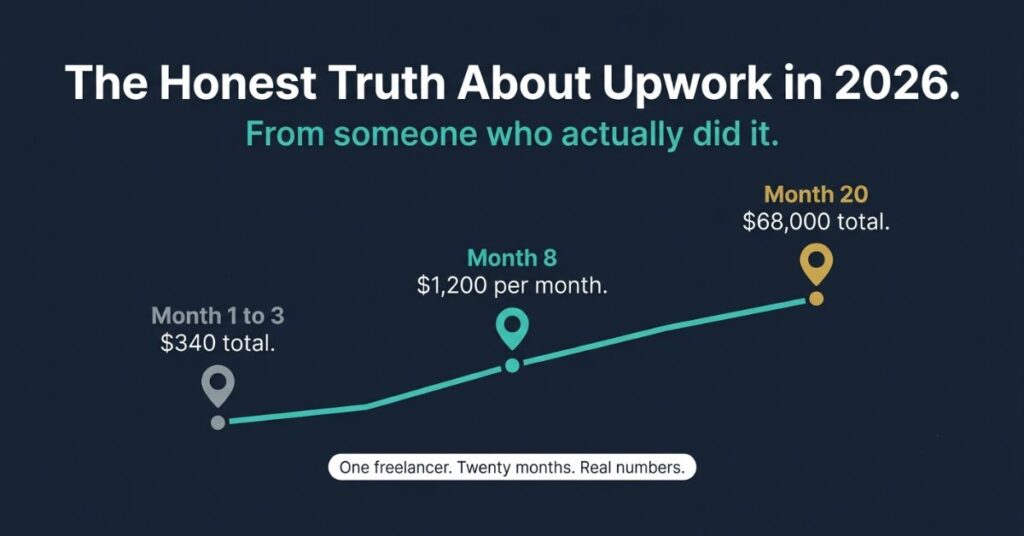
I made $340 in my first three months on Upwork, not per month. Across twelve proposals, four responses, three interviews and two completed projects. The hourly rate on those two projects averaged $12. I was charging $12 because I thought that was what someone with my level of experience should charge on a platform where I had no reviews.
I almost quit, most people do at that stage. The platform feels like a lottery where everyone else has already won the good tickets and you are standing in line with a bucket of connects wondering why nobody is clicking on your profile.
I made some of those early decisions right and some wrong. This is not a tutorial on setting up a profile. It is what actually happened, what the numbers looked like at different stages and what I would change if I were starting over today.
The First Three Months
My first proposal on Upwork was for a content writing job. The client wanted ten blog posts on personal finance topics, 1,000 words each for $150 total. That is $15 per post. I did not get that job, which in retrospect was fortunate.
What I submitted was a generic proposal that started with “I am a professional writer with experience in content creation and I believe I would be a great fit for your project.” I know because I still have it. It is painful to read. The proposal was about me and my credentials rather than about the client’s project. It did not reference anything specific from the job posting. It could have been sent to a hundred different jobs without changing a word.
I sent eight more proposals in the same style before I realized the problem. I was writing cover letters the way I had been taught to write cover letters, putting my best foot forward and hoping someone would be impressed enough to hire me. Upwork clients are not reading cover letters, they are reading the first two lines of a message that appears in a list of twenty other messages. And they are deciding in about four seconds whether to read further or not.
The shift that changed my response rate was reading the job description carefully enough to identify one specific thing the client had mentioned that most applicants would ignore. A sentence in passing about their previous writer missing deadlines. A note that they needed someone who understood a specific industry. A comment that they had tried three other freelancers without success. Those details were the entry points.
My revised proposals started with: “I noticed you mentioned (specific thing from their posting). Here is how I would handle that.” Response rate went from roughly one in nine to roughly one in four. That number is not from memory, I tracked it.
My first review on Upwork came from a UK-based marketing consultancy that needed a case study written. The budget was $85. I took it because I needed the review more than I needed the money. I delivered it in three days, revised it once and the client left me a five-star review with a written comment that mentioned my turnaround time specifically.
That $85 job paid me back probably fifteen times over but not directly. Through every future client who read that first review and decided to message me before reading any of the others.
Months Four Through Eight
By month four I had four reviews and a JSS (Job Success Score) of 100 percent. My rate had moved from $12 to $22 per hour. That might sound modest. The reason I raised it was not because I felt more confident. It was because a client offered me $22 before I named a price and I realized I had been leaving money in every previous negotiation.
Month four to month eight is where Upwork either starts to work or convinces you it never will. The platform has an internal algorithm that weights your profile in search results based on your JSS, your recent activity, your bid amounts relative to the job budget and several other factors that Upwork does not fully disclose. What I found empirically is that the algorithm rewards consistency over intensity. A freelancer who submits six well targeted proposals per week for eight weeks will outperform a freelancer who submits thirty proposals in week one and then disappears for three weeks.
I tested this accidentally. In month five I went two weeks without submitting any proposals because I had enough active work. When I came back the visibility of my profile in search had dropped noticeably. It took about three weeks of consistent activity to recover it. I do not know precisely how the algorithm weights activity but I know that gap cost me at least two or three jobs that I would otherwise have been in contention for.
My income in month four was $680 and month five was $1,100. Month six was $1,450 while month seven was $890, the month I went quiet. Month eight was $1,200. The income was real but volatile, and the volatility was almost entirely a function of how many new clients I was acquiring in any given month versus relying on repeat work.
What Upwork Actually Takes From Each Job
Upwork charges freelancers a sliding fee based on their lifetime billings with each individual client. Upwork’s own support page explains the full fee structure with examples. For the first $500 earned with a client, Upwork takes 20 percent. From $500.01 to $10,000 with the same client, the fee drops to 10 percent. Above $10,000 with the same client, it drops to 5 percent.
This structure has a significant implication that most people who write about Upwork underemphasize. The platform is most expensive when you are newest and cheapest when you are most established. A new freelancer on a $500 project pays $100 in fees. An established freelancer who has billed $12,000 to a long-term client on a new $500 project pays $25 in fees.
The practical consequence is that building long-term relationships with clients on the platform is significantly more financially beneficial than constantly acquiring new clients. Every new client relationship starts you back at 20 percent. Every retained client who crosses the $10,000 threshold moves you to 5 percent.
I had two clients in my second year who I billed over $10,000 each. On the combined work above $10,000 across both clients, I saved roughly $1,500 in fees compared to what I would have paid if those had been new clients. That is real money and it came entirely from retention rather than acquisition.
The Connect System
Upwork requires freelancers to spend Connects to apply for jobs which cost money. Standard jobs cost 6 Connects to apply for. Upwork gives you a small number free each month and you buy more as needed. A pack of 80 Connects costs $12.
This is the mechanic that makes a lot of freelancers angry and I understand why. You are paying to apply for jobs that you might not get. In the early months when your acceptance rate is low, you can burn through $30 to $40 in Connects per month with little to show for it.
My honest assessment is that the Connect system is less of a problem than it feels like in the early months and here is why. The cost of Connects forces you to be selective about which jobs you apply for. When applying is free, you apply for everything marginally relevant. When it costs money, you read the posting more carefully and only apply when you have something specific to say. Counterintuitively, being forced to spend Connects made me a better proposal writer because I stopped applying for jobs where I had nothing genuinely useful to offer.
In my best month on Upwork I spent $18 on Connects and earned $3,200. In my worst month I spent $24 on Connects and earned $620. The Connect spend was not the variable. The quality and targeting of the proposals was.
Rate Progression And How It Actually Moved
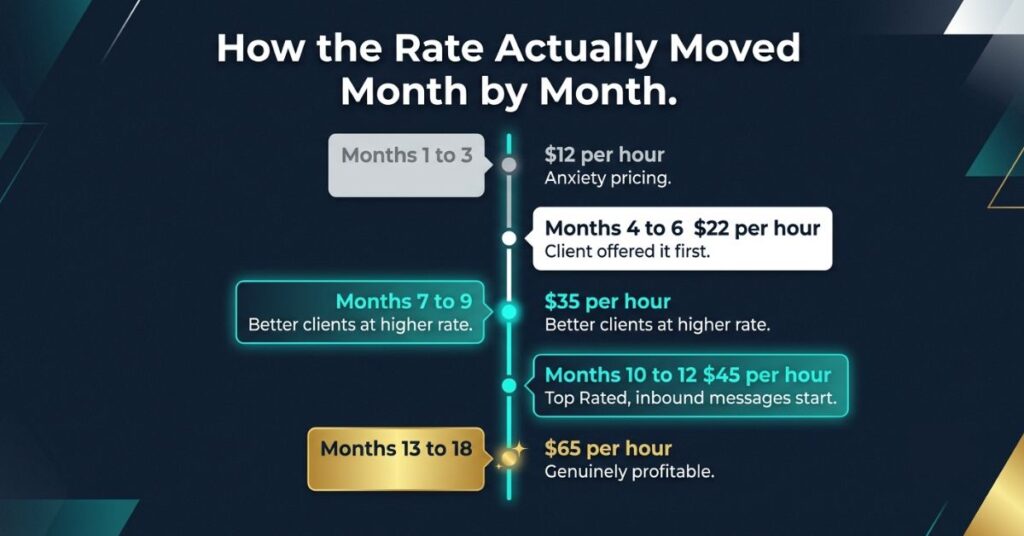
I want to give you a timeline of my rate because I think the vague advice to “raise your rates as you get more experience” is less useful than seeing what the actual progression looked like.
Month 1 to 3 I charged $12 per hour. I set this because it felt like what someone with no reviews could charge without being laughed out of the platform. In hindsight it was too low even for someone with no reviews.
Month 4 to 6 I charged $22 per hour. Raised after the accidental discovery that a client had assumed this was my rate without me naming it.
Month 7 to 9 I charged $35 per hour. Raised after I noticed that at $22 I was attracting a certain type of client, price sensitive, high maintenance, slow to approve work and that slightly higher rates attracted clients who were more serious and easier to work with.
Month 10 to 12 I charged $45 per hour. Raised after I had enough reviews and a high enough JSS that my profile ranked well enough in search that I was getting inbound messages rather than only finding work through proposals.
Month 13 to 18 I charged $65 per hour. This is where Upwork became genuinely profitable rather than just a source of income. At $65 an hour with primarily long-term clients in the 10 percent fee bracket, my effective net rate after fees was around $58.50 per hour.
The single most important rate insight I can share is, on Upwork a higher rate often attracts better clients rather than fewer clients, up to a point. The clients willing to pay $65 per hour are not the same clients looking for $15 per hour work. The pool is smaller but the quality of the engagements is dramatically higher. I had fewer proposals accepted at $65 than at $22 and earned significantly more money.
At $65 per hour with US clients, understanding why that rate is justified relative to what the market pays in different geographies helps when you need to defend the number, our geo-pricing guide covers exactly that.
The Types of Jobs That Work and the Ones That Do Not
Not all Upwork categories are created equal and nobody told me this when I started.
Fixed-price jobs under $200 are almost always a bad idea for someone without a strong, specific niche on the platform. The competition is fierce, the clients are often inexperienced and prone to scope creep and the fee structure means you lose 20 percent on top of what is already a low number. I took several of these in the first three months and regretted most of them.
Hourly contracts with established businesses are where I made the most money consistently. Not the companies posting $5 per hour article spinning jobs. The mid-sized businesses with specific operational needs, content strategy, research, analysis, consulting, who were looking for someone reliable to bring into their workflow on an ongoing basis. These clients are harder to find but they exist on the platform in meaningful numbers.
Long-term retainer work was the best outcome Upwork ever produced for me. I had one client, a US-based fintech company, who I worked with for eleven months through Upwork before we moved the relationship off-platform. Over that period I billed $14,200 through the platform. The work was consistent, the communication was professional and by month four I was essentially an embedded team member who happened to be a freelancer.
The categories with the most genuinely paid work on Upwork in 2026, based on what I have seen and what the platform’s own data suggests, are AI integration and development, specialized writing including technical, legal and financial content, UX research and product strategy, data analysis and e-commerce management. General content writing is oversupplied and underpriced. If that is your category, you need a specific angle within it to compete effectively.
What the Platform Does Not Tell You
Upwork’s Rising Talent badge and Top Rated status are real and they matter. Top Rated requires a JSS of 90 percent or above, $1,000 in earnings in the past year and an account in good standing. Once you hit Top Rated your profile is flagged in search results and clients can filter specifically for Top Rated freelancers. The filter matters because clients who use it are specifically looking for someone reliable, which is also the type of client who is easier to work with and more likely to leave a good review.
I hit Top Rated at month ten. In the two months before I hit it, my inbound message rate was roughly two per month. In the two months after, it was nine per month. The badge changed the nature of my activity on the platform from outbound proposal writing to responding to inbound interest. That shift was significant for both my income and my stress levels.
What Upwork does not tell you is that the JSS is calculated on a rolling basis and can drop suddenly if you have a project end badly, a client leaves a private negative review or you cancel a contract. I had one contract cancelled by mutual agreement with a client who was genuinely difficult, and my JSS dropped from 100 to 91 percent overnight. It recovered over the following three months as more completed contracts were added to the calculation but those three months felt precarious in a way that affected how I approached new client relationships.
The private feedback system is something most freelancers do not know exists until it affects them. Clients can leave private feedback that Upwork uses in your JSS calculation but that you cannot see. You know your JSS changed but not specifically why if the feedback was private. This system is designed to protect clients who are worried about retaliation from freelancers who receive bad reviews. It is a reasonable design decision that is genuinely frustrating when you are on the receiving end of a score change you cannot explain.
One underrated benefit of keeping clients on the platform is that Upwork’s payment protection handles a problem our guide to getting paid covers in depth for off-platform work.
Moving Clients Off Platform
Upwork’s terms of service prohibit moving client relationships off the platform without paying a contract buyout fee if the initial connection was made through Upwork. The fee for taking a client off-platform is $595 as of 2026. This is a real and enforced policy.
I moved two clients off-platform, both after we had worked together for over a year and both with the full buyout fee paid by the client who wanted to simplify their billing. I am not suggesting you circumvent this rule. I am saying it exists, it costs real money and you should factor it into your thinking about the long-term economics of any Upwork client relationship.
Moving a client off-platform means managing the relationship without Upwork’s infrastructure. Having a proper contract in place before you do that is not optional and our freelance contract guide covers the specific clauses that matter.
The clients I chose not to move off-platform were the ones where the Upwork fee structure, by that point in the 5 percent range, was less expensive than the administrative overhead of managing the relationship independently. At 5 percent fees on a long-term relationship, Upwork is not expensive. It is handling payment processing, dispute resolution if needed and a paper trail that protects both parties. That is worth something.
What I Would Do Differently
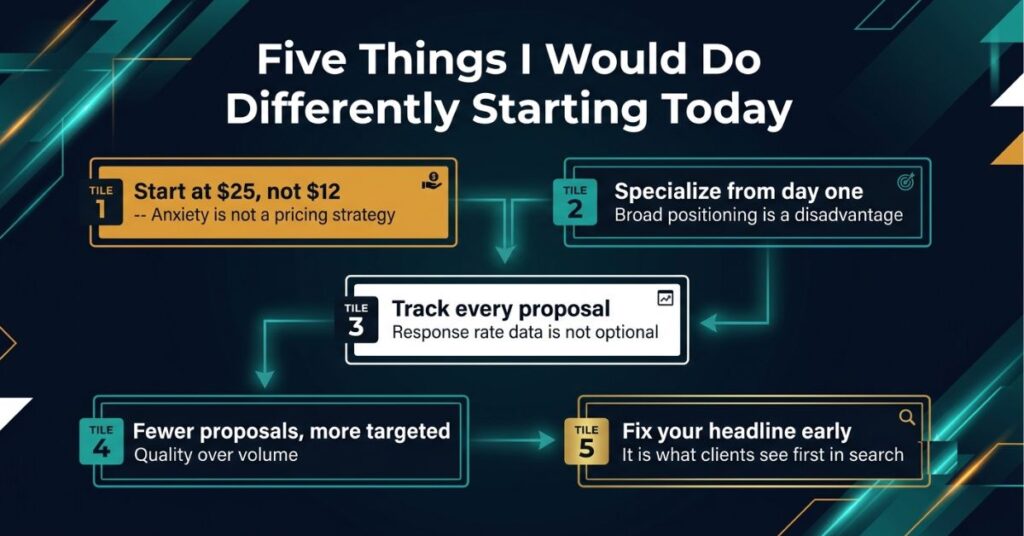
I would set my initial rate at $25 rather than $12. The difference in client quality between $12 and $25 is significant. The difference in proposal acceptance rate is much smaller than I feared it would be. I was charging $12 out of anxiety rather than calculation.
I would specialize from day one. My early profile said I was a content writer. My later profile said I was a content strategist with specific experience in fintech and B2B SaaS. The second profile attracted fewer total inquiries and significantly more qualified ones. Broad positioning on Upwork is a disadvantage not a safety net.
I would track every proposal and its outcome from week one. The data I accumulated later, response rates, acceptance rates, which types of jobs converted best, was invaluable for understanding what was working. I spent months operating without that data and it cost me.
I would apply for fewer jobs with more specificity. In month one I sent twelve proposals. Four got responses. If I had sent six proposals, all of them specifically targeted with something real to say, I believe the response rate would have been similar and I would have spent fewer Connects and less time.
I would invest in my profile photo and headline earlier. I upgraded both at around month seven and my profile view rate increased noticeably. The headline especially matters because it is what clients see in search results before they click. “Content Writer” is invisible. “B2B Fintech Content Strategist with 3 Years of Industry Experience” is findable by someone who needs exactly that.
Twenty Months In
My total Upwork earnings over the period I used the platform actively were just over $68,000. That took roughly twenty months from a starting point of $340 in the first three months. The curve was steep in both directions at different stages and the factors that determined which direction it went were almost always within my control rather than determined by the platform.
The platform has real structural advantages and real structural frustrations. What I kept finding was that the frustrations were loudest in the months where I was least consistent and the advantages compounded in the months where I was most deliberate. That pattern held from month one to month twenty without much variation.
If you are three weeks in and wondering whether any of it is working, the honest answer is that three weeks is not enough information. Give it six months of consistent, targeted effort before you decide whether the platform works for you. Most people who say Upwork does not work stopped at month two.
Frequently Asked Questions
How many proposals should I send per week as a new freelancer?
Six to ten well-targeted proposals per week is more effective than twenty generic ones. The Connect cost forces this discipline to some extent. Each proposal should reference something specific from the job posting, lead with what you can do for the client rather than who you are and be short enough that a client can read it fully in under thirty seconds. The length most new freelancers aim for is too long. Two to three focused paragraphs is usually enough.
Is Upwork worth it if I am based outside the US or UK?
Yes, and I say that as someone based in Nigeria. The platform connects you with clients in the US, UK, Canada, Australia, and Europe who are paying market rates for those countries. The geographic arbitrage is real and meaningful. A $45 per hour rate from a US client represents significantly more purchasing power in Nigeria than it does in New York. The main practical considerations are payment withdrawal options, which vary by country and time zone management for clients who expect real-time communication.
Should I take fixed-price or hourly contracts as a beginner?
Hourly contracts are generally safer for beginners because the scope is harder to abuse and payment is guaranteed for hours worked regardless of the client’s satisfaction with the direction. Fixed-price contracts can be profitable but are riskier when you are new because scope creep is harder to push back on without reviews and leverage. Start with hourly where possible and move to fixed price for well defined projects once you have enough of a track record to negotiate with confidence.
What is the most common mistake new Upwork freelancers make?
Giving up after the first month. The first month almost always looks like failure regardless of how well you are doing the right things. The platform’s algorithm takes time to index your profile meaningfully, you have no reviews to show and the clients with the best jobs are hiring freelancers with the longest track records. Things get noticeably better in month two and month three, not because you have learned something dramatic but because the platform has had time to register that you exist and that you are consistent. The freelancers who succeed on Upwork are almost entirely the ones who stayed past the point where quitting felt rational.
How do I handle a client who leaves a low rating after what I thought was a successful project?
Respond to the review calmly and professionally within the platform’s response window. Do not be defensive or argue with the client’s characterization. Address one or two specific points if you have a genuine professional response and keep it brief. Future clients read both the review and the response. A measured, professional response to a negative review often reflects better on a freelancer than no response at all. After responding, flag it internally as a data point about the type of client or project to avoid in future, and move on. One bad review among ten good ones does not define your profile. Two or three in a short window can affect your JSS meaningfully, which is why client selection matters more than most new freelancers realize.

Johnson Alaekezie is a freelancer and digital content creator with several years of experience working across writing, content strategy, and digital services. He founded IncomeGigAI to share honest, practical information about building income online without the hype that dominates most of this space. Johnson has worked with clients in the US, UK and beyond, and writes from direct experience rather than theory. He is based in Nigeria and covers the digital income topics he has personally navigated as a working freelancer.