
Nobody told me I was using ChatGPT wrong. I figured it out by watching someone use it right.
I had been on the tool for a few months at that point, using it the way most people do. Type something in, read what comes out, close the tab. It was useful in the same way a microwave is useful. Convenient, fast and reliably good enough. I was not complaining about it, but I was not particularly impressed either.
Then I sat next to a freelancer I knew while she was working through something difficult. A client relationship had gotten complicated. There was tension around scope, money and what had been promised versus what was being delivered. She was trying to figure out how to approach a conversation that could go badly in several different directions.
She was not asking ChatGPT to write an email for her. She was building a picture. She typed out the history of the project, what the client’s working style was like, what she was trying to preserve in the relationship and what outcome she actually needed from the conversation. Then she asked it to find the holes in her plan. To tell her where she was being naive or where her assumptions might be wrong.
What came back was not a generic response. It was specific, uncomfortable in the way honest feedback is uncomfortable, and useful in a way I had never experienced from the tool. It identified an assumption she had made about the client’s priorities that, once she saw it, was obviously wrong.
I had been treating ChatGPT like a vending machine. She was treating it like a thinking partner. The outputs were not in the same category.
That gap is what this article is about.
The Vending Machine Problem
The vending machine metaphor is useful because it describes the transaction most people are having with ChatGPT without realising it. You put something in, something comes out. The interaction is closed. There is no relationship between the person asking and the tool being asked, because there is no context. Just a request and a response.
This works fine for simple, self-contained tasks. Translate this sentence. Explain this concept. Give me five ideas for a headline. The request contains everything the tool needs and the output is proportionally useful.
The problem is that most people apply this same closed transaction model to complex tasks, and then wonder why the results feel thin.
Writing a proposal for a high-value client is not a simple task. Thinking through how to position yourself against cheaper competition is not a simple task. Figuring out whether to take on a project that feels slightly off is not a simple task. These are judgment-heavy situations that require context, nuance and some understanding of the specific person in the specific situation.
When you submit a bare request for help with any of these, what you get back is what ChatGPT gives everyone who asks a similar question with no context. A 2025 OpenAI study analyzing 1.5 million conversations found that nearly 80% of all ChatGPT interactions fall into just three categories: seeking information, writing and practical guidance. All of which are fundamentally output-driven rather than conversation-driven.
Which is an answer shaped by the average situation not your situation. It reads well because the writing is fluent. It feels useful because it is coherent. But it does not actually move you forward because it was not built around where you actually are.
The output looks like help. It just is not.
Four Ways the Vending Machine Mistake Shows Up
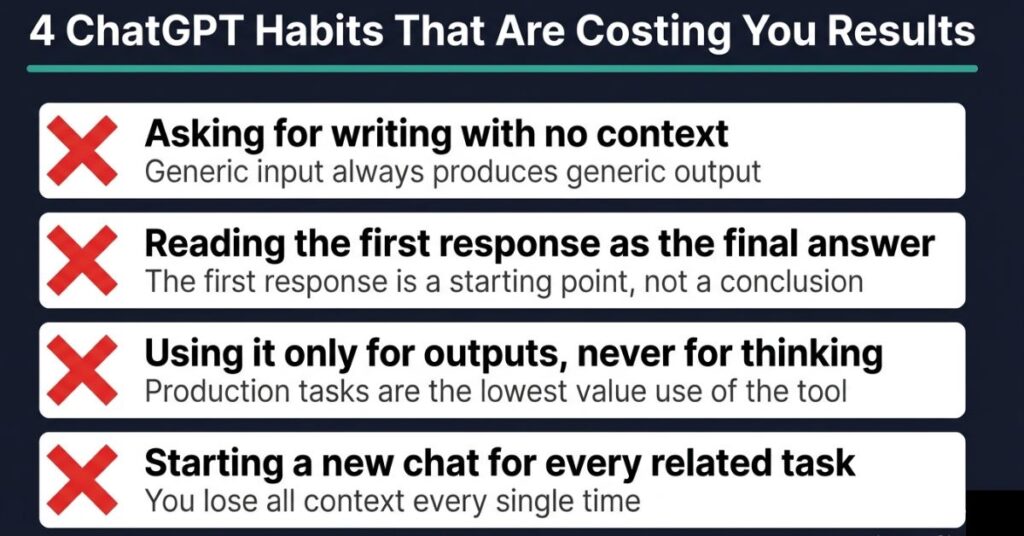
These are specific patterns I have watched repeatedly, including in my own early use of the tool.
Asking for writing without giving anything to write from.
Write me a pitch for a new client, is a request that will produce a pitch. It will have a structure, some professionally worded sentences and a call to action. It will also be recognizable to any client who has received more than three ChatGPT-assisted pitches, which in 2026 is most of them.
The tool is not producing bad writing. It is producing writing built from nothing. You gave it no client, no service, no relationship context, no specific problem you are solving and no reason why you specifically are the right person to solve it. Of course the output is generic. You gave it nothing to be specific about.
Reading the first response as the final answer.
The first response ChatGPT gives is a starting point. It is built on the initial information you provided and whatever assumptions it made to fill the gaps. Treating it as the finished output is like taking a first draft out of a printer and sending it to a client without reading it.
The people who get the most out of ChatGPT spend more time in the conversation after the first response than before it. They push back, redirect, ask for alternatives, question the assumptions the tool made and keep going until they have something genuinely useful. The first response is where the conversation starts, not where it ends.
Using it for outputs instead of thinking.
Write this. Summarise that. Generate a list. These are production tasks and ChatGPT handles them adequately. But adequate is a low ceiling.
The higher value use is thinking. Using the tool to develop an idea before you commit to it. To stress-test a plan before you pitch it. To identify what you might be missing before you make a decision. To explore the other side of an argument before you take a position. These are things that used to require either a sharp colleague with time to spare or enough experience to run the internal simulation yourself. ChatGPT can do this if you approach it as a conversation rather than a request queue.
Starting a new chat every time.
This is a small habit with a surprisingly large cost. Every new chat window is a blank slate. All the context you established in a previous conversation is gone. People who open a new chat for every related task spend a significant portion of each session re-establishing who they are and what they are dealing with, which is time spent on setup rather than on thinking.
When you are working through a project, a client situation or a creative problem, staying in the same conversation and building on it consistently produces better results than starting fresh each time.
What the Thinking Partner Model Actually Looks Like
The shift is not complicated to describe. It is harder to execute consistently, mostly because it requires slowing down before you type.
Instead of opening ChatGPT and asking a question, you open it and start a conversation. Before the question comes the context. Not a novel’s worth. Two to four sentences of genuinely specific information about who you are and what you are dealing with.
The practical difference is significant.
Here is the vending machine version of a common freelancer request:
Help me respond to a client who is unhappy with my work.
Here is what a thinking partner opening looks like:
I am a freelance brand strategist and I have been working with a startup founder for three months on their positioning. Last week I delivered a brand strategy document that I feel good about. Yesterday they sent me a message saying it does not feel right and that they expected something more concrete. I know from working with them that they are results-oriented and struggle to engage with abstract strategy work. I want to respond in a way that takes their concern seriously without abandoning the strategic approach entirely, and that moves us toward a specific next step rather than an open-ended conversation about whether the work is good. Help me think through this before I write anything.
The second version gives the tool a real situation. The client type. The nature of the work. What specifically went wrong. What the person knows about the client’s personality. What they are trying to achieve in the response.
The conversation that follows will be built around that actual situation. Not around the average freelancer in the average dispute with the average client.
Context is not a supplement to a good ChatGPT request. It is the foundation. Everything useful that comes out of the tool is built on what you put into it.
The Techniques Worth Actually Using
Ask it to argue against you.
After ChatGPT gives you a plan, a recommendation or a draft, ask it to find the problems with it. Specifically, what are the weakest assumptions in what you just recommended? or If someone wanted to argue against this approach, what would they say?
This is the most consistently valuable thing I do with the tool. The pushback response almost always surfaces something important that the original response skipped over. Plans look better than they are when you build them yourself. Having something challenge them before you commit is the function a good advisor serves. ChatGPT can serve it surprisingly well if you ask directly.
Give it a specific role before you ask anything.
Not act as an expert in a vague sense. Something precise. You are an experienced freelance consultant who has worked primarily with small and medium businesses and who has strong opinions about scope management and client communication. That level of specificity changes the register of the responses, the vocabulary it uses and the assumptions it brings to the conversation.
Generic roles produce generic responses. Specific roles produce responses shaped by a particular perspective, which is what you actually need when you are working through a real problem.
Ask for options, not answers.
What should I charge for this project? will produce a number or a range, and you will either accept it or dismiss it without really understanding why.
What are three different ways I could think about pricing this project, and what does each approach assume about the value I am delivering? forces the tool to show its work. You see the logic behind different approaches and can choose based on your actual judgment rather than accepting a recommendation you cannot evaluate.
This is especially useful for decisions where there is no objectively correct answer. Pricing. Positioning. Deciding whether to specialise. The value is not in the answer ChatGPT gives. It is in the frameworks it surfaces for thinking about the question.
Use it to rehearse before high-stakes conversations.
This is what the freelancer I mentioned was doing and I have since adopted it as a regular practice before anything I am anxious about.
Before a pitch, a difficult client conversation, a negotiation or any situation where I want to think through how it might go, I describe the other person to ChatGPT in as much detail as I know. Their working style. What I know they care about. What they are likely to push back on. What a good outcome looks like from their perspective.
Then I ask it to respond to my planned approach as that person would. It will not perfectly simulate them. But it will surface the obvious objections I might not have thought through, which is all I need. Walking into a conversation having already encountered the likely resistance is completely different from encountering it for the first time in the room.
Build on conversations rather than repeating yourself.
Stay in threads and refer back to earlier parts of the conversation. Ask ChatGPT to build on something it said ten responses ago. The tool does not accumulate understanding across separate conversations, but within a single conversation it can develop and refine ideas in a way that consistently produces better results than a series of disconnected fresh starts.
This is one of the core problems that building an AI workflow that runs consistently solves, a defined process replaces the habit of starting from zero.
The Context Template
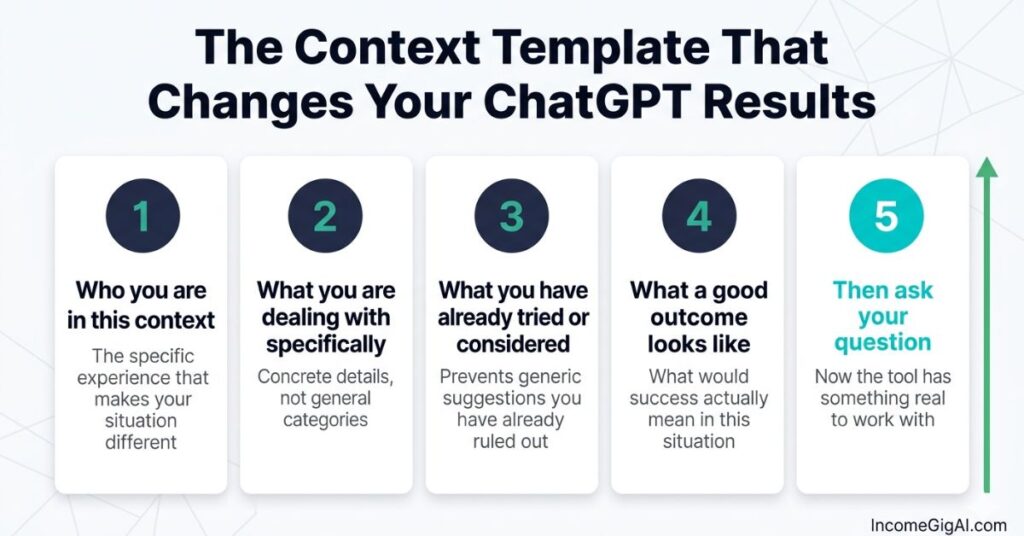
Here is the structure I use before asking anything complex. It is not a rigid formula, it is a way of making sure I am giving the conversation what it needs.
Who I am in this context: One or two sentences about the specific experience that makes my situation different from the average person asking something similar. Not a full bio. Just the relevant part.
What I am dealing with specifically: The concrete situation. Real details. The more specific the better.
What I have already considered or tried: This prevents ChatGPT from suggesting things I have already ruled out. It also signals where the genuine uncertainty is.
What a good outcome looks like: What am I actually trying to achieve? What would success look like in practice?
The question: Now that the tool has context, the actual request.
Used consistently, this structure changes the quality of what comes back almost every time. The responses feel less like they were written for anyone and more like they were written for the specific situation you described. Because they were.
Why Freelancers Are Leaving the Most Value Behind
I have a particular view on this because I have spent years working as a freelancer and thinking about what makes the difference between people who struggle with it and people who build something sustainable.
The hardest parts of freelancing are rarely the core skill. According to OpenAI’s own research, the fastest growing use of ChatGPT is not writing or information retrieval but decision support and strategic thinking. Exactly the kind of thinking freelancers need most and currently get the least help with.
A good writer can write, a good designer can design. What gets people is everything around the skill. Selling themselves, handling difficult clients, pricing correctly and deciding which projects to take and which to walk away from. Managing the emotional weight of depending on other people’s decisions for your income.
These are judgment problems, not skill problems. And they are exactly the kind of problems that benefit from thinking out loud with someone sharp before you act.
Most freelancers do not have that resource available on demand. A mentor with relevant experience is rare and their time is limited. A peer group is valuable but you cannot call them at 11pm before a difficult email.
ChatGPT, used correctly, is available at 11pm. It does not get tired of your questions. It does not judge you for not knowing something you feel you should already know. And it will push back on your plan if you ask it to, which most people in your life will not do because they do not want to be discouraging.
The freelancers I know who use it most effectively are not using it to do their work for them. They are using it to think more clearly before they do their work themselves. That distinction is everything.
What ChatGPT Cannot Do and Why This Matters
The thinking partner model only works if you stay clear about what the tool actually is.
ChatGPT generates responses based on patterns in its training data. It does not verify what it tells you before it tells you. It can produce a confident-sounding answer that is factually wrong without any signal that something has gone wrong. This is not a bug that will be fixed in the next version. It is a structural feature of how these models work.
For anything with significant consequences, specific facts need to be verified independently. Legal questions, financial figures, specific market data, anything where being wrong has a real cost. Use the tool to think through the question and then check the facts it relies on before you act.
The other thing it cannot do is know your industry, your clients or your market in the way someone with actual experience in your specific space knows it. When it gives you advice about how to handle a particular type of client, it is drawing on general patterns, not specific knowledge of how clients in your niche actually behave. Your read of a specific situation is almost always more accurate than a general heuristic, even a well-articulated one.
This is why the thinking partner model works better than the answer machine model. You are not asking it to tell you what to do. You are using it to think more clearly before you decide what to do, your judgment stays in the loop and the tool extends and sharpens it. That is the right relationship between the person and the tool.
For a broader picture of how AI actually fits into online income models without the hype, this guide covers the realistic applications.
Frequently Asked Questions
Is it safe to share client details with ChatGPT?
This is a question worth taking seriously before you develop a habit of pasting client information into the tool. OpenAI uses conversations to train its models unless you disable this in your account settings under Data Controls. For sensitive situations, the simplest approach is to use descriptive placeholders rather than real names and identifying details. “A founder in the HR tech space” works just as well as a real company name for the purposes of thinking through a situation. The context you need to give the tool is almost always about the nature of the situation, not the specific identities involved.
Does the free version work for this approach?
Yes. The techniques described here work with whatever version you have access to. The paid version gives you access to more capable models which do produce noticeably better results on complex, nuanced tasks. But the thinking partner approach will outperform the vending machine approach on any version. Getting the method right matters more than which model you are using.
How much context is too much context?
More than you think is too much is usually fine. What kills a conversation is vagueness, not length. That said, the most useful context is specific and relevant, not comprehensive. You do not need to explain your entire work history before asking a question about pricing. You need to explain the specific aspects of your situation that make your case different from the generic version of the question. Three sentences of genuinely specific context will outperform three paragraphs of general background every time.
Can ChatGPT replace a good mentor?
No, and it should not try to. A mentor brings specific knowledge of your industry, your market and your particular situation built up over time. They have skin in the game in the sense that they care about your actual outcome. ChatGPT has none of that. What it offers is availability, patience and the ability to hold a complex conversation without getting tired. Used alongside good mentors and peers it adds genuine value. Used instead of them it produces a particular kind of confident mediocrity that is hard to spot from the inside.
Why does it sometimes give me confident answers that are wrong?
Because generating a confident-sounding response and generating an accurate response are two separate things for these models, and the mechanisms that produce one are not the same as the mechanisms that guarantee the other. The model produces the most statistically likely continuation of the conversation based on its training data. When that happens to be accurate, great. When it does not, there is no internal alarm that fires. The practical implication is simple: treat specific facts in ChatGPT’s responses as hypotheses to be verified, not conclusions to be acted on.

Johnson Alaekezie is a freelancer and digital content creator with several years of experience working across writing, content strategy, and digital services. He founded IncomeGigAI to share honest, practical information about building income online without the hype that dominates most of this space. Johnson has worked with clients in the US, UK and beyond, and writes from direct experience rather than theory. He is based in Nigeria and covers the digital income topics he has personally navigated as a working freelancer.