
A client of mine was paying $19 a month for a tool that did exactly one thing.
It monitored his competitors’ blogs and sent him a digest every morning of anything they had published. No dashboard to log into, it has no settings to fiddle with, it’s just an email, every day with links. He had been using it for over a year without thinking twice about the cost because it saved him the 20 minutes he used to spend checking five different websites manually.
I got curious. I looked the tool up. The person who built it was not a startup founder. There was no funding round, no team page, no press coverage but just one person who noticed a tedious thing that marketing professionals did every single day and built a small automated solution for it.
That moment stuck with me. Not because it was revolutionary but because it was so undramatic. IT’s no big idea or disruption but a specific problem, a clean solution and a growing list of people paying monthly to use it.
That is what Micro-SaaS actually looks like in practice. And I think it is one of the most underrated ways to build sustainable online income that almost nobody in the “make money online” space talks about honestly.
What Micro-SaaS Is, And Why the Definition Matters
SaaS stands for Software as a Service. It is the model behind Notion, Slack, Spotify, Zoom. You pay a recurring fee to access software hosted online. You do not buy it once, you subscribe.
Micro-SaaS is the same model shrunk down to human scale.
One person or a very small team. One focused problem. One specific group of people who have that problem. A small monthly fee. No venture capital. No ambition to become a platform. Just a tool that works, users who find it genuinely useful and recurring revenue that builds quietly in the background.
The reason the definition matters is that people hear “build a SaaS” and immediately picture a development team, a product roadmap, investor meetings and millions in funding. That picture is accurate for enterprise SaaS. It has nothing to do with Micro-SaaS. Conflating the two is what puts most people off before they ever seriously consider it.
A better mental model: Micro-SaaS is closer to building a very good specialized tool than it is to building a technology company. The tool solves one thing. The right people find it. They pay. They stay.
Why This Window Exists Right Now
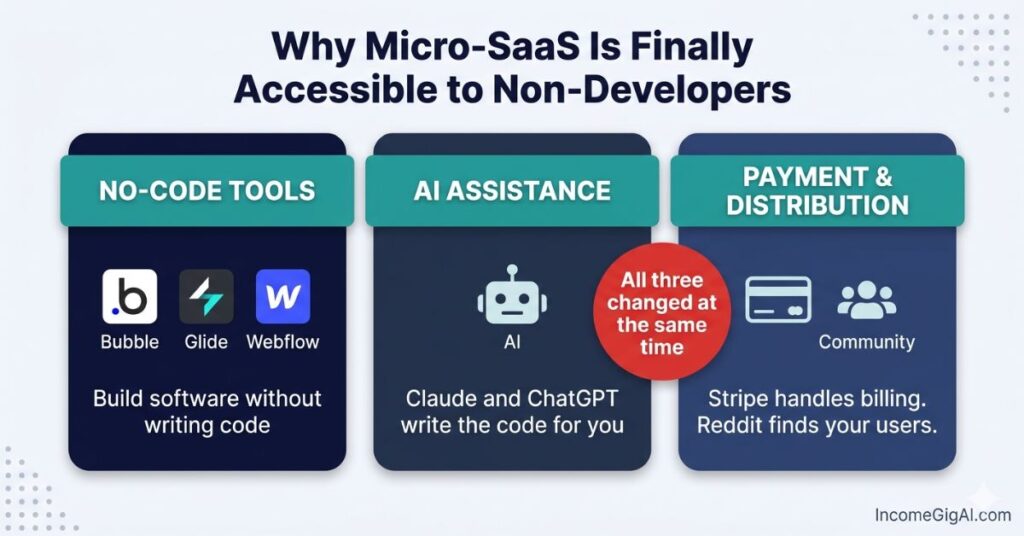
This is not something that was accessible five years ago to the same degree. A few things changed at roughly the same time and created an opening that did not exist before.
No-code tools became genuinely capable. Bubble, Glide, Webflow, Softr and others reached a point where you can build functional, deployable software without writing traditional code. Not toy projects. Real tools that handle real workflows. The technical skill requirement dropped significantly and it has kept dropping.
Then AI arrived and dropped it further. Someone who can describe clearly what they want to build can now generate working code using Claude or ChatGPT. That does not mean the code is always perfect or that you need zero technical understanding. It means the gap between having an idea and having a functional prototype got shorter than it has ever been. A person who understands a problem deeply but was never a developer can now participate in building a solution to it in a way that simply was not possible before.
Payment infrastructure became invisible. Stripe, Paddle and Lemon Squeezy turned subscription billing into something you can set up in an afternoon. Recurring payments, failed card retries, refunds, invoicing, tax compliance across different countries, revenue dashboards. All of it handled. This used to require dedicated engineering work. Now it is a few API connections.
And distribution channels opened up in a way that directly benefits small operators. The communities where your ideal users already spend time, whether that is a subreddit, a Slack group, a LinkedIn niche, a specific forum, are findable and reachable without a marketing budget. You can have a genuine conversation with the people you are trying to serve before you have built anything.
None of these things individually would have been enough. Together they created something different. A moment where one person with the right problem and enough persistence can build a recurring revenue business without the infrastructure that used to make this exclusive.
The Part That Makes It Different From Freelancing
I want to be specific about this because I have lived on the freelancing side of this comparison for years and the difference is not abstract.
Freelancing is fundamentally time-constrained, you sell your hours and when you run out of hours, you run out of income. Getting more clients does not solve that problem indefinitely. At some point you hit a ceiling that is determined entirely by how much time you can work and what the market will pay per hour of that time. Every freelancer I know has bumped into this ceiling eventually.
Micro-SaaS breaks the relationship between time and income. Once the tool is built and running, a new subscriber paying $20 a month does not require any additional work from you. They signed up, entered their payment details and they are using the product. You did not trade an hour for that $20, it just arrived.
The compounding effect of this is the real story, a hundred subscribers at $20 per month is $2,000. You are not doing $2,000 worth of work every month to maintain that. You are doing some customer support, maintenance and occasional improvements. The income is not perfectly passive but the ratio of income to time invested tilts in a completely different direction from anything built on hourly work.
This is the ceiling that does not exist in the same way. When a freelancer gets more clients they get busier. When a Micro-SaaS gets more subscribers the business gets stronger without the operator necessarily getting busier.
What Makes an Idea Worth Pursuing
Most people who explore Micro-SaaS get stuck at the idea stage, either they cannot think of anything or they think of things that sound good but do not hold up when you examine them closely. Here is what actually separates ideas worth pursuing from ones that feel compelling but go nowhere.
The problem has to be specific and recurring not a general frustration. A specific task that someone does repeatedly and regularly wishes they could hand off. The more often the problem occurs, the stronger the case for paying to solve it. A problem someone encounters twice a year is a nuisance, a problem they deal with every single working day is something they will pay to fix.
The target needs to have money and a reason to spend it, B2B is almost always better than B2C for this. Businesses buy tools to save time or make more money, they evaluate purchases against those outcomes. An individual consumer deciding whether to spend $15 a month goes through a very different emotional calculation and is much more likely to cancel when money feels tight. A tool for e-commerce store owners, marketing agencies, property managers, accountants, logistics coordinators or recruitment teams will convert and retain better than the same level of quality aimed at general consumers.
It should be painful to do manually. The best Micro-SaaS products replace something that currently involves either tedious repetition, switching between multiple tools, copying and pasting data between platforms or building manual reports from fragmented sources. If the alternative to your tool is something people dread doing, you have something.
It needs to be explainable in a single sentence. Not because simplicity is a virtue in itself, but because if you cannot explain it simply you probably have not understood the problem clearly enough yet. Clarity of problem usually precedes clarity of solution.
Real Examples That Are Not Exaggerated
I want to be careful here. There is a version of this conversation that involves screenshots of revenue dashboards that cannot be verified and founder stories polished for maximum inspiration. That is not what this is.
Closet Tools is a browser extension for people who sell on Poshmark. Poshmark’s algorithm rewards sellers who share their listings frequently throughout the day. Doing this manually is tedious and time-consuming. Closet Tools automates it. It charges around $10 a month. The audience is large, the pain is real, the solution is focused. Thousands of people pay for it.
Transistor.fm is a podcast hosting platform. Not a micro product in terms of its eventual scale, but it started as two people building something focused, grew entirely through word of mouth and subscription revenue and reached meaningful annual recurring revenue without outside funding.
There are hundreds of smaller examples that never get written about because they are not dramatic enough. Tools making $2,000 a month for someone who spent three months building them. Extensions earning $800 a month that the founder updates occasionally and otherwise leaves running. These do not make headlines, they make their owners financially comfortable in a way that compounds over time.
The Indie Hackers community documents these honestly. Real founders share real numbers including the bad months, the churn spikes, the features that flopped. Reading those case studies will teach you more about what actually works than any course or framework.
Why Freelancers Are Sitting on Better Ideas Than They Realize
This is an opinion I hold firmly and I think it is underappreciated.
Freelancers spend their working days inside other people’s businesses. They see the workflows, the workarounds, the frustrations, the tools that do not quite fit and the processes that still happen manually because nobody has built the right thing yet.
When I was doing content work I watched clients manually compile analytics from three different platforms into a spreadsheet every month to create a performance report. Every month, the same spreadsheet, the same manual process. Nobody had built a clean, affordable tool that pulled exactly that data for exactly that use case.
That is a Micro-SaaS idea and I did not invent it by being clever. I observed it by being present.
Most freelancers are sitting on several of these observations without recognizing them as product ideas. The thing is, the advantage of having seen the problem in a real context is enormous. You are not guessing whether anyone has this problem, you watched someone deal with it last Tuesday. That specificity is what separates ideas with traction potential from ideas that sound good in theory.
The Honest Challenges
I am not going to skip this part to make the opportunity sound cleaner than it is.
Most Micro-SaaS products do not find paying customers, the failure mode is usually not technical. It is a problem that was not painful enough, a market that was too small, a solution that was hard to explain or a go-to-market strategy that never found the right audience. Building well is not enough if the right people never find out the thing exists.
Validation before building is not just a best practice, it is the difference between spending three months on something useful and spending three months on something nobody will pay for. Before you build, find 10 people who have the problem and ask them if they would pay for a solution. Not if they think it is a good idea, not if they would use it if it were free. If they would pay for it. That conversation is uncomfortable and clarifying in equal measure.
Churn is the metric that determines whether a Micro-SaaS actually works as a business. If you are signing up 20 new users a month and losing 15 to cancellations, you are not growing. You are running in place. Keeping subscribers means the product has to keep delivering value every single month. It cannot be impressive once and forgettable after that.
Support is real work because when something breaks or a user does not understand how to do something, they reach out. Early on, you are handling all of it. That is manageable but it is not nothing. Factor it into any honest assessment of what this life actually looks like day to day.
How to Start Without Burning Everything Down
You do not need to leave your current work to begin exploring this seriously.
Start observing with intention every time you encounter a repetitive task that should not require a human, write it down. Every time a client or colleague mentions a tool being too expensive, too complicated or missing a feature they wish existed, write it down. You are building a problem list, not committing to anything yet.
Spend time in Indie Hackers and read the case studies of products that found traction. Look for the ones that reached profitability with a small user base. Pay attention to how founders described the problem they were solving, where they found their first users and what they got wrong initially. The patterns that emerge from reading fifty of these are more useful than any framework.
When an idea starts to feel worth pursuing, validate it before you build. Post about the problem in communities where your target users hang out, ask questions and see how people respond. Put up a landing page describing the tool and see if anyone signs up for early access. Real signal before real investment.
If you want to learn a no-code tool, pick one and commit to it for a month. Build something small just to understand how the pieces fit together. It does not need to be the idea just something functional that teaches you how the tool works. That month of learning will make you far more capable of executing when the right idea comes along.
AI tools have made this significantly more accessible than it was even two years ago. This guide covers specifically how to use AI in an online income workflow.
What the Income Realistically Looks Like
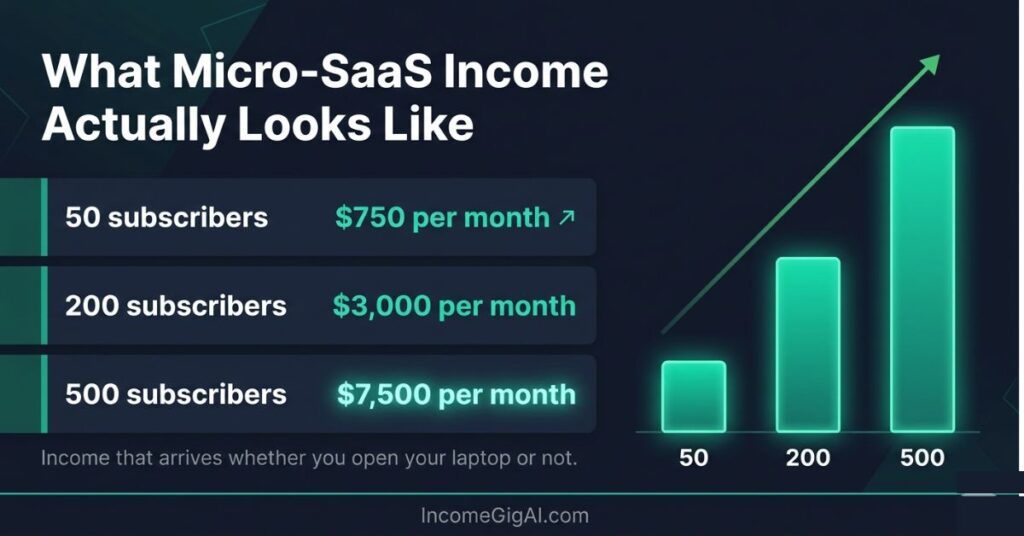
At $15 a month, 50 subscribers is $750. At 200 subscribers it is $3,000. And at 500 it is $7,500. Those are not extraordinary numbers at the top end but consider what they represent. That money arrives whether you are working or not. It is not contingent on you completing a project or delivering a deliverable. It exists because people found your tool useful enough to keep paying for it. Before comparing it to passive income models, the passive income comparison is worth understanding because the two concepts are often conflated in ways that set wrong expectations.
Getting to 50 paying subscribers with a first product realistically takes between three months and a year. The range is wide because the variables matter enormously. How well was the idea validated? How focused is the target audience and how clearly is the value communicated? And how consistently are you finding new potential users and telling them about it?
The people who get there fastest are not usually the most technically skilled. They are the ones who understood a specific problem deeply, built something focused enough to actually solve it and found the specific community of people who needed it.
Is This Actually for You
Honestly, it depends on what you are trying to build and what you are willing to tolerate on the way there.
If you want income that starts next month, this is the wrong path. The early phase of any Micro-SaaS involves building, validating and iterating with little or no return. The payoff is in what compounds over time, not in what arrives immediately.
If you are a freelancer who has bumped against the ceiling of trading time for money, who is curious about building something that does not require your constant presence to keep earning, and who has real observations about problems that businesses deal with repeatedly, this is worth taking seriously.
The skill set transfers more directly than most people assume. Understanding business problems, communicating clearly about what something does and does not do, managing expectations, iterating based on feedback. Freelancers do all of these things already. The application is different but the underlying capabilities are the same.
What I Actually Think About This
The online income space is full of people selling simplified versions of complicated things. The Micro-SaaS conversation often gets the same treatment: find a problem, build a tool, make money. Easy.
It is not easy. But it is more achievable than most people assume if they go in with honest expectations.
The client paying $19 a month for that competitor monitoring tool was not thinking about the founder. He was thinking about the 20 minutes it saved him every morning. He would have kept paying for it indefinitely as long as it kept working. That is the relationship at the heart of a good Micro-SaaS. Not a transaction. A habit. Something that becomes part of how someone works and stays there because removing it would mean going back to doing something tedious manually.
Building that kind of relationship with a few hundred people is a real business. A quiet one, an unglamorous one but a real one.
And right now in 2026, the tools exist to build it without a team, without funding and without being a professional developer. That window will not stay open forever. The no-code space is maturing, competition in specific niches is growing and the advantages of being early are real.
The question is not whether Micro-SaaS is worth understanding. It clearly is. The question is whether you are willing to do the unglamorous work of finding a real problem, building something focused and telling the right people about it consistently until it finds traction.
Most people are not. Which is exactly why the ones who are tend to find the space less crowded than they expected.

Johnson Alaekezie is a freelancer and digital content creator with several years of experience working across writing, content strategy, and digital services. He founded IncomeGigAI to share honest, practical information about building income online without the hype that dominates most of this space. Johnson has worked with clients in the US, UK and beyond, and writes from direct experience rather than theory. He is based in Nigeria and covers the digital income topics he has personally navigated as a working freelancer.