
Most people, when they hear newsletter income, immediately picture the same thing. Someone writing a weekly email, building an audience over two or three years and eventually landing a brand sponsorship. That model is real. It is also one of the slower, harder and more demanding paths to online income that exists right now.
What I find more interesting, and what almost nobody writes about honestly, is the set of income models built around newsletters that somebody else is writing.
Not hacks. Not workarounds. Legitimate business models with real infrastructure behind them, built on the same economics that make newsletters valuable in the first place. Referral networks that pay you to send subscribers to newsletters you did not build. Curation models that let you publish without creating original content. Sponsorship brokering that turns your industry relationships into a commission business. Newsletter acquisition and resale, which is exactly what it sounds like and works on the same logic as buying and flipping any other income-generating asset.
I want to be specific about why this matters right now specifically. The newsletter economy has matured. Substack alone reported over $300 million in annual subscription revenue flowing to creators in 2024. The total addressable market for newsletter monetisation in 2026 exceeds $2 billion annually. That money moves through real infrastructure, platforms, networks, marketplaces and brokers, and not all of it flows only to the people who publish every Tuesday morning.
Here is where the rest of it goes.
Why Newsletters Became Worth This Much
Before the income models make sense, the underlying economics need to be clear, because the reason newsletters command real money is not obvious if you have not thought carefully about it.
Email is the only communication channel that no platform controls. When Instagram changes its algorithm, organic reach collapses overnight. When Google updates its ranking systems, search traffic disappears from pages that had been earning it for years. None of that happens to a newsletter. The subscriber list belongs to the publisher, the relationship with the reader is direct. No platform sits between them and charges rent for the connection.
That ownership is genuinely rare in 2026, most content creators own nothing. Their audience lives on platforms that can reprice access to it at any time and have done so repeatedly. Newsletter publishers own an asset in a way that Instagram creators and even some YouTube channels do not.
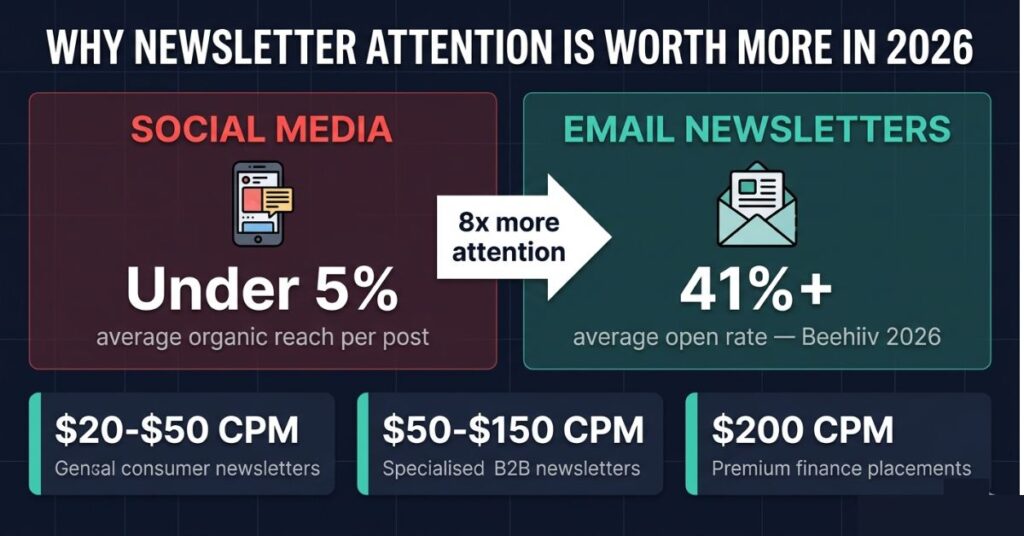
The attention quality that comes with that ownership is what drives the advertising economics. The average open rate for newsletters across niches hit 41% or above in 2025, according to Beehiiv’s State of Newsletters 2026 report, which analyzed data across 65,000 active newsletters and 28 billion emails sent during the year. Social media organic reach on most platforms is under 5% for non-viral content. A newsletter with 10,000 engaged subscribers reaching 40% of them with each send is delivering 4,000 focused, self-selected reads per issue. Compare that to a social media post that appears briefly in a feed while someone is also watching a video and arguing in the comments.
That difference in attention quality shows up directly in advertising rates. General consumer newsletters command $20 to $50 CPM (cost per thousand readers). Specialised B2B newsletters command $50 to $150 CPM. Finance and investment newsletters run $50 to $100 CPM with premium placements reaching $200. A niche newsletter with 50,000 engaged subscribers in a high-value category is not a hobby. It is a revenue asset, and the infrastructure that has grown up around newsletter assets is what creates the opportunities for people who are not newsletter writers themselves.
Referral Programmes: The Most Accessible Entry Point
This is where most people should start, not because it is the most lucrative but because the barrier to entry is the lowest and the mechanism is the most transparent.
Newsletters pay to acquire new subscribers. Not to advertise broadly, but specifically to reach people who are likely to remain engaged readers. They set a bounty, typically between $1 and $5 per verified subscriber and pay it to anyone who sends them subscribers who meet their quality criteria. The verification requirement matters: bounties are paid on confirmed, active subscribers not on clicks or on people who unsubscribe within a week.
SparkLoop is the primary infrastructure for this network in 2026. It connects newsletters actively seeking growth with publishers, bloggers and anyone with an existing audience who is willing to recommend newsletters to that audience. The mechanics are simple. You join the network, browse partner newsletters that match your audience, add a recommendation to your existing content or email and earn the bounty when referrals convert to confirmed subscribers. Payouts happen every Thursday via Stripe, the minimum withdrawal threshold is $50.
Beehiiv operates a parallel programme called Boosts with the same economic logic. A newsletter with 10,000 subscribers generating 200 referral sign-ups per month at $2 each earns $400 per month from referrals alone, without writing a single additional word of content. That is not a primary income. It is the kind of income that adds itself to something you are already doing, which is often more valuable than it sounds.
The ceiling of the referral model is directly tied to how closely your existing audience matches what newsletter owners are paying to reach. A personal finance blog recommending a personal finance newsletter to its readers generates strong referral economics because the audiences align. The same blog recommending a cooking newsletter generates almost nothing because the fit is wrong and the conversion rate reflects it. Niche alignment is the mechanism, without it the model does not work regardless of how many people you have.
The honest entry requirement is an existing traffic or audience source of a few thousand people minimum. This is not a model that generates income from zero because the referrals have to come from somewhere. For someone who has spent time building a blog, a newsletter of their own, a social media following or a YouTube channel and is not yet monetising that traffic effectively, referral programmes are one of the cleanest additions available.
Curated Newsletters: Publishing Without Original Content
The curated newsletter model is consistently underestimated, probably because it sounds like a compromise. It is not a compromise. It is a specific value proposition that the market has proven works at scale.
A curated newsletter does not write original content. It reads, selects, organises and presents the most useful or interesting content in a specific domain. The editor does the reading and filtering so that their subscribers do not have to. In a world where the volume of information in almost every professional domain has become genuinely unmanageable, that filtering is a real service.
Morning Brew is the example that makes this point best. It is one of the most successful newsletter businesses built in the last decade, and it is fundamentally a curation operation and does not report original news. It finds the most relevant business and finance developments of the day and presents them in a format that is faster and more engaging than reading the original sources. It sold for $75 million in 2020. The editorial team is not producing original journalism, they are producing excellent selection and presentation.
The same model works at significantly smaller scale. A curated newsletter covering AI developments for non-technical business leaders, or financial regulation for compliance professionals, or supply chain news for procurement managers, serves an audience that has a specific reading problem and no efficient current solution. The editor’s job is to have enough genuine knowledge of the domain to know which of the forty things published this week the five thousand people on the list actually need to see.
That editorial judgment is the real skill requirement. It is not writing in the traditional sense. But it is genuine and it cannot be faked indefinitely. A curated newsletter in a domain the editor does not actually understand will reveal itself quickly through poor selection, missed important developments and recommendations that do not match what the audience actually needs.
For someone who already reads extensively in a specific domain, either through professional interest or personal obsession, a curated newsletter is a way of turning that existing habit into an asset. The additional time required beyond what they are already doing is real but modest. The asset that accumulates, a subscriber list in a specific niche with documented engagement, is worth real money in the acquisition market if they ever decide to exit it.
Monetisation follows the same path as any newsletter. The Beehiiv Ad Network provides a low-friction entry point to sponsorship income without requiring any sales work. Direct sponsorship relationships become available once subscriber counts reach a level where brands are willing to have the conversation, typically 2,000 to 5,000 for initial B2B niche discussions. Referral programme income layers on top of that without any additional content work.
Sponsorship Brokering: Turning Relationships Into Commission Income
This model is less talked about than the others and genuinely more demanding to set up. It is also the one with the clearest ceiling above the others for people who have the right starting position.
The business logic is straightforward. Newsletters with engaged audiences often lack the sales infrastructure, the brand relationships or the time to sell their own sponsorship inventory effectively. Brands that want to reach those audiences often lack the editorial relationships and the knowledge of which newsletters are worth their budget. A broker who knows both sides earns a commission for connecting them.
In practice this means identifying newsletters in a specific niche that are leaving sponsorship revenue on the table, building a relationship with the publisher based on genuine value rather than just a sales pitch, identifying brands that would benefit from reaching that audience and brokering the deal between them. Standard brokering commission runs between 15% and 25% of the placement value.
The economics become interesting when you run the specific numbers. A B2B newsletter in a specialised niche with 30,000 engaged subscribers might command $3,000 to $5,000 per sponsorship placement, consistent with the CPM rates documented by AdMailr for specialised B2B audiences in 2026. A broker taking 20% on a $3,000 placement earns $600. With five active newsletter relationships and two placements per newsletter per month, the monthly income from brokering alone runs between $6,000 and $10,000.
The setup period is the difficult part and where most people who try this model underestimate what is required. The credibility that makes a publisher trust you with their audience relationship does not appear automatically. It comes from demonstrating genuine knowledge of their niche, understanding what their readers actually value and being selective about which brands you propose to them. A broker who sends every newsletter the first sponsor willing to pay is a broker who loses publisher relationships quickly.
The entry point that works best is starting within a niche where you already have some credibility or existing relationships. If you have spent years in the fintech space as a professional, you understand which brands are actively spending on audience development, what they are looking for in a newsletter partner and how to speak to both sides of the transaction in a language that earns trust. That domain knowledge is the credibility that opens the first conversation. Cold brokering from no existing context is a much slower and more uncertain start.
Newsletter Acquisition: Buying and Building an Existing Asset
The acquisition market for newsletters is real, documented and more accessible at the smaller end than most people assume.
Newsletters are valued and traded as business assets. Air Mail, a weekly newsletter covering the news behind the news, was acquired by Puck Media for $16 million in 2025. The Ludwig-van Newsletter, a focused classical music publication with a dedicated but not enormous audience, sold for $1.1 million. These are the headline transactions, the market that matters for most people operates at a different scale entirely.
Paid communities operate on similar recurring economics and are worth understanding alongside the newsletter model if your goal is predictable monthly income.
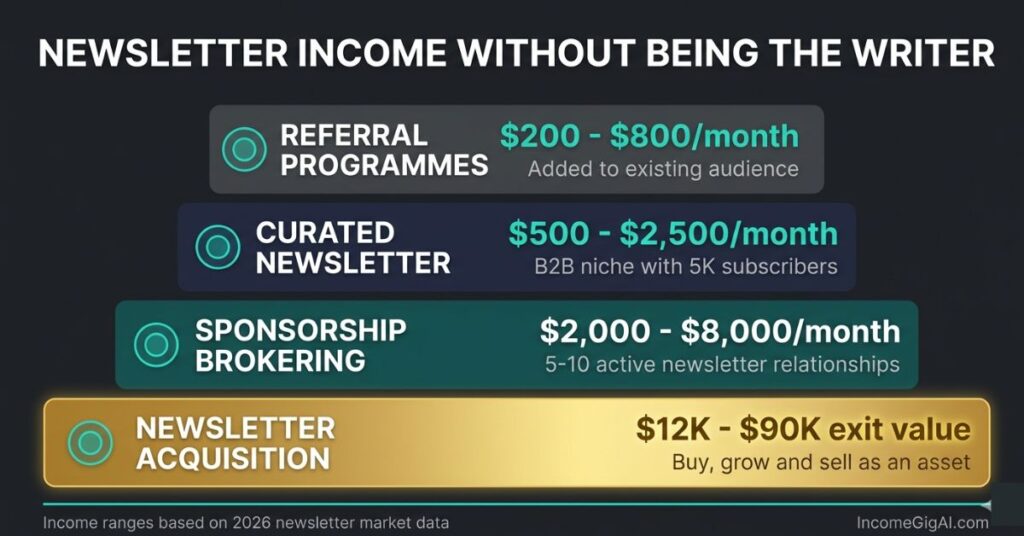
Newsletters earning $500 to $3,000 per month from a combination of ad network income, direct sponsorships and referral programmes sell regularly for between $12,000 and $80,000, based on the standard valuation multiple of 24 to 36 times monthly revenue. A newsletter earning $1,000 per month might sell for $24,000 to $36,000. One earning $2,500 per month might sell for $60,000 to $90,000.
The income model for someone entering the acquisition side is building or purchasing a newsletter in a specific niche, growing it to a stable revenue level and either continuing to operate it as a cash-flowing asset or selling it at a valuation multiple that exceeds the acquisition price plus growth investment.
There is a specific opportunity within acquisition that gets less attention than it deserves: newsletters with dormant but intact subscriber lists. Some newsletters build genuine audiences, generate real income for a period and then get abandoned when the creator’s circumstances change. These sometimes sell significantly below their fundamental value because the seller is motivated by wanting to exit cleanly rather than by maximizing price. Acquiring one of these, reinvesting in the subscriber relationship through consistent publishing and returning it to active monetization is a real play. The subscriber list is the asset, Whether it is being used well is a separate question from whether it has value.
Flippa and Acquire.com are the most active platforms for smaller newsletter transactions. Due diligence before any acquisition requires at minimum six months of analytics data showing open rate trends and subscriber growth sources, revenue documentation broken down by income stream and an honest assessment of how much of the newsletter’s value is tied to the personal brand of the original creator versus the topic and format itself. The last question matters because a newsletter whose subscribers are loyal to the person writing it does not transfer as cleanly as one whose subscribers are loyal to the subject it covers.
Sponsorship Marketplaces: Passive Infrastructure for Ad Revenue
Separate from the active brokering model, there are platforms that have built passive infrastructure connecting newsletters with sponsors without requiring either side to develop and maintain direct relationships.
Paved is the most established of these. It operates as a marketplace where newsletter publishers list their properties with audience data and rates, and brands browse and purchase placements directly. The publisher lists once and receives inbound sponsorship enquiries rather than having to pursue them. For a newsletter that has built an audience but cannot yet support the time investment of a direct sales operation, Paved changes the revenue viability of the sponsorship model meaningfully.
The trade-off is that marketplace rates run lower than direct rates because the platform takes a margin and because the ease of comparison shopping for brands creates some downward pricing pressure. A direct sponsorship deal with a brand that genuinely values your specific audience might command $3,500 for a placement that a marketplace would price at $2,000. For newsletters at early stages of audience development, the marketplace rate is still real revenue that would otherwise not exist. For newsletters with established audiences and strong niche alignment with specific brands, the direct relationship is worth the additional effort to develop.
What the Income Actually Looks Like at Different Entry Points
The income figures need to be specific rather than aspirational to be useful.
Referral programme income for someone with an existing niche audience of 5,000 to 10,000 people runs between $200 and $800 per month, depending on niche alignment and how actively they promote partner newsletters. This is supplemental income attached to something they are already doing. It is not a living on its own.
A curated newsletter built to 5,000 engaged subscribers in a B2B niche and monetised through Beehiiv’s Ad Network plus direct sponsorship relationships generates between $500 and $2,500 per month. Reaching that subscriber level organically takes six to twelve months of consistent publishing. Acquiring a subscriber base to accelerate the timeline requires upfront capital but compresses the revenue-generating period significantly.
Sponsorship brokering with five to ten active newsletter relationships in a specific niche generates between $2,000 and $8,000 per month, with the range reflecting the difference between general lifestyle niches and high-CPM B2B or finance verticals. The setup period before income is consistent runs three to six months.
Newsletter acquisition and resale is the highest variance model. Acquiring a newsletter for $10,000, growing it over twelve to eighteen months to a revenue level justifying a $40,000 valuation and selling it represents a $30,000 gain over that period, not accounting for any operating income during the holding period. It requires capital, analytical discipline and patience. The downside risk is real if due diligence is inadequate.
Who Each Model Actually Suits
If you are still working toward making your first meaningful online income before any of these models becomes relevant, start here.
The referral model suits someone who has already built a content audience and is not currently monetising it effectively. It does not work from zero because the referrals need somewhere to come from.
The curated newsletter model suits someone who reads extensively in a specific domain as part of their existing life and has genuine editorial judgment about what matters in that space. It does not suit someone hoping the format compensates for shallow knowledge of the subject.
The brokering model suits someone who already has commercial relationships in a specific industry and the instinct to operate as a trusted intermediary. Cold brokering from zero existing context is a slow and uncertain start.
The acquisition model suits someone with capital and analytical discipline who can evaluate newsletter assets accurately and execute due diligence without rushing. It is the wrong model for someone looking for low-risk income because the downside of a bad acquisition is real.
None of these are effortless. What they share is a path to income from the newsletter economy that does not require you to commit to writing original content every week indefinitely. That distinction is what makes them worth understanding.
If you are evaluating this against other recurring income models, the passive income reality behind models like this is worth reading before you commit time to one direction.
Frequently Asked Questions
Do I need my own newsletter to earn from referral programs?
You need an audience or traffic source but not necessarily a newsletter. If you have a blog, an email list of any size, a social media following or a website with meaningful traffic, you have something to work with. SparkLoop and Beehiiv Boosts pay you when people you send to partner newsletters confirm their subscriptions. The quality of the match between your existing audience and the newsletter you are recommending determines your conversion rate and the bounty rates available to you far more than the size of your audience does.
How do I find newsletters actively paying for referrals?
SparkLoop’s partner network is the most direct route. After creating an account you can browse newsletters filtered by niche and see the per-subscriber bounty they are offering. Beehiiv’s Boosts programme works similarly for anyone already publishing on Beehiiv. For direct arrangements outside the platforms, the most effective approach is identifying newsletters in your specific niche, reading them consistently for a month to understand their audience and editorial quality, and reaching out directly to propose a referral arrangement. Direct deals typically offer better economics because there is no platform margin between you and the newsletter owner.
How small can a curated newsletter be at launch and still be viable?
Smaller than most people assume. A curated newsletter with 200 to 500 subscribers in a tightly defined niche, publishing consistently every week for six months, will generate meaningful organic growth if the curation quality is genuinely good. The subscriber level that unlocks initial B2B sponsorship conversations, typically 2,000 to 5,000, is reachable within a year for a newsletter in a growing niche with consistent publication. The variable that matters most is whether the editorial judgment behind the selection is strong enough that readers feel they are receiving something they could not easily compile themselves. If the answer to that is yes, the growth follows. If the answer is no, subscriber counts do not fix it.
What should I verify before acquiring a newsletter?
Six months of analytics data minimum, showing open rate trends over time rather than a single current snapshot, subscriber growth sources broken down by channel, and revenue documentation by income stream. Open rate trends are more informative than current open rates because they reveal whether engagement is stable, growing or slowly declining. Subscriber growth sources tell you whether the audience was built through quality channels or through low-quality tactics that inflate subscriber counts with people who never engage. Revenue concentration is the final thing to evaluate: a newsletter earning entirely from one sponsorship relationship is more fragile than one earning from three or four sources. Beware of newsletters whose value is tied primarily to the personal reputation of the creator rather than to the topic, because that value does not transfer to a new owner.
Is the newsletter market too crowded to enter now?
The honest answer is that it depends entirely on the niche. In general consumer categories with no clear editorial focus, the market is genuinely crowded and the income models discussed in this article are harder to make work. In specific professional niches with defined audiences and documented advertiser interest, the market is less saturated than it appears from the outside, partly because most people who consider starting a newsletter in a niche back away from the perceived difficulty before they begin. HubSpot’s 2025 State of Newsletters report found that 45% of creators expect their newsletter profits to increase significantly over the following twelve months. The same report notes that 55% expect earning newsletter revenue to become meaningfully harder by 2030. That five-year window is not infinite, but it is real. A thoughtful entry now is different from the ground-floor opportunity of 2019, but it is also different from the saturated market that may exist in 2030.

Johnson Alaekezie is a freelancer and digital content creator with several years of experience working across writing, content strategy, and digital services. He founded IncomeGigAI to share honest, practical information about building income online without the hype that dominates most of this space. Johnson has worked with clients in the US, UK and beyond, and writes from direct experience rather than theory. He is based in Nigeria and covers the digital income topics he has personally navigated as a working freelancer.