
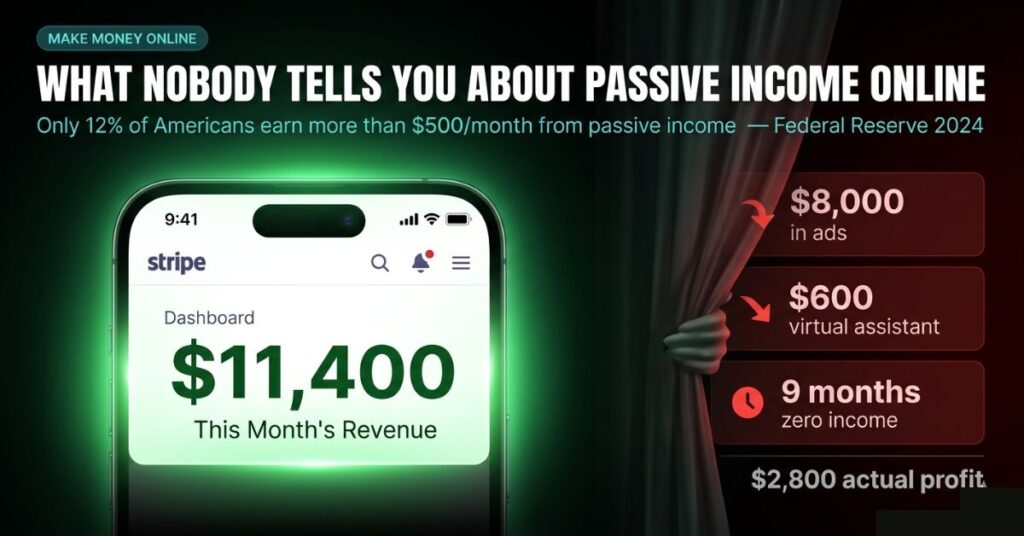
A few years ago someone showed me a screenshot. $11,400 in a single month from a course they had built. The number was real, I checked the Stripe dashboard they showed me. What they did not mention until much later was the $8,000 they had spent on ads that month to drive traffic to it, the virtual assistant they paid $600 to manage customer emails and the fact that they had spent nine months building the course before a single dollar came in.
Strip those out and the passive income was closer to $2,800. Still real money but not what the screenshot suggested.
I keep thinking about that conversation because it captures something that almost nobody in the passive income space wants to say directly. The screenshots are usually accurate but the story around them usually is not.
I have been building online income for a while now. Some of what I have built does earn with significantly less ongoing effort than it took to create. I am not going to pretend it does not, because it does. But I also remember what the building phase actually felt like, which is nothing like what the passive income content I consumed before I started had prepared me for. It was slow and unpredictable. For months at a stretch nothing seemed to be working and I had no reliable way to know if it ever would.
That experience is not exotic. According to Federal Reserve research from 2024, only 12% of Americans earn what qualifies as meaningful passive income, defined as more than $500 per month from sources that do not require their active labour. US Census Bureau data on passive income confirms that among the households that do earn it, the median amount is $4,200 per year, not per month, per year.
If passive income were as accessible as the content about it suggests, those numbers would look completely different.
What the people selling it actually does
This is the part that becomes obvious once you see it but is easy to miss if you are deep in the content.
The people making the most money from passive income content are not making their money from passive income. They are making it from you, the course purchase. From the affiliate commission on the tools they link to. From the brand deal that pays them to mention a platform. That is active income. You are watching someone perform passive income success while they earn active income from the performance.
There is nothing technically dishonest about this. But it creates a massive structural incentive problem. The people with the largest audiences and the most reach in the passive income space are financially motivated to make passive income sound more achievable, faster and simpler than the people who have actually built it would describe it.
The people who have genuinely built passive income streams tend to be busy running the businesses that generate it. They are not making daily YouTube videos about how they did it because making daily YouTube videos is itself a full-time job. The ones you hear from most are the ones selling the method, which is an entirely different activity from the one they are describing.
I am not saying every passive income educator is dishonest. Some are genuinely trying to share what worked for them. But the ecosystem rewards the version of the story that sells courses and that version consistently underplays how hard the upfront work was and how much ongoing attention the income stream still requires.
Bankrate’s Financial Freedom Survey found that 30% of Americans in 2024 believed they would never achieve financial security, a figure that has risen every year since 2023. The passive income content that promises otherwise is speaking directly to that anxiety, which is exactly why it performs so well.
What Passive Actually Means in Practice
Strip away the marketing and the definition of passive income is pretty simple. It is income that continues arriving after you stop actively working on the thing that generates it.
That definition does not say anything about how hard it was to build. It does not say the maintenance is zero. It just says the income continues after the active phase ends. That narrower definition is useful because it immediately shows you which income models have a real path to that state and which ones never will, regardless of how they are framed.
A well-researched article ranking in Google search can generate advertising or affiliate income for years without being rewritten. The writing phase was active. The earning phase, if the ranking holds, is closer to passive. The catch which I will come back to, is that the ranking holding is not guaranteed.
Newsletter-based income models sit in a similar category. Recurring without being fully passive and worth comparing to digital products before committing to one.
A digital product sold on a marketplace handles its own transactions, delivery and payments. Once built and listed, sales can arrive without you being involved in each one. Building the product, validating that anyone would buy it and generating the initial reviews that give it momentum all active. The recurring sales is closer to passive.
Freelance income is never passive because the income stops the moment you stop delivering the service. Building an agency is sometimes described as passive because other people do the delivery work but managing the people doing that work is itself a full-time job for most agency owners. Social media income is active because the income stops when you stop posting. These models are often called passive income in the content that promotes them mean why, they are not.
The distinguishing question is whether the primary asset, the thing generating the income, degrades quickly without your ongoing attention. If it does, the income is not passive. It just has a lag between when you stop working and when the income dries up.
The Active Phase Nobody Shows You
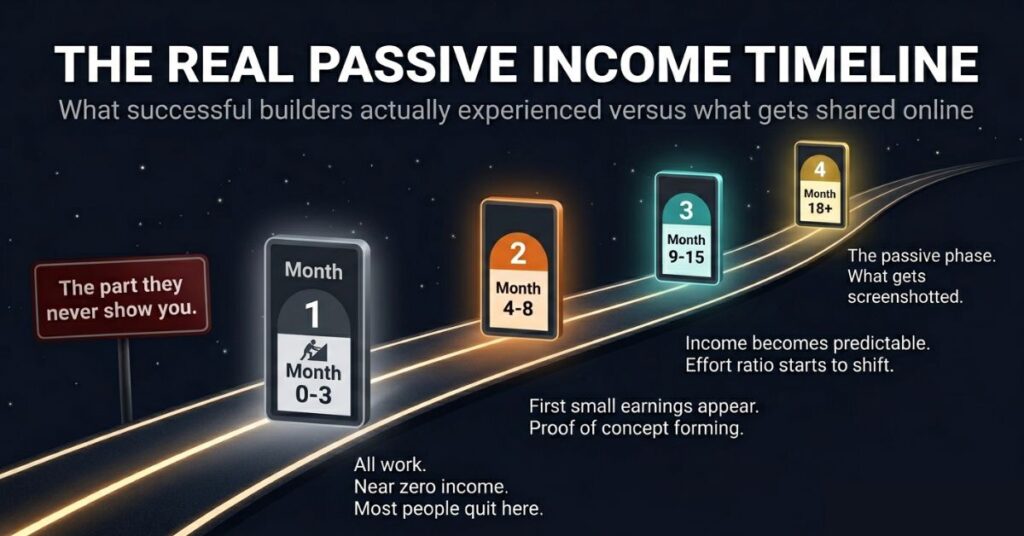
I built a small content site a few years ago. For the first four months I published articles twice a week, did keyword research I was still learning how to interpret correctly, got almost no traffic and made essentially nothing. The fifth month I earned $14 and earned $31 the sixth month.
At month eight I had my first month over $200. At month fourteen it crossed $500 for the first time. That was also around the point when I started being able to maintain the income with significantly less ongoing work than it had taken to build it.
None of that was passive, it was patient. Which turns out to be a different thing entirely.
Every passive income stream that actually works has this phase underneath it. The length varies by model. The intensity varies by model. But it is always there, and the gap between what people describe publicly and what the building phase actually involves is where most people lose the most time and money.
A digital product portfolio can reach a point where sales arrive without daily promotion. Getting there requires researching the market, building and launching products that do not sell, understanding why they did not sell, trying different approaches, accumulating the reviews that generate organic visibility and learning how the marketplace algorithm rewards products that meet certain engagement signals. Notion templates as a digital product model are one of the more documented examples of this trajectory. The economics and honest timeline are worth understanding before choosing this direction. That takes time, typically a lot more time than the success stories make it sound like.
Dividend investing becomes more hands-off once the portfolio is established. Getting there requires either accumulating a significant amount of capital over years, or starting with capital you already have and accepting that the dividends on a small portfolio are financially irrelevant for most people. The US Treasury 10-year yield is around 4.3% in early 2026. A 4% return on $20,000 is $800 per year. Not as passive income but as part of a long-term wealth building strategy but these are different things.
The active phase is not inspiring content, it does not screenshot well. It is the reason the people who most authentically describe passive income building are rarely the ones with the largest audiences, because large audiences are built on content that makes people feel good about starting, not content that accurately describes what starting is like.
The Expiry Date Problem
There is something that bothers me every time I see passive income presented as a destination you reach and then stay at.
Most passive income streams expire. Not suddenly, usually. Gradually. And the gradual nature of the decline is part of what makes it easy to miss until it has already done significant damage.
A content site I know of lost 60% of its traffic in a single Google core update in 2024. The site had been earning steadily for three years. Nothing about the content changed. The algorithm’s assessment of its value changed. The income that had been largely hands-off for two years suddenly required months of active remediation work to partially recover.
That is not an edge case. Google ran multiple major core updates in 2023, 2024 and 2025, each one redistributing significant amounts of search traffic between sites. Every content site earning passive income from search rankings is exposed to this risk whether or not the owner is paying attention to it.
Courses go out of date. The field moves and the course does not. Sales slow. New releases by other creators with bigger audiences take the space. The platform changes how it promotes content or adjusts its revenue share terms.
Print-on-demand stores built around a trend watch but when the trend fade, the store keeps running but the sales already dropped.
None of these failure modes eliminate these income models as worthwhile pursuits. They do mean that treating passive income as something you build once and stop thinking about is a significant misunderstanding of how these businesses actually work. The people maintaining passive income over years are the ones monitoring their assets, catching declines early and doing the active work of adjustment before the situation becomes serious.
Passive income is a ratio of effort to return that can shift significantly in your favour over time. It is not a state you reach and remain in permanently without attention.
The Models Worth Pursuing in 2026
Rather than a list of every possible passive income idea, here is where I think the realistic opportunities are for people without significant existing capital.
Content sites with advertising and affiliate income are the model with the widest access and the longest active phase. The creator economy reached $250 billion in 2025. Content monetisation through display advertising and relevant product recommendations is a well-documented path. The realistic timeline before the income becomes meaningfully self-sustaining is six to eighteen months of intensive work. Getting there requires either strong writing and SEO capability or enough money to hire for what you cannot do yourself.
Digital products sold through established marketplaces are the model with the best effort-to-passivity ratio for people who have a specific skill or area of knowledge they can package. Analysis of more than 5,000 digital product creators suggests income of $1,000 to $5,000 per month within six to twelve months is achievable in a validated niche with consistent effort. What that analysis does not always make clear is that the products which perform best are built by people who genuinely understand the problem they are solving. Generic templates and guides compete against too many other generic templates and guides to generate meaningful passive income.
Dividend investing and index funds are the model that becomes most reliably passive once established, and the one with the highest capital requirement. There is no shortcut here. The income from a dividend portfolio is directly proportional to the capital in it and building meaningful capital takes either time or exceptional income during the active earning years.
Licensing creative or intellectual assets, music, photography, code, designs, educational content, works for people who create prolifically and whose output has catalogue value. The income from any single asset is small. The income from a large catalogue developed over years can become genuinely hands-off. The competitive landscape for many of these categories, particularly stock photography, has shifted significantly because of AI-generated content, which is worth factoring into which categories are worth investing in now.
Before You Commit to Any of This
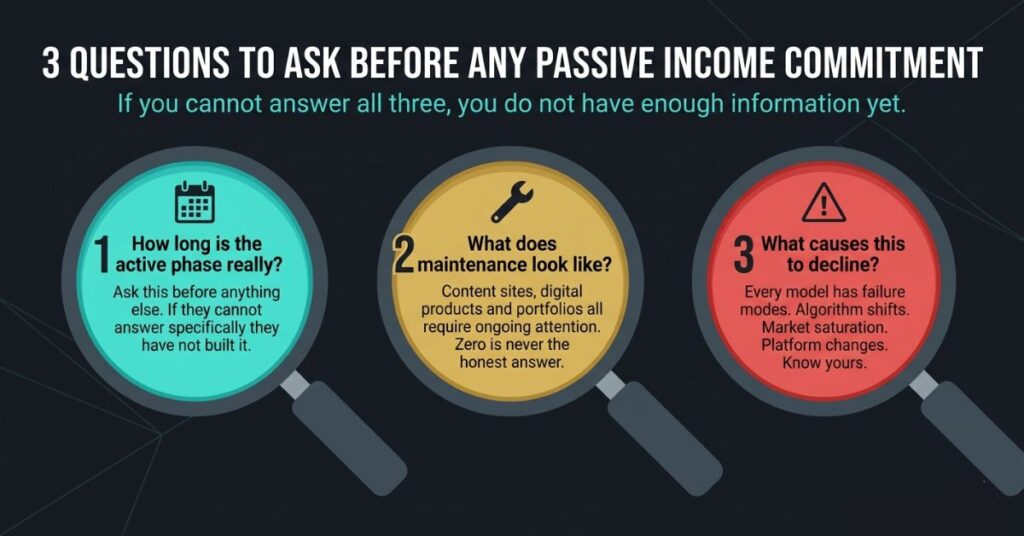
There are three things I wish someone had told me to ask before I chose which direction to go.
What does the first twelve months actually look like, not the success story version, but a realistic description of the work involved, the likely income at different points and what failure looks like from the inside? If you cannot find an honest answer to this question from someone who has done it without selling a course about it, you do not have enough information.
What ongoing work does maintaining the income require after it is established? This is a different question from what building it requires and both answers matter. A content site in maintenance mode still requires monitoring, occasional updates, technical management and awareness of platform changes. A digital product business still requires customer service, periodic product refreshes and some level of ongoing promotion. None of this is burdensome if you plan for it. It is surprising and demoralising if you assumed the income was truly set and forget.
What would cause this income to decline significantly and what would the early warning signs look like? Knowing the failure modes in advance is not pessimism. It is the thing that gives you the ability to respond before the damage is serious. Algorithm dependency, market saturation, platform policy changes, trend sensitivity different models have different exposures. Understanding yours determines whether you are managing an asset or slowly losing one without realizing it.
What I Actually Think About This
Passive income is worth building. Not the version that gets sold but the version that exists, which is income that compounds over time and requires significantly less ongoing effort than the work that built it.
The reason it is worth building is not because it is easy or fast. It is because active income has a ceiling that is determined by time and energy, both of which are finite. Building something that earns while you are doing other things, even imperfectly and with ongoing maintenance, changes what is possible for you over a long enough period.
The people I know who have built real passive income streams share a few things. They chose a model that matched their existing skills and had a realistic path to the outcome they were after. They stayed in it significantly longer than felt comfortable during the early months when nothing seemed to be working. And they never stopped treating the income as an asset that required attention, even after it became relatively hands-off.
None of that is complicated. Very little of it resembles what the passive income content ecosystem suggests you are signing up for. But the gap between what is being sold and what is real is knowable in advance if you are willing to look for the honest version of the story.
The honest version is what I have tried to write here.
If you have not yet earned anything online, the right starting point is getting your first $100 before thinking about passive income.
Frequently Asked Questions
I started a content site six months ago and I am making almost nothing, should I keep going?
This depends more on the quality of what you have built than on the timeline. Six months with no meaningful traction is not unusual and is not itself evidence the site will not work. What matters is whether the content you are publishing genuinely answers questions that people are searching for, whether Rank Math or a similar tool shows your pages actually being indexed and crawled, and whether your traffic, even if tiny, is growing at all. If the answers are yes, yes and yes, six months is early. If you are publishing content nobody is searching for on a site Google has not indexed properly, the problem is directional rather than patience-related and more time alone will not fix it.
Is it possible to build passive income in a competitive niche?
Yes, but the definition of competitive matters here. A niche with high search volume and hundreds of well-funded sites competing for the same keywords is genuinely hard to break into without significant resources or a genuinely differentiated angle. A niche that feels competitive because you found five other people writing about it is usually not competitive in any meaningful sense. The niches worth worrying about are the ones where the first page of Google results is dominated by major publications with enormous domain authority and dedicated editorial teams. The ones worth pursuing despite apparent competition are the ones where the existing content is thin, generic or outdated.
What is the biggest mistake people make when trying to build passive income?
Treating validation and building as the same step. The typical failure pattern is spending months building a product, a site or a course before finding out whether anyone will pay for what it produces. The information you need to determine whether an idea is worth building is almost always available before you build it. Search volume data tells you whether people are looking for the thing. Competitor revenue estimates tell you whether people are paying for it. Direct conversations with potential buyers tell you whether your specific take on it would be chosen over alternatives. Skipping the validation step to get to the building step faster is how people spend a year on something that was never going to work.
Do I need a large social media followers to make passive income?
No but the social media path to passive income is actually one of the weaker ones because social media income is almost entirely active. The income stops when you stop posting, which means it was never passive in the first place. The income models with the clearest passive trajectory, content sites, digital products, dividend investing and licensing, do not require a social media following to work. They require either an existing audience of some kind, specific domain knowledge, capital or creative output in large enough quantities to build a catalogue. A social media following can accelerate any of these by giving you an initial distribution channel. It is not the mechanism of the income itself.
How do I avoid passive income scams without becoming so skeptical I dismiss legitimate opportunities?
The most reliable signal is how the income is generated by the person presenting the opportunity, not by the students or followers who have taken their advice. If the main income source of the passive income educator is the course teaching passive income, they have built a business model around your aspiration rather than around the strategy they are describing. This does not mean the strategy is wrong. It means you should verify it independently through people who applied it without buying a course first. Case studies published by marketplaces, creator economy research, income reports from bloggers and product creators who share detailed transparent numbers without trying to sell you anything, these are the sources that give you an honest baseline for what a specific model actually produces.

Johnson Alaekezie is a freelancer and digital content creator with several years of experience working across writing, content strategy, and digital services. He founded IncomeGigAI to share honest, practical information about building income online without the hype that dominates most of this space. Johnson has worked with clients in the US, UK and beyond, and writes from direct experience rather than theory. He is based in Nigeria and covers the digital income topics he has personally navigated as a working freelancer.