

I almost built one of these. Back in early 2023, I had this idea for a tool that would take a freelancer’s Upwork proposal, run it through GPT and rewrite it to sound more confident and client-focused. I had the idea on a Tuesday, by Thursday I had a rough prototype working in my browser. I showed two freelancer friends and they both said “I would pay for this.”
I did not launch it. And honestly, I am glad I didn’t, because within four months, three nearly identical tools had appeared on Product Hunt, Upwork had started experimenting with its own AI proposal suggestions and the window I thought I had spotted had basically closed.
That experience made me start paying close attention to AI wrapper businesses. Who was building them, which ones were surviving, which ones were dying quietly and why. I have been watching this space for over two years now. What I have found is not what most AI content creators are telling you.
What Is an AI Wrapper Business?
I want to get this definition right because people use the term loosely.
An AI wrapper business is a product or service built primarily by calling an AI API like OpenAI or Anthropic, then presenting the results to users through a custom interface. The AI does the heavy lifting. The wrapper adds a focused use case, a cleaner interface, sometimes a specific prompt structure and a way to charge people for access.
Real examples you have probably seen: tools that rewrite your resume using GPT. Tools that generate Instagram captions from a product photo. Chatbots built on a company’s support docs. Services that produce SEO articles from a keyword list. Apps that turn voice notes into formatted meeting summaries.
All of these are, at their core, wrappers. Someone else’s AI is doing the actual work. The wrapper business is packaging it, pointing it at a specific problem and selling access.
I want to be clear, building on top of existing infrastructure is not automatically a bad idea. Shopify is built on payment processors. Half the SaaS tools you use daily are running on AWS. The question is not whether you are using someone else’s foundation. The question is what you are building on top of it that has real, lasting value. Most AI wrappers do not have a good answer to that question. Let me explain why.
The Moat Problem (This One Kills Most of Them)
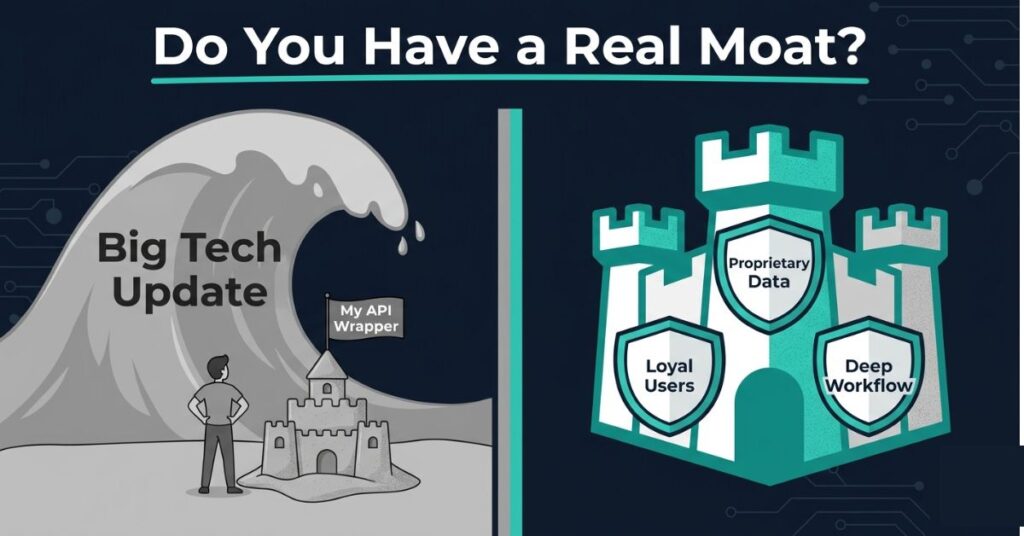
When I talk to freelancers excited about their AI wrapper idea, the conversation is almost always the same. They have found a niche use case. They have a working prototype. They might even have a handful of paying users. Things feel like they are working.
Then I ask: what stops someone from copying this next weekend?
I do not ask it to be harsh, I ask it because most of the time the answer is nothing.
In normal software businesses, moats come from things that are genuinely hard to replicate. Network effects, where the product gets more valuable the more people use it, think of a marketplace or a platform where buyers and sellers both need to be present. Proprietary data, where you have trained on or accumulated something a competitor cannot easily get. High switching costs, where users have so much of their history inside your product that leaving is a real pain. Patents. Regulatory approvals.
AI wrappers almost never have any of these. They have a prompt, an API key, and a UI built on a template. A developer can reverse-engineer the core concept in a weekend. A well-funded competitor can build a better version in a week and spend the money they saved on Google ads, burying the original without anyone noticing.
I know someone who built an AI email reply tool in mid 2023. It was good, he had around 400 paying users at his peak. Then Gmail added smart reply improvements, then Outlook added Copilot. His tool did not get worse, it just became pointless. The users left not because they were unhappy but because the thing his tool did was now just built into the apps they were already using.
A16z’s research on generative AI consumer behavior found that users switch AI tools frequently when the underlying value proposition is not sufficiently distinct, which is exactly what happened here.
His moat was not a moat. It was a temporary gap that platform companies eventually filled, which is what platform companies always do.
The wrappers that survive this have something underneath the AI that is hard to replicate. A legal AI tool trained and validated on years of case outcomes from a specific jurisdiction is not just a wrapper anymore. A medical documentation tool that has learned the billing patterns of a specific hospital system is not just a wrapper anymore. The AI is one component of a product with real depth. This is visible in how the small businesses using AI most effectively have integrated it, not as a standalone product but as one layer inside an existing operation. If your wrapper could be rebuilt by anyone with an API key and a free afternoon, you have a feature, not a business.
What is The Margin Math Nobody Shows You?
I want to walk through a number exercise that most AI business content conveniently skips.
Say you charge users $29 per month. Your API cost per user averages $4 per month based on your testing. Looks like $25 margin per user, right? Healthy enough.
Here is what actually happens.
Your testing was done with moderate usage and if you have not checked OpenAI’s API pricing structure carefully against real usage patterns, the margin gap will surprise you. Real paying users use the product more than test users do, sometimes a lot more. The person who pays for your AI caption tool and has a product launch coming will generate 60 captions in a week, not the 10 you budgeted for. Your heavy users are your most engaged users, which means they are also your most expensive users. You end up losing money on the customers who love your product most. That is a genuinely bad situation.
Then API pricing shifts. It has generally trended downward over time, which sounds like good news until you realize that lower API costs also lower the barrier for new competitors. The cheaper the infrastructure becomes, the more people build on it, the more crowded the market gets and the more pressure there is on your pricing. You do not keep the savings because the market takes them.
Then the model gets updated. I had a friend who built a product that generated personalized cold email sequences. It was working, real clients, real revenue. Then OpenAI updated GPT-4 and the tone of the outputs shifted noticeably. Not broken exactly, just different enough that clients started asking what had changed. He spent almost a month re-engineering his prompt stack for a model change he had no say in, no warning about and no recourse for. It cost him two clients who ran out of patience during the disruption.
When your entire business depends on one API provider, you are one product decision by that company away from a very bad month. The businesses that handle this well build their architecture so they can switch between providers, OpenAI, Anthropic, Google, open-source models, depending on what performs best and at what cost. That takes more work upfront. It is also the difference between having a business and having a subscription to someone else’s infrastructure.
Why Everyone Always Sounds the Same
Strip the branding off ten AI writing tools. Remove the logos, the color schemes, the pricing pages. What you have left is ten products that take text in and return text out. The prompts differ a bit. The interfaces look slightly different but the outputs, for most everyday use cases are close enough that a typical user could not tell which product produced which result.
This is a terrible competitive position. When users cannot distinguish products on quality, they choose on price. When everyone competes on price, margins disappear and the only winner is whoever has the lowest cost base, which is never the small indie wrapper with five hundred users.
I have watched two people I know personally get squeezed out of niches they helped create because a better funded competitor came in, priced lower and ran ads. Not because their product was worse. Because they had no way to explain to a new user why their product was different in any way that actually mattered.
The wrappers that escape this trap do one of two things well.
First one is hyper-specialization. Not “an AI writing tool” but “an AI tool specifically for Airbnb hosts that generates listing descriptions calibrated to the patterns of high-converting listings, optimized for the specific character limits and formatting requirements of the Airbnb platform.” That product does not sound interchangeable with a general writing tool, even if the underlying API call is nearly the same. The specificity is the product, the AI is just how it runs.
Second is deep workflow integration. When a product connects to the tools your user already has, outputs in the formats they already need and removes multiple manual steps between raw input and finished result, leaving feels costly. Not because of artificial friction but because the product has become part of how the user actually works. The AI is one component of something that fits tightly into an existing professional workflow. Users do not abandon things that fit that tightly into their day.
Both paths require a level of specific user understanding that most wrapper founders skip. They build for “content creators” or “small business owners” instead of one very specific person with one very specific recurring problem in one very specific context. Narrowing the target feels like shrinking the market. It is actually the only way to build something defensible.
Why Prompt Engineering Is Not the Advantage You Think It Is
I will say something that might annoy some people but I think it’s true. Prompt engineering as a competitive advantage has a much shorter shelf life than most wrapper founders believe.
In 2022 and early 2023, getting reliably good outputs from a language model required real craft. The difference between a naive prompt and a well-structured one with proper context, reasoning chains and output formatting was significant and measurable. People who understood this had a genuine edge.
That edge has narrowed a lot. The models have gotten much better at understanding what you want from simpler, more natural instructions. The gap between a sophisticated system prompt and a basic one has compressed as the underlying models have improved at inferring intent.
What this means practically is that, the thing wrapper founders thought was their defensible technical advantage, their prompt stack, erodes as the models get smarter. And the models are getting smarter faster than most wrapper businesses can re-engineer their moat.
I am not saying prompt engineering is useless. I am saying it is not the foundation of a durable business by itself. The founders who are actually doing well are, almost without exception, the ones who were primarily thinking about the user experience, the customer relationship and the distribution not the prompt. The technology was always supposed to be the means not the point. Somewhere along the way a lot of people got that backwards.
Distribution Is Where Almost Everyone Fails
I want to be direct about this because I see it constantly with freelancers who are drawn to building AI products.
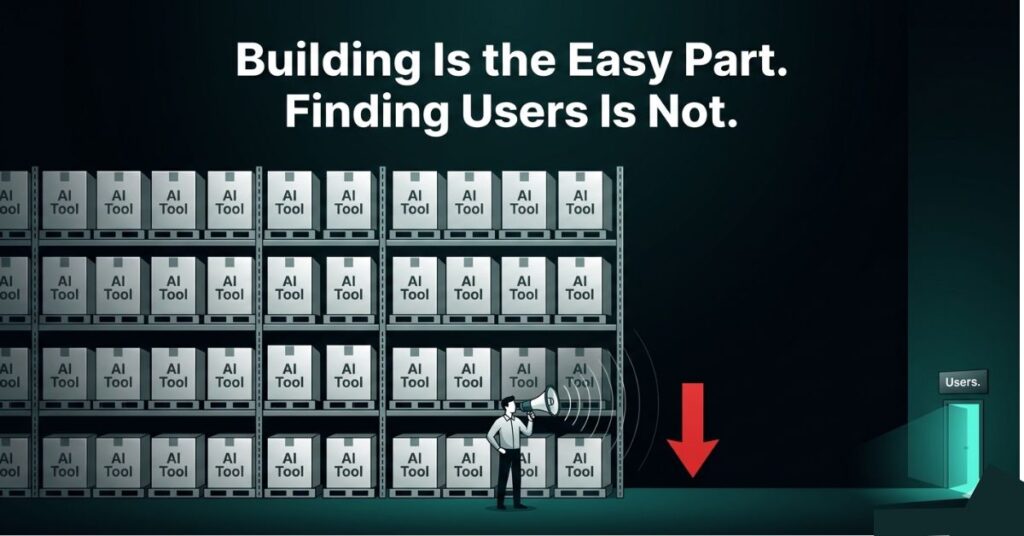
Building the wrapper is not the hard part. I mean that genuinely. With the right documentation and a week of focused effort, most people with basic technical ability or access to no-code tools can put together a working AI product. Bubble, Glide, Softr, and similar platforms have made the build accessible to almost anyone motivated enough to learn them.
Getting users is the hard part, it is almost always the hard part. And most wrapper builders spend ninety percent of their time building and ten percent thinking about how anyone will actually find the product.
A wrapper with no distribution is a side project with a monthly API bill.
I have watched people spend four months building polished AI tools, launch them on Product Hunt, get a brief spike of curiosity traffic, and then watch the user count stall at thirty because they had no plan for where paying users would actually come from. Product Hunt is not a distribution strategy, posting on Twitter once is not a distribution strategy. “I will do SEO” is not a distribution strategy for a product with no domain authority, no backlinks and no content yet.
The wrappers that build real user bases almost always have distribution worked out before or during the build, not after. They already have a newsletter with the exact people they are building for. They have a YouTube channel where their target user hangs out. They have a consulting practice that serves the clients who would buy the product. They have built relationships in a specific professional community over years and can get the first twenty users through direct personal outreach and use those users’ testimonials to drive the next hundred.
If you are building an AI wrapper right now and you genuinely do not have a clear answer to where your first hundred paying users will come from, that is the problem to solve. Not the UI and not the prompt but the distribution. Everything else is secondary until that question has a real answer.
The Ones That Are Actually Working
I do not want to leave the impression that all AI wrapper businesses fail because that is not accurate. Some of them are making serious, sustainable money. When I look at the ones that work, the pattern is consistent.
They serve one specific professional with one specific recurring problem. Not “marketers” but “email marketers at e-commerce brands who need to write promotional sequences for weekly sales without burning out their list.” The specificity creates retention because the product fits tightly into an existing workflow that repeats. The user does not need convincing every month. The problem comes back every week and so does the product.
They had distribution before they had the product. The founder had 8,000 newsletter subscribers in the e-commerce marketing space before they built the email tool. The product did not create the audience. The audience told them what product to create.
They price for the value delivered, not for API access. A tool that saves a professional three hours a week on a task that earns them $150 per hour can justify significantly more than a $19 per month SaaS fee. The ones that get pricing right think about what the outcome is worth to the user, not what feels like a reasonable subscription.
They treat the AI as infrastructure. When I talk to the founders of AI wrappers that are growing, they almost never lead with “we use GPT-4” or “our prompts are really sophisticated.” They talk about their user. They talk about the problem. The AI comes up the way a plumber might mention their pipe wrench — it is how they do the work, not what the work is about.
They designed for retention from day one. Every early product decision was filtered through the question: why is this user still paying six months from now? What data has accumulated that makes the product more valuable over time? What would they lose if they cancelled? Not every wrapper can answer these questions perfectly, but asking them early changes the shape of what gets built.
My Advice To Freelancers
Here is my honest take, as a freelancer who almost went down this road and has watched a lot of other people go down it.
The window for building a profitable AI wrapper with a thin prompt, a basic interface and no real distribution or moat has mostly closed. Not completely, but mostly. If that is the plan as it stands, you are entering very late into a crowded market against people with more capital, more engineering resources and more time.
But there is an opportunity right next to this one that I think is significantly underexploited and it is one that freelancers are actually well-placed to take.
Use AI to make your freelance services dramatically better instead of trying to package AI into a product.
A freelance copywriter who uses AI to produce strong first drafts and spends their time on strategy, editing, positioning and client relationships can handle two or three times the client load they could before, without a proportional increase in hours. Their moat is not a prompt, it is their editorial judgment, their understanding of what clients actually need, their professional relationships. Those things are not replicable by a competitor with an API key.
A freelance researcher who uses AI to synthesise information faster can deliver more comprehensive work in less time. A freelance designer who uses AI tools in their concepting process can show clients more creative directions in the same number of billable hours.
These are not AI wrapper businesses. They are freelance businesses that are stronger because of AI. The defensibility comes from expertise and relationships, which are things the freelancer already has or is building anyway.
The irony is that this is more defensible than most AI wrapper businesses and it requires no product development, no customer support infrastructure, no API bill management and nothing like distribution strategy beyond the client relationships the freelancer is already building.
If You Still Want to Build Something
If you have read all of this and still want to build an AI wrapper business, I think that is a valid choice. Some of the problems I described are solvable. But I would sit with these questions honestly before committing serious time and money.
Who specifically is this for and how do you know they have this problem badly enough to pay for a solution? Not a category of users. One person with a specific daily frustration that your product would actually relieve.
What do you have that a well-funded team could not replicate in three months? If the honest answer is nothing, what would need to be true for that answer to change?
Where are your first hundred paying users coming from, and do you have a realistic path to them before your runway or motivation runs out?
What happens if OpenAI raises API prices by 40 percent? Or releases a product that competes directly with yours? Both of these things have happened to businesses in this space. They are not edge cases.
What makes the user stay past month one? If the only answer is that the product is useful, that is not enough. Useful products get replaced by slightly more useful products all the time. What creates genuine switching cost or loyalty for your specific user?
If you have real, specific answers to all five of those, you are ahead of the majority of people building in this space right now.
Frequently Asked Questions
Is it too late to build an AI wrapper business in 2025?
For a thin wrapper with no moat, no distribution and no specific user focus honestly, yes. That window closed fast but for a focused, workflow-specific tool built around a niche you genuinely understand and an audience you already have access to. There is still room. The bar has just gone up significantly from what it was in 2022.
What is the actual difference between an AI wrapper and a real AI product?
A wrapper calls an API and presents the result. A real AI product does that too, but it also accumulates proprietary data over time, integrates deeply into a user’s existing workflow, gets more valuable the longer someone uses it and would be genuinely painful to replace. The AI is infrastructure in both cases. The difference is everything built around it.
Which AI API is best to build on, OpenAI or Anthropic?
Depends entirely on your use case. OpenAI’s GPT-4o is generally stronger for creative and generative tasks. Anthropic’s Claude handles long documents and nuanced reasoning particularly well. The smarter move is to build provider-agnostic from the start so you can switch without rebuilding your product. Locking into one provider is a business risk, not just a technical preference.
How much does it actually cost to start an AI wrapper business?
The API costs are lower than most people expect at the start, you can prototype for under $20 a month. The real costs are time, hosting and customer acquisition. Most people dramatically underestimate how much it costs to get users not to build the product. Budget more for distribution than for development and you will be thinking about it correctly.
What I Actually Think
AI wrapper businesses are real and some of them will continue to make real money. The version that does not work is the one built on a thin prompt, a templated interface, no distribution plan and the assumption that being early to a use case is the same as having a business. That version is losing and losing fast.
The version that works looks less like a tech startup and more like a very focused service business with software at the center, specific user, specific problem. Distribution that exists before the product, pricing that reflects actual value. A reason the user stays.
If you are a freelancer looking at this space wondering where you fit, my genuine recommendation is this: start by using AI to get substantially better at what you already do, build the skills. We ran a thirty-day experiment integrating AI into every part of a freelance business to find out exactly what those skills look like in practice and where the real limits show up. Understand where it helps and where it falls short. That knowledge will make you a better service provider right now and a significantly better builder if you do decide to create something.
The easy version of the AI wrapper opportunity is gone. What is left is just building a real business, which has always been the harder thing and has always been the thing worth doing.

Johnson Alaekezie is a freelancer and digital content creator with several years of experience working across writing, content strategy, and digital services. He founded IncomeGigAI to share honest, practical information about building income online without the hype that dominates most of this space. Johnson has worked with clients in the US, UK and beyond, and writes from direct experience rather than theory. He is based in Nigeria and covers the digital income topics he has personally navigated as a working freelancer.