
I raised my rates twice last year, I lost one client and was able to keep seven.
The one I lost was not a good client anyway. He emailed at 11pm expecting replies before breakfast, asked for revisions on revisions and once told me my pricing was aggressive for someone without a degree. I should have raised my rates on him sooner honestly. He left and I did not chase him.
The seven I kept did not flinch. Two of them said something like “makes sense, let me know what the new invoice looks like.” One actually said he was glad I finally did it because he had been referring me to people at my old rate and feeling a bit embarrassed about how low it was. That one surprised me.
I am telling you this upfront because most articles about raising freelance rates treat it like defusing a bomb. Like your clients are sitting on a hair trigger waiting for any excuse to leave, in my experience that is just not true. The clients worth keeping almost never leave over a rate increase done right. The ones who leave were already on their way out.
That said, there is a right way and a wrong way to do this. And the difference is not whether you raise your rates. It is the timing, the framing, and the actual words you use. Get those three things right and it is genuinely not a difficult conversation. Get them wrong and even a fair increase creates friction that could have been avoided.
This is the practical version. Not “know your worth” motivation. The actual email, the actual pushback responses, word for word.
Most Freelancers Already Know They Are Undercharging
The problem is not information, it is fear. The fear sounds like: “If I raise my rates my clients will leave and I will have no income.” Sounds rational. But when you actually look at it, it does not hold up.
Think about the clients you have right now. How long have some of them been with you? Six months? A year? Two years? They are not staying because of your rate. They are staying because you do good work, you are reliable, you communicate well, and finding someone new is a headache they do not want. The rate is one factor among several and for most long-term client relationships it is not even close to the most important one.
The other version of the fear is “I do not have enough leverage yet.” I did this for almost two years. Told myself I would raise rates after I had more testimonials, after I finished a certain course, after I redesigned my portfolio and it grows to after I landed one more big client.
The leverage never feels like enough from the inside. There is always one more thing to wait for. But here is the thing, the clients paying you right now are already telling you something. They think you are worth what you charge, the market validated you or maybe you are just the last one to accept it. Before figuring out how to raise your rate, it is worth checking whether your current rate is even benchmarked correctly for the market your clients are actually based in. US clients pay very differently from UK clients for the same work.
If you genuinely are not sure what the market is paying for your type of work right now, the Bureau of Labor Statistics occupational wage data is a solid starting point for anchoring your numbers to something real.
Timing Is More Important Than Most People Think
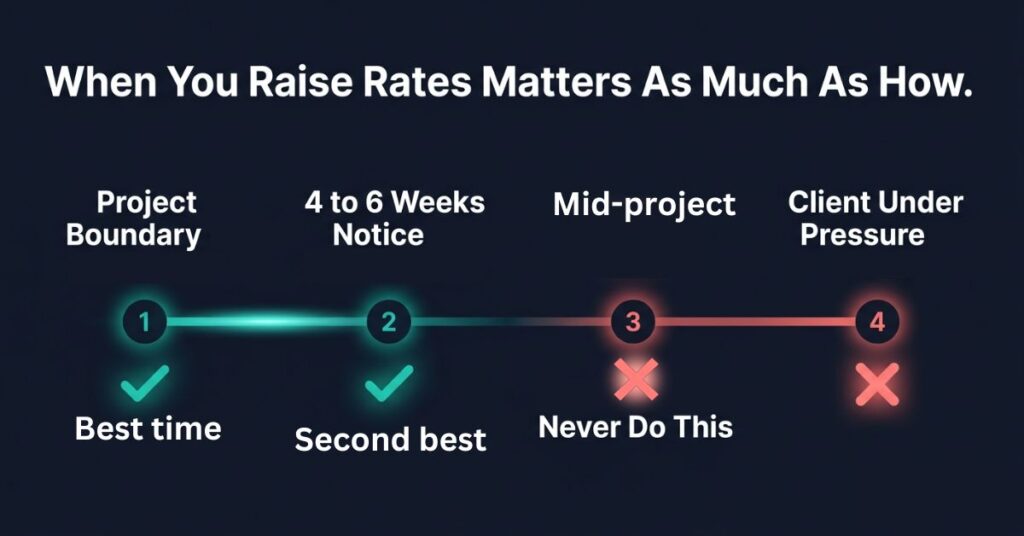
Bad timing can sink a rate increase that the client would have accepted without any issue.The best moment is right at a project boundary. When one project ends and a new one is about to begin, you are in the strongest position. The client has just seen your work delivered, when the value is fresh. And they are about to make a new commitment anyway, so bringing up new pricing fits naturally into a forward-looking conversation rather than disrupting something already in motion.
I raised my rate with one long-term client right after I delivered a content strategy document she later told me saved her team three weeks of internal planning work. I did not plan the timing. It just happened to be when the project wrapped up. But when I sent the note about new pricing for the next project, she was sitting with the clearest possible reminder of what she actually gets from working with me. The timing did half the work for me.
If you are on a retainer with no clear project boundaries, four to six weeks notice is the standard. It gives the client time to adjust their budget, gives you time to finish current work at the old rate and shows that you handle transitions professionally.
Two things to avoid completely are:
Mid-project. I have watched freelancers try this, even when the client accepts it, it damages the relationship because it feels like a bait and switch. You agreed to a price for a piece of work. Changing it before the work is done breaks something, don’t ever do this.
During a stressful period for the client. If they are in the middle of a product launch, difficult hiring period, funding crunch, anything high pressure, just wait. The conversation will land badly not because the increase is unreasonable but because the timing signals you are not paying attention to what is happening on their side. Clients remember that.
What You Say and What You Do Not Say
Most freelancers get this wrong because the instinct is to justify the increase with personal reasons. Cost of living went up, you are busier now. You need to hit a certain income target.
None of that is the client’s problem. Presenting it that way puts them in an awkward position, either agreeing to pay more out of sympathy or feeling like they are being pressured. Neither is good.
What works is framing the increase as a natural reflection of what the relationship has actually become.
When you started working with a client, you were new to them. They were taking a chance on you. It made sense to price lower. Now, a year or two in, you know their business, their voice, their preferences, their audience. You know what they hate. You know which directions to avoid before even pitching them. You have made mistakes and fixed them. The work you do for them now is genuinely different from the work you did at the start, not just because you have improved generally but because the specific knowledge you have built about their situation has real value.
The increase is not “my rates are going up.” It is “the work we do together has evolved and my pricing is going to reflect that.”
To the client, one of those feels like a bill. The other feels like a conversation between partners, the difference matters.
The Actual Email
This is what most articles leave out. They tell you to communicate your value and be confident and then give you nothing to work with.
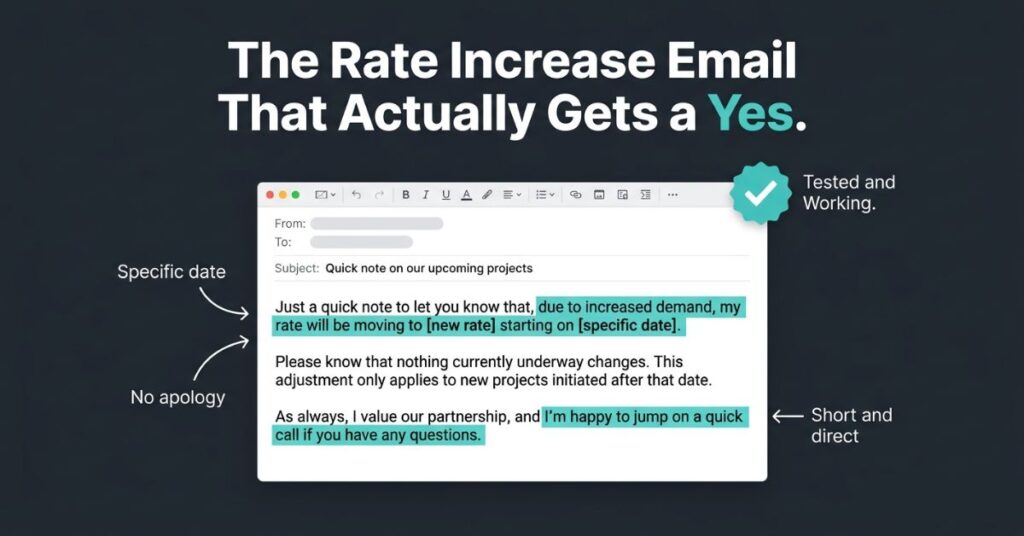
Here is the email I have used, adapted slightly for each client. It has worked consistently.
Subject line: Quick note on our upcoming projects
Hi [Name],
Wanted to give you a heads up before we kick off the next round of work.
Starting [specific date four to six weeks out], my rate for new projects will be moving to [new rate]. Everything we have underway right now stays the same.
Working with [their company] over the past [timeframe] has genuinely been one of the better parts of my client roster. I know how [their product or industry] works in a way that took a while to build and I think the work reflects that now.
Wanted to flag this early rather than spring it on you last minute. If you want to talk through what this looks like for the projects we have been planning, happy to jump on a quick call.
[Your name]
A few things to notice about what that email does and does not do.
It does not ask for permission. “I was thinking about possibly adjusting my rates” is an invitation to negotiate before you have even made a case. “My rate will be moving to” is a professional communication. Clients respond better to the latter even if they do not say so explicitly.
It protects current work. Clients feel safe when they know the ongoing engagement is not being disrupted. You are setting new terms for what comes next, not changing the rules mid-game.
It is specific. A specific date and a specific number. Vague rate increase emails create anxiety. “I will be raising my rates soon” leaves the client in limbo.
You need to make it short. Every extra sentence increases the chance something in the email creates a question or an objection. Short and direct reads as confident while long and thorough reads as nervous.
The email only works if you have the payment terms and late fee clause already written into your contract. If those are not there yet, our freelance contract guide covers the specific language worth adding before you send anything like this.
When They Push Back
It happens not often but it does. Here is how I have handled the three versions that come up most.
Can you keep the old rate for me?
This is the most common one. The client is not necessarily saying they cannot afford the increase. They are testing whether it is firm. How you respond depends on whether you want to hold the line.
If you are holding it: “I appreciate you asking. I am keeping the new rate consistent across my roster so I need to stick with it. I do want to keep working together and I think what we have built is worth the adjustment.”
If you are open to a different arrangement: “The rate I quoted is for project work. If we moved to a retainer with a guaranteed monthly scope I could work with a different number. Would that be worth exploring?”
What not to do: immediately drop back to the old rate with no conditions. That signals the increase was not serious, that future increases will also fold under mild pressure and it shifts the power dynamic in a way that is hard to recover from. Even if the client is happy in the short term, something has changed.
Your rates are higher than others I have looked at.
This one is designed to create doubt. I respond directly and calmly.
“That may be true. I cannot speak to what others are charging or what they are delivering. What I can tell you is what you have received from our work together and what I bring to your specific projects at this point. If the rate does not work for your budget I understand completely. If you want to make it work I am happy to talk through what that looks like.”
You are not defending yourself against a comparison you cannot verify. You are redirecting to the value of the specific relationship. If the client has genuinely been happy with the work, that redirect lands.
No response at all.
Some clients just go quiet, hoping you will soften the position if they wait long enough.
Wait five to seven business days. Then send one short follow-up: “Just wanted to make sure my note landed. Happy to jump on a quick call if that is easier than email.”
If they still do not respond, you have your answer. Move on without drama.
The Time I Almost Got This Wrong
About eighteen months into working with an e-commerce brand, I sent a rate increase notice. The increase was about 30 percent. I knew it was at the high end but felt it was justified given what I had been delivering.
The founder responded within an hour. Not hostile but not warm either. He said the jump was more than he had budgeted for and asked if we could talk.
We got on a call. He told me honestly that 30 percent felt sudden even with four weeks notice. I asked what number felt workable. He said 15 percent. I said I could do 20 and we could revisit in six months. He agreed immediately.
Two things I took from that conversation.
The percentage matters as much as the actual number. A client on a $500 monthly retainer hearing it will now be $700 is not processing a $200 difference. They are processing a 40 percent increase. If yours is genuinely large, acknowledge it directly. “I know this is a bigger jump than usual.” That acknowledgment takes the sting out better than pretending it is small.
Negotiating is not losing. I ended up at 20 percent instead of 30. That client stayed for another year. The relationship was honestly better after that call than before it because we had talked about money directly for the first time and both felt fine about where we landed. Negotiation is two professionals working out an arrangement. That is all it is.
How Often Should You Actually Do This
More often than you think and by smaller amounts each time.
A 5 to 10 percent annual increase is almost never questioned by a client who is happy with your work. It reads as normal business, the same way any supplier adjusts pricing annually. A client who has been with you for two years at the exact same rate is already, on some level, slightly puzzled. Good work gets more valuable over time. Flat pricing implies the opposite.
The freelancers I know who dread this conversation the least are the ones who set the expectation from the start. They mention during onboarding that they review pricing annually. So when the increase comes, it is not a surprise. It is just what happens.
If you have not raised your rates in over a year, you are giving yourself a quiet pay cut every month as costs rise around you. And the freelancers who stay underpriced the longest are usually the ones delivering work with the most frustration underneath it. That frustration shows up eventually, in the quality, in the communication, in the enthusiasm they bring to the client. Clients feel it even when they cannot name it.
New Clients Play by Different Rules
A mistake I see often: applying the same logic to new clients and existing ones.
For new clients, there is no history to protect and no relationship to soften the number. Quote your current rate. Present it like someone who delivers at that level. Let them decide. If they push back, that is a sales conversation and you handle it accordingly.
For existing clients, everything in this article applies.
The specific trap to watch for is raising rates for new clients but keeping existing clients at old rates out of loyalty or because the conversation feels awkward. Over time you end up in a situation where your newest clients are paying significantly more than your longest-running ones for the same or better work. That is not loyalty to the old client. It is just avoidance. And it is a conversation that would benefit both of you.
The Clients Who Leave
Some will, not many but some.
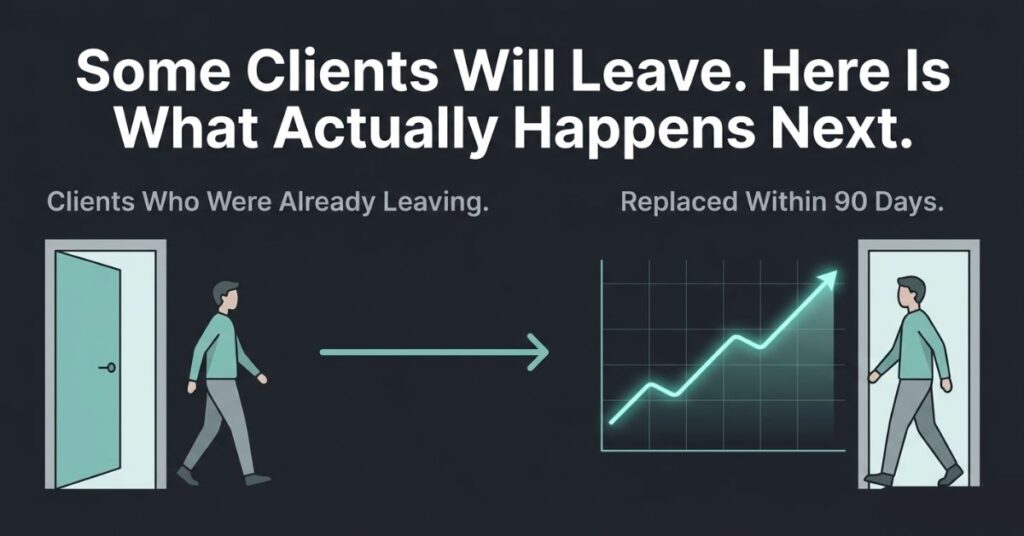
The ones who leave are usually in one of a few situations. They were already looking for a reason to cut costs. They were never deeply committed to the relationship and had been quietly shopping alternatives. Their business is genuinely struggling and the increase is a real problem for their budget. Or occasionally they feel the increase is not backed by the value they have been receiving, which is worth taking seriously even when it is uncomfortable to hear.
None of those are situations you should be devastated about.
Every time I have lost a client after a rate increase, I have replaced that revenue within two to three months with a client at the new rate who has never known any other version of my pricing. The transition is uncomfortable for a few weeks. It has always worked out.
One thing worth paying attention to though: if you raise your rates and lose more than one or two clients in a short window, that is worth examining. Not panicking over, but looking at honestly. Did the increase come with enough notice? Was it too large in one jump? Is there a gap between what you think you are delivering and what the clients are actually experiencing? Losing one client after a rate increase is normal. Losing four is signal.
Do This Today
If you have been sitting on a rate increase for more than six months, here is how to actually move on it.
Write down every active client. Next to each name, write what you charge them and what you honestly think fair market rate for the work you do for them would be right now. The gap between those two numbers is what you have been leaving on the table every single month.
Pick the client you feel most secure with. The one with the strongest relationship, the one whose work you enjoy most, the one most likely to stay. Draft the email using the template above. Change the language so it sounds like you. Then send it.
That is it, wait to see what happens.
The first one is the hardest. The response is almost always better than whatever version of it you have been imagining at 2am. And once you have done it once and it went fine, doing it with the next client is noticeably easier. The fear genuinely does not survive contact with the reality.
The money you are not earning from underpriced work does not come back. Every month at the old rate is gone. Start with one client. This week if possible.
Questions I Get Asked a Lot
Should I raise rates for all clients at once or one by one?
One by one. Doing everyone simultaneously creates a cluster of potentially awkward conversations in the same window and increases the risk of losing a few clients at the same time, which hits income harder than spreading it out. Start with whoever you feel most confident about. Let that one go well and use the momentum for the next.
I am new to freelancing and do not have established clients yet. What should I do?
Start higher than feels comfortable. Seriously. It is far easier to come down slightly in an early negotiation than to raise rates on someone you signed at a low number six months ago. Setting the right rate from the start is only half of the new client conversation. Having a deposit policy and a payment terms clause in place from day one matters just as much. Most new freelancers underprice at the start because it feels safer and then find themselves stuck because the client relationship was built around that number. Price for where you want to be in six months, not where you feel today.
My client is a small business owner and I genuinely know their budget is tight. Do I still raise rates?
Yes, but you can be thoughtful about it. A smaller increase with more notice than usual. Or a conversation before the email to give them a heads up it is coming so they can plan. You do not have to match what you would charge a bigger client. But staying at the same rate indefinitely is not kindness. It is you absorbing a cost that should be shared.
How do I raise rates if most of my work comes through a platform like Upwork or Fiverr?
On Upwork, you can adjust your hourly rate in your profile settings at any time and propose a new contract rate at the start of each new engagement. For existing contracts you will need to send a change request through the platform. On Fiverr, your gig prices can be updated directly. For existing custom orders, the conversation happens in messages before the order is placed. The framing in this article applies on any platform — the channel just changes how you send it.
What if the client says yes but then starts reducing the work they send me after the increase?
Give it sixty to ninety days before reading too much into it. Workload naturally fluctuates for most clients and sometimes the timing of a slow period overlaps with a rate change by coincidence. If after three months they are consistently sending less, that is worth a direct conversation. Not accusatory just be honest. “I have noticed things have been quieter than usual on my end. Is everything going well on your side?” Sometimes there is a real budget issue that was not mentioned. Better to know than to guess.

Johnson Alaekezie is a freelancer and digital content creator with several years of experience working across writing, content strategy, and digital services. He founded IncomeGigAI to share honest, practical information about building income online without the hype that dominates most of this space. Johnson has worked with clients in the US, UK and beyond, and writes from direct experience rather than theory. He is based in Nigeria and covers the digital income topics he has personally navigated as a working freelancer.