
My friend Dele runs a plumbing business in Manchester. Four guys, two vans, more booking calls than he can keep up with. Last year I asked him what had changed about how he runs things and he mentioned, almost as an aside, that he had started using AI to write his quote follow-up emails.
His daughter had shown him ChatGPT one Sunday. Within twenty minutes he had his first email written. He has used it every week since.
He does not call it AI adoption. He calls it not dreading the admin anymore.
I have been talking to small business owners in the US and UK for several months now, trying to understand what is actually happening with AI at ground level. Not the startup pitch version, not the enterprise transformation version. What a letting agent in Leeds actually does with it on a Tuesday morning. What a personal trainer in Edinburgh uses it for before her 7am client.
What I found is pretty different from what most AI content describes. And I think it is more useful.
Nobody Read a Whitepaper And Nobody Had a Strategy.
Every week there is a new headline about AI productivity gains, billions in investment, job categories being reshaped. You read enough of those and you start to picture some kind of coordinated transformation happening inside businesses everywhere.
A woman who runs a three-chair hair salon in Birmingham. Said she uses AI to respond to Instagram DMs when she is mid-appointment. That is her AI story, no strategy and no implementation. Just a tool that stopped her losing enquiries while her hands were in someone’s hair.
The gap between the coverage and the reality is massive. Most small business owners I spoke to are not running AI experiments. They hit a problem, someone mentioned a tool, they tried it, it worked well enough to keep using. That is the whole story.
The problems being solved are unglamorous. Late night emails to difficult clients, social media posts that never got written, quotes that looked unprofessional. Tenant communication templates that needed rebuilding from scratch every time. Small things, recurring things. Exactly the kind of thing that quietly drains a small business owner’s time and energy week after week.
Research from the Federation of Small Businesses consistently shows that time spent on admin and communication is one of the top drains on small business productivity in the UK, which makes it the obvious place AI is showing up first.
The Emails Nobody Wanted to Write
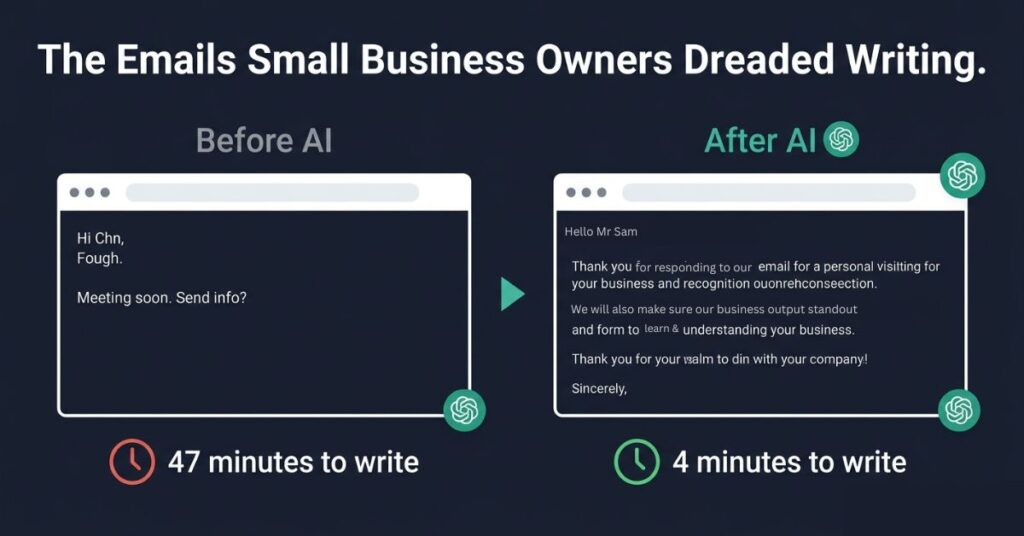
This came up more than anything else. Across every business type, every city, both countries. Small business owners hate writing customer emails. Not because they are inarticulate but because it takes time they do not have and the difficult ones especially the late payment chasers, the scope pushbacks, the complaints sit in draft folders for days.
A consultant in Austin uses Claude for exactly those emails. Every message involving tension of any kind, a client who has not paid, a project going off scope, a deadline that needs pushing. She writes a rough version of what she wants to say and asks the AI to make it clearer and more direct without making it sound aggressive. Four minutes instead of forty.
“I used to sit on those emails for days,” she told me. “Now I send them the same afternoon.”
A letting agency in Leeds, two staff, uses ChatGPT for all their standard tenant communication. Move-in instructions, maintenance acknowledgements, end of tenancy checklists. The owner built the templates one afternoon with AI help. Has not rewritten them since. Every tenancy now gets consistent, professional communication without anyone having to think about it from scratch.
The one that surprised me most was a restaurant owner in Chicago. He uses AI to respond to negative Google reviews. His thing is that his first instinct when he reads a bad review is defensive, he wants to argue back. So he types what he actually wants to say, pastes it into ChatGPT and asks it to keep the substance but take out anything that sounds like he is picking a fight. He reckons it has saved him from at least three public arguments that would have made the original review look small by comparison.
I thought about that one for a while. Using AI not to automate a task but to put a buffer between your emotional reaction and the public record of it. A therapist might find that interesting, it works though.
Sarah Side Of The Story
I want to stay with one story a bit longer because it shows something about how this actually happens.
Sarah runs a solo bookkeeping practice in Columbus, Ohio. Been doing it eleven years, twelve local clients, no plans to scale. Her problem was never the bookkeeping itself. It was the communication surrounding it.
Every single month she was writing the same kinds of emails. Receipt reminders and missing bank statement follow-ups. Quarterly tax explanations written in English that non-accountants could actually read. The same three questions coming from different clients in slightly different forms.
Her nephew mentioned ChatGPT at a family dinner in early 2023. She tried it that night to write a receipt reminder that did not come across as passive aggressive. She had been trying to solve that exact tone problem for two years.
Within about a month she had a complete library of email templates covering every recurring situation in her practice. She now spends maybe forty minutes a month updating them. Before, she was losing close to nine hours a month writing and rewriting the same categories of messages.
Those nine hours did not vanish. She took on a new client with some of it and she finishes earlier on Fridays with the rest. She has not changed her fees, not repositioned anything, no need to build any kind of AI product. She just stopped haemorhaging time on a problem that a tool could handle.
That is what small business AI adoption mostly looks like. Not transformation but time back.
What Are The Things That Never Got Done
Most of the small businesses I spoke to do not have blogs, do not run ads and do not have a content strategy. What they do have is the vague ongoing guilt of knowing they should be posting on social media and mostly not doing it.
AI has partially fixed that for a surprising number of them.
The personal trainer in Edinburgh I mentioned has twelve clients and no marketing budget. Instagram three times a week is her main way of attracting new people. Before she started using AI she would spend twenty to thirty minutes staring at her phone trying to figure out what to write. Now she spends five. She tells ChatGPT what happened with her clients that week, what results someone got, what she has been thinking about and asks for three post ideas. She picks one, edits it until it sounds like her, then posts it.
Her words: “It is not doing my job. It is doing the bit of my job I am rubbish at.”
A bakery in Portland uses AI to write the product descriptions for their weekly online order form. The owner bakes the products, photographs them, then spends about ten minutes describing each item and asking for short appealing descriptions. She used to leave descriptions to last and rush them or skip them entirely. Her average order value has gone up since she started doing them properly. She cannot say for certain that the descriptions are why. She has a theory though.
A freelance photographer in Bristol had a specific problem I had not thought about. He takes good photos but writes terrible delivery emails. Every time he sent a gallery to a client he would write two awkward lines and the client would respond with more enthusiasm than he had shown about his own work. He now spends five minutes describing the shoot to Claude and asking for a warm specific delivery message. His rebooking rate has improved and he thinks the delivery experience is part of it.
Tradespeople Are Using This More Than You Would Expect
Electricians, plumbers, landscapers, builders. Not an obvious fit for AI tools. But I kept coming across examples and they were some of the most practical ones I found.
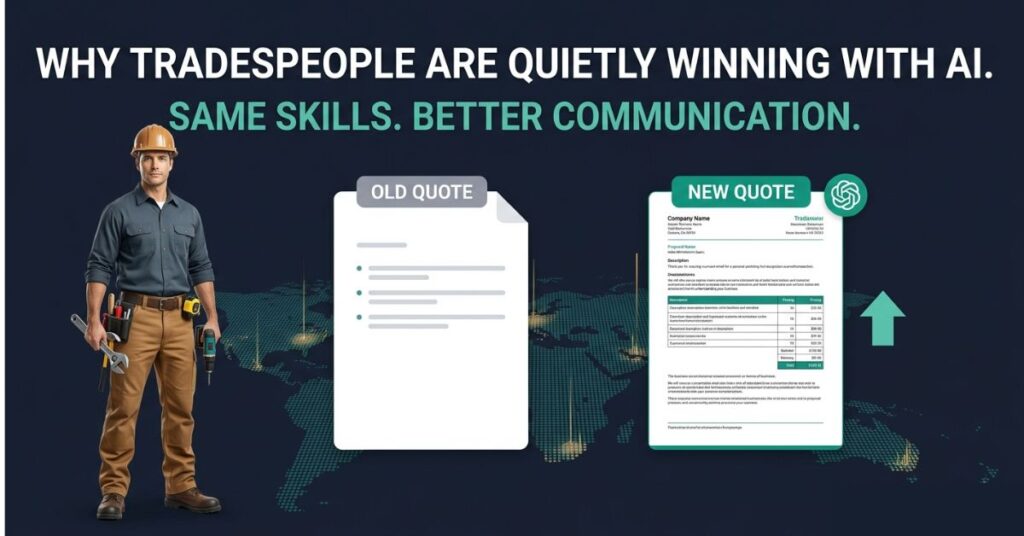
A sole trader electrician in Birmingham uses AI to write his quotes. Not the numbers — he calculates those himself — but the explanatory text that goes with them. He used to send sparse documents with a price and a few bullet points. He lost a job to a competitor whose quote read like a professional proposal. Started using ChatGPT to write the context around his pricing — what the work involves, why certain materials are specified, what the process looks like for the homeowner. His close rate on quotes went up in the months after.
A landscaping company in Connecticut, three employees, uses AI for project proposals and seasonal maintenance reminders. The owner told me he has never been a natural writer and always felt like his written communication made the business look smaller than it was. Now his proposals read the way his work looks. He has not hired anyone to help with that. He just has a better tool.
The pattern across both countries is the same. Tradespeople whose strength is practical physical work have often felt disadvantaged in written communication, the quotes, the follow-ups, the professional-sounding emails that bigger competitors seem to produce easily. AI has levelled that specific thing. The actual skills are entirely theirs. The surrounding communication no longer has to be the weak point.
Admin, Scheduling, and the Hours That Drain Quietly
A physiotherapy practice in Glasgow, two practitioners, uses an AI-assisted intake process. New patients fill in a short form and the system drafts a personalized pre-appointment email based on their specific issue. What to bring, wear or what to expect. The practitioners review and send. About ninety seconds per new patient. One of the practitioners was previously spending the first ten minutes of every new-patient morning writing those emails manually.
A small accountancy firm in Denver has started using AI to produce first drafts of client-facing financial summaries. The accountants do all the actual analysis. Turning that analysis into readable summaries that non-financial clients can follow used to take thirty to forty minutes per client. Now it takes about ten and they have not reduced fees. They have taken on four more clients in the same working hours.
A virtual assistant in London, someone who provides admin support to small businesses as her job uses AI to do a first pass on inbox management for her clients. She reads everything, makes all the decisions, but drafts responses to routine enquiries with AI help. Her output speed has roughly doubled. Her clients think she is incredibly fast. She told me “I have not corrected that impression.”
US and UK with Same Tools, Slightly Different Attitude
Talking to businesses on both sides of the Atlantic, a few real differences showed up.
UK small business owners are noticeably more cautious, particularly around data. GDPR comes up. Several had either checked with a solicitor or read the platform terms carefully before using customer information in AI prompts. One letting agent in Leeds had a written internal policy about what categories of tenant data could and could not go into AI tools. That kind of caution is probably healthy and the UK business owners who had done that groundwork felt more confident in their use as a result.
US small business owners moved faster and asked fewer questions upfront. They found useful workflows quicker. A handful had also used AI in ways that, thinking about it later, might have created issues with customer data they had not considered at the time.
On tools, ChatGPT dominates in both markets on name recognition alone. Claude came up more in UK conversations, specifically among people who had tried both and found it better for longer documents and more nuanced writing tasks. Several US business owners mentioned Gemini appearing in their Google Workspace and trying it out of convenience rather than preference.
On pricing, UK business owners were more likely to have tried paid tiers and cancelled when the free tier felt sufficient. US business owners who had upgraded mostly stayed, usually because they had found one specific feature worth paying for.
Neither market is ahead of the other. Just experimenting with the same tools through slightly different lenses.
What None of Them Are Doing
Worth being clear about this because the distance between the AI conversation and reality runs in both directions.
Almost none of the businesses I spoke to are doing anything technically complex. No API access, custom GPTs with elaborate system prompts, automated multi-tool workflows and AI trained on their proprietary data. One or two had experimented with those things and found them more setup than the benefit justified at their scale.
Nobody is replacing staff. Every business owner who mentioned AI was clear that it was replacing time they personally were spending, not time an employee was spending. A few said AI had let them avoid hiring a part-time admin person they would otherwise have needed. That is real but it is different from replacing someone who already works for them.
And without exception every output gets reviewed before it goes anywhere. Nobody is pressing send without reading. The AI is producing first drafts and human is deciding what actually leaves the building.
That oversight is probably why the failure stories were rare and minor. A tone that felt off and a description too generic to be useful. An email that needed more personalization before it felt like it came from a real person. Nothing that got through and caused damage.
What This Means If You Are a Small Business Owner Reading This
The thing that connects all of these examples is that none of them started with AI. They started with a problem.
Such as the emails taking too long, the quotes looking thin, social posts not happening and same messages being rewritten from scratch every month. Somebody mentioned a tool or a family member showed them something. They tried it for the specific problem they already had and it helped enough to keep using.
Nobody I spoke to would describe themselves as an AI user in any meaningful sense. They would describe themselves as someone who found a faster way to do a thing they were already doing.
If you are a small business owner wondering whether any of this applies to you, that is the frame. Not should I be using AI. Just what is the specific thing you do regularly that takes longer than it should or that you keep putting off because you are not sure how to phrase it or that you rush because you have run out of time for it?
Start there, open ChatGPT or Claude. Describe the problem and see if the output, with your editing and judgment on it, is better than what you were doing before.
For most of the people in this article, the answer was yes. Nothing dramatic happened. They just got a bit of time back and the specific thing got done better than it was getting done before. That turns out to be enough.
A Few Honest Warnings
Customer data going into public AI tools is something to think about before you start, not after. If you are pasting customer names, financial details, health information or anything sensitive into ChatGPT, read the platform’s data policy. ChatGPT has a setting that turns off conversation history and training on your inputs. Claude does not use conversations for training by default on paid plans. Either way, treat any AI tool like a public forum if you would not want that information visible beyond the conversation, anonymize it first. UK business owners especially need to be aware of how this intersects with GDPR obligations.
The outputs need editing because every business owner who was happy with how AI was working had edited the outputs. The ones who used them raw mostly found them generic or slightly off. AI gives you a first draft. You give it the judgment and the specific detail that makes it sound like it came from an actual business with an actual personality.
Not everything benefits from AI help. Technical specifications, anything that needs hyperlocal knowledge or creative work with a very specific voice. Several people tried AI on tasks like these and got back something that was worse than just writing it themselves. Part of using any tool well is knowing which problems it actually solves.
Frequently Asked Questions
I have never used AI tools before, Where do I even start?
Open ChatGPT or Claude in your browser, both have free tiers that do not require a credit card. Pick the single most annoying piece of writing in your business right now. The email you have been putting off. The product description that is still blank. Describe the situation to the AI the way you would explain it to a friend and ask for a draft. Read what comes back. Edit it until it sounds like you. Send it or post it. That is the whole process for getting started. You do not need to understand how it works to use it.
Do I need to pay for the premium version?
Not as a starter, The free tiers of both ChatGPT and Claude handle email drafting, social content, quote writing and template building without any issue. Upgrading becomes worth considering if you find yourself hitting usage limits during busy periods, if you need to upload and work with documents or if you want faster responses. Most small business owners I spoke to started free and a significant number stayed there permanently.
I run a trade business, is this actually relevant to me?
Yes, the highest value application for most trade businesses is quote and proposal writing, follow-up emails and maintenance reminder campaigns. Things that tend to look sparse and unprofessional compared to larger competitors but take real time to do well. AI can produce a solid first draft of any of those from a few bullet points you give it. The practical skills that are the actual business stay entirely yours. The written communication around it stops being a weak point.
How do I stop it sounding generic?
Give it more context upfront. Instead of “write a follow-up email after a quote,” try “write a follow-up email to a homeowner in his 50s who seemed concerned about disruption during the work, emphasising how we manage the process to minimise mess and noise, and keeping it under 150 words.” The more specific you are about who you are writing to and what matters to them, the less generic the output. And then edit it. Add one detail that only you would know. That one detail is usually enough to make it feel real.
Is my customer data safe to paste into these tools?
This one genuinely depends on what data you are using and which platform. If you are in the UK, GDPR is relevant and you should know whether pasting customer information into a third-party AI tool counts as a data transfer under your obligations. Both ChatGPT and Claude have options to limit how your inputs are used for training, look in the settings before you start. The practical safe habit is to anonymize anything sensitive before it goes into a prompt. Replace real names with placeholders. Remove account numbers, health details, anything that would matter if it were visible to someone outside the conversation.
Johnson Alaekezie is the founder of IncomeGigAI. He has spent several years freelancing across writing, content strategy, and digital services and built this site around honest practical content for people doing real work in the digital economy.

Johnson Alaekezie is a freelancer and digital content creator with several years of experience working across writing, content strategy, and digital services. He founded IncomeGigAI to share honest, practical information about building income online without the hype that dominates most of this space. Johnson has worked with clients in the US, UK and beyond, and writes from direct experience rather than theory. He is based in Nigeria and covers the digital income topics he has personally navigated as a working freelancer.