
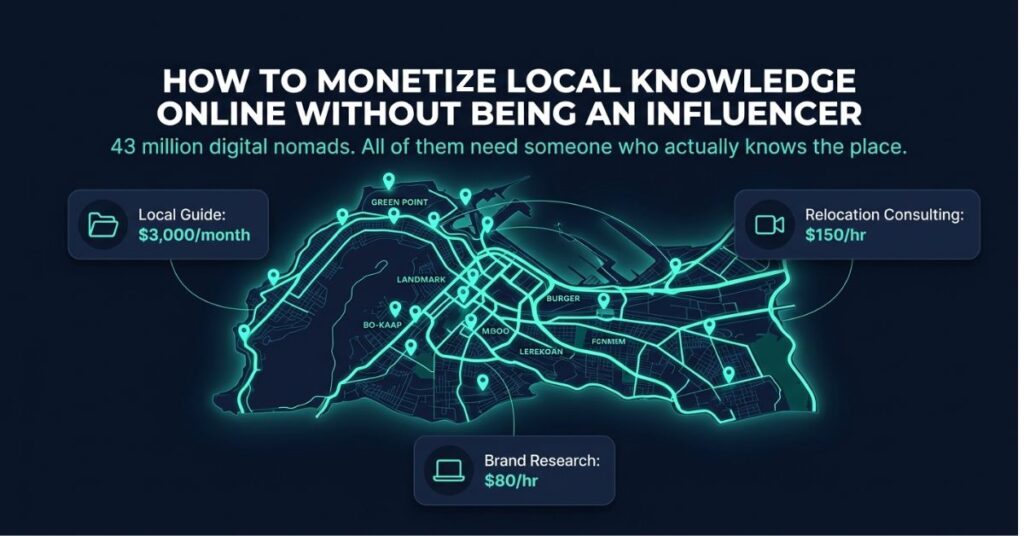
I grew up in Nigeria and spent years navigating Lagos before I started freelancing. When I eventually moved into content work. And I started writing for international clients, I noticed something that took me a while to name properly.
The questions I kept getting was not in client briefs but in real conversations. It were almost never about content strategy or SEO frameworks. They were about Lagos, what it was actually like to run a business there. How banking worked practically for someone without Nigerian citizenship. Which neighborhoods made sense for different types of people. What the official information about various processes consistently got wrong.
I did not think of any of that as a product, it felt like conversation. Like telling someone what I already knew. It took seeing someone else build a real income from the same type of knowledge before I understood what I had been sitting on.
A woman I connected with in an online community had built a $3,000 per month income stream from knowing Lagos better than most people who lived there. Not from a large following or a content studio or a YouTube channel. She wrote detailed relocation guides for professionals moving to Nigeria for work, ran consulting sessions for companies sending staff to Lagos offices and put together curated digital resources for digital nomads arriving in the city without context. The income came entirely from the fact that the information she had was genuinely hard to find elsewhere and people with real money to spend needed it.
That conversation changed how I thought about what I already knew.
The standard online income advice defaults to universal knowledge almost immediately. Build a course about something generally useful. Write about finance or fitness or productivity. These paths work for some people. They are also saturated in a way that local, specific, place-tied knowledge is not. Someone in Manchester who has spent fifteen years inside its restaurant industry, housing market and professional networks has knowledge that a company in New York planning to open a UK office cannot access through any database. That knowledge has commercial value, almost nobody is packaging it.
Nobody Is Writing About Where You Actually Live
The internet resolved a particular type of information gap: general knowledge is now abundant, searchable and mostly free. If you want to understand how supply chains work or what content marketing involves or how to start investing, the resources exist. You can find them in minutes.
What the internet has not resolved is the gap between searchable general information and genuinely useful local knowledge. These are not the same thing and the difference matters more than it might seem.
Reading about a city and having lived and worked in it for a decade produces completely different types of knowledge. The lived version includes what the official information consistently gets wrong. The things that changed recently that the published guides have not caught up with. The informal knowledge that does not appear in any searchable source because nobody has ever thought to write it down in a form anyone else could find.
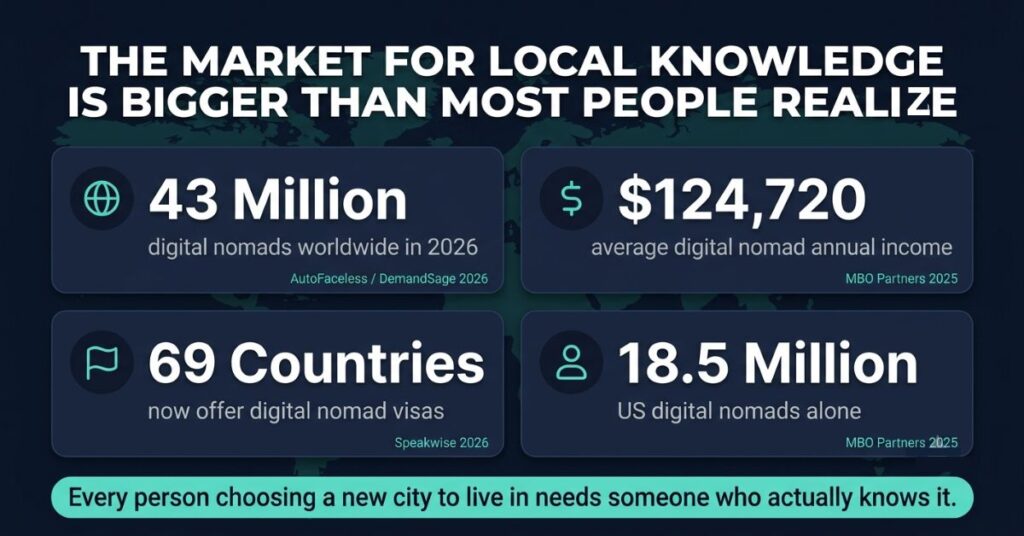
Remote working accelerated this market in a way that is still playing out. The global digital nomad population reached 43 million in 2026, up from 35 million in 2023, according to data from DemandSage and MBO Partners. Each of those people is making practical decisions about places they have never lived. They need information that goes well beyond what a travel blog covers.
Medical facilities in practice rather than on paper. Realistic cost of living including the costs that do not appear in the headline figures. Neighborhood safety that reflects current reality rather than the situation from three years ago when the expat guide was last updated. Visa processes that account for common complications rather than only the ideal case.
As of 2026, 69 countries now offer digital nomad visas or remote work residency programm, creating an entirely new category of person who is actively choosing where to live rather than simply accepting proximity to an office.
The person who has actually navigated all of this and can explain it clearly, in a format that someone arriving in two months can use, has something a lot of people in that situation will pay for. Companies expanding into new markets, investors evaluating real estate, journalists covering stories in cities they do not live in, brands developing location-specific campaigns. All of these represent real demand from people with budgets who cannot get what they need from a Google search.
The Guide You Could Write This Weekend
The most direct way to convert local knowledge into income is to package it as a digital guide and sell it.
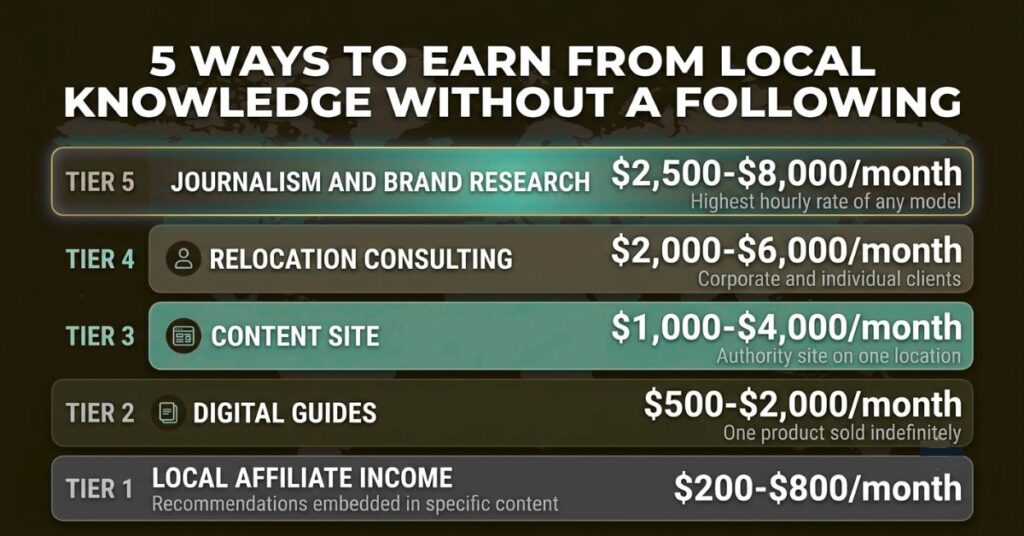
The economics are straightforward, digital products achieve 80 to 90 percent profit margins because there is nothing to manufacture, store or ship. You create the product once and can be sold an unlimited number of times without any additional input from you. For local knowledge specifically, this is unusually well-suited because the information you are packaging is yours to begin with and the cost of production is almost entirely your time.
AI tools that speed up the research and writing process are worth deploying here specifically to reduce the production time without reducing the quality of the local knowledge behind it.
What determines whether a local guide sells or sits untouched is specificity. A guide to Paris is not a product anyone will buy because that information is available everywhere. A guide to finding long-term accommodation in Paris as a non-EU citizen working remotely, covering the specific documents that landlords require, the neighbourhoods that work well for different types of people and the agencies that reliably work with international tenants, is a product because the information in that exact form is not easily available anywhere else.
This is actually an advantage for most people thinking about this. You do not need to know everything about a place. You need to know one specific aspect of it well. The person who went through the process of setting up as a self-employed professional in Berlin has material for a guide that Berlin-based freelancers have been trying to find in reliable form for years. The person who spent six months researching the best international school options in Dubai for children with specific learning needs has material that no general expat guide touches.
Gumroad, Etsy and Sellfy handle the selling infrastructure without requiring you to build a website. For a broader look at digital products more broadly as an income model with honest income expectations, this comparison is worth reading alongside the local guide approach.
Etsy has an established buyer base for digital downloads and location-specific guides consistently appear in search results for relocation queries. A guide priced between $15 and $45 with genuinely specific information can generate sales for years without active promotion because the search intent behind the queries leading to it is strong. The person searching for this exact type of information needs it and will pay for it when they find something credible.
A single guide produces modest per-unit income. Three to five guides covering different aspects of the same location, or different locations you know well from having lived there, start to produce something more meaningful. The compounding happens slowly, it also happens while you are doing other things.
What Companies Pay to Know Before They Send Someone
Digital guides work for standardised information. They do not work for the more complex, individualised decisions that someone is about to spend significant money on and where the stakes make them want a conversation rather than a document.
Companies that regularly send staff to offices in cities where those staff have never worked are willing to pay for incoming employees to be properly briefed. Not the orientation their HR department provides, which is typically about logistics. The real briefing: what the neighbourhood around the office is actually like, which areas work for families with children of different ages, how banking actually works for someone without local citizenship, what the social norms in this specific professional context are and what the common mistakes are that incoming staff regularly make.
I have had versions of this conversation, informally, about Lagos with more people than I can count. People who arrived with incomplete information, made predictable mistakes and wished they had talked to someone who knew the place before they arrived. That informal conversation is a consulting offer that most people with this kind of knowledge have never thought to formalise.
The rate for relocation consulting ranges from $50 to $200 per hour depending on how specialised the knowledge is and whether you are working with individuals or with corporate clients through HR and mobility departments. The corporate route pays better. It also has lower sales friction per engagement because a company managing regular staff relocations wants an ongoing reliable resource rather than a one-time service.
Real estate investors represent another market. Someone evaluating whether to buy property in a city they do not live in needs information that listing sites and market reports do not fully provide. The trajectory of specific neighbourhoods over the last few years and where they seem to be going. What managing property remotely in that specific market practically involves. The realistic picture of tenant demographics by area and how rental demand varies across a city. Investors making significant financial decisions based on incomplete local knowledge are the people most motivated to pay for someone who actually knows.
Building consulting income without an existing following requires being findable by the right people. LinkedIn is the most direct channel for this. A clearly written profile describing what you know and who it is useful for, combined with content that demonstrates the depth of that knowledge, surfaces you to HR managers, relocation coordinators and investors who are actively looking for exactly this. The first consulting client rarely arrives in the first month. The pipeline builds as the content accumulates.
The Version of This That Works and the Version That Does Not
Affiliate income from local recommendations falls into two categories and only one of them is worth pursuing.
The version that does not work in 2026 is writing generic list content about the best hotels or restaurants in a city in order to earn commissions on bookings. The competition for those queries comes from TripAdvisor, Eater, Time Out, Lonely Planet and dozens of other platforms with years of domain authority and enormous link equity. A new local content site cannot meaningfully compete for high-volume travel queries and the small amount of traffic it might attract converts poorly because visitors who arrived from travel searches are not in a buying mindset for services that carry real commissions.
The version that works is affiliate income from recommendations embedded in content that is genuinely specific and useful. A guide covering how to set up as a freelancer in a specific city, with a genuine recommendation for the accounting software most commonly used by local self-employed professionals in that market, earns commission from readers who trust the recommendation because the surrounding content clearly comes from someone who knows what they are talking about.
The affiliate relationships worth developing for this type of content are with services that expats, relocating professionals and international businesses actually use and pay for: international banking through Wise or Revolut, health insurance for international residents, accommodation platforms that cater to longer-term stays, legal and accounting firms that work with foreign nationals in specific markets. These products carry meaningful commissions because the transaction values are higher than typical consumer products and the buyer’s intent at the point of clicking is clear.
Building Something That Earns After You Stop Writing
A content site covering one specific place in depth for one specific type of reader is the slowest model on this list and the most durable one if built properly. An alternative that builds recurring income faster is paid communities built around local or niche knowledge, where members pay monthly for ongoing access rather than for a one-time product.
The principle is that a site covering all of Bangkok for tourists is not findable in any meaningful way. A site covering Bangkok specifically for professionals relocating there with families, covering schools, healthcare, housing and the practical administrative experience in depth, can rank well for the specific queries that audience uses. Those queries are not being served well by generic travel content. Competition is lower. A site built on genuine expertise from direct experience can achieve meaningful search visibility without the domain authority that competing in broad travel content requires.
Online courses alone represent a $200 billion global market and the digital products performing best in that environment are the ones solving specific problems that AI cannot address by synthesising existing content. Local knowledge from direct experience is exactly that type of product. AI tools can aggregate what has been written about a place. They cannot tell you what it is actually like to navigate a specific neighbourhood for a specific purpose right now.
The honest constraint is time. A content site that earns meaningfully takes one to two years of consistent publication. What comes faster, usually within three to six months, is evidence that the audience exists. Search traffic arriving for specific queries, Email subscribers, comments and enquiries from readers who found exactly what they were looking for and want more. That early evidence is what tells you the direction is right before the income follows.
The Model Nobody Mentions and the Highest Hourly Rate
Journalists covering stories in cities they do not live in need local researchers. Not exactly sources. People who can verify information, identify the right contacts, understand the cultural and political context of what they are reporting and translate the lived reality of a place into something a visiting reporter can actually use.
The rate for this ranges from $25 to $100 per hour depending on the outlet, the complexity of the work and what the assignment involves. It is not the easiest income to find but the hourly rate for someone with genuinely deep local knowledge is hard to match in most other categories at the same barrier to entry.
Brands developing location-specific campaigns have a similar need. A company planning a significant launch in a specific market that references local culture needs someone who can tell them whether the references actually land or whether they reveal the kind of shallow understanding that local consumers will identify immediately. That gap between what looks right in a brief and what reads as authentic to someone who lives there is the specific thing being paid for.
These opportunities do not appear through a website or a Fiverr profile. They come through visible presence in the professional networks where journalists and brand managers operate, through LinkedIn content that demonstrates both the depth and the currency of your knowledge, and through relationships built over time with fixers, agencies and journalists who work across multiple markets and regularly need exactly this type of resource.
Getting the first engagement requires establishing credibility before you have proof of it. Writing specifically about the aspects of your local knowledge most useful to media and marketing professionals, and making that writing visible where those professionals spend their time, is the most direct path.
Your Starting Inventory Is Bigger Than You Think
Every model in this article starts from the same place: what do you know about where you live, or where you have lived, that is genuinely difficult to find anywhere else?
Most people underestimate their answer because local knowledge feels ordinary from the inside. The things you know about your city that took years to accumulate do not feel like expertise because they feel like common sense. They are not common sense to someone arriving with a budget and decisions to make, which is the only perspective that matters when you are deciding whether something has commercial value.
The exercise that helps is writing down, without editing yourself, everything you know about your location that fits these categories: what surprised you when you first arrived, what the official guides get consistently wrong, what has changed recently that most published information has not caught up with, what is genuinely difficult to navigate from outside and what you had to figure out the hard way because nothing explained it clearly.
That list is your raw material. Some of it becomes a guide which supports a consulting offer. Some of it becomes the editorial foundation for a content site. The specific model depends on how much time you can invest, what the demand looks like in your particular location and which format the knowledge translates into most naturally.
The income from local knowledge is not quick and it is not passive in any meaningful sense until assets have been built and established. What it is, is genuinely yours in a way that most online income models are not. The knowledge came from your actual life. The product is irreplaceable by someone who has not lived what you have lived.
Frequently Asked Questions
I moved away from the place I know best. Can I still build income from knowledge of it?
Yes, though the shelf life of different types of knowledge varies. Practical navigation knowledge, how specific processes work, which institutions to use for what, what specific neighbourhoods are actually like, stays relevant for two to three years in most stable markets before enough has changed to require significant updating. Cultural context and understanding of professional norms stays relevant longer. Real estate market knowledge dates fastest. The practical approach is to keep one or two contacts in the location who can update you on significant changes, and to flag clearly in any products or guides when the information was last verified. Buyers respond well to honesty about recency. What they do not tolerate is confident guidance based on information that turned out to be outdated.
What if I have lived in several places but do not know any single one extremely well?
Multiple moderate depths of knowledge in different locations is often more commercially valuable than single very deep knowledge of one place, because you can serve a broader range of clients and cover more queries on a content site. A person who has lived and worked in three or four cities for one to two years each has a meaningful firsthand perspective on all of them even if they are not a deep local expert in any one. The key is being honest in how you position the knowledge: firsthand experience from living there rather than claiming the kind of knowledge that comes from having been born and raised in a place.
How long does a local digital guide take to produce?
A properly researched and well-written guide covering one specific aspect of one location typically takes one to two weekends of focused work. The research is mostly drawing on what you already know, verified against current sources. The writing is translating that knowledge into a format a reader unfamiliar with the location can use. Formatting, cover design and platform setup add a few hours. The instinct to make the first guide perfect before publishing it is the main thing that slows most people down. A guide that is good and published outperforms a guide that is excellent and still in draft.
What platforms do journalists use to find local researchers?
The most active hiring channels for local research are journalism job boards like Journalism Jobs and MediaBistro, the HARO (Help a Reporter Out) platform where journalists post requests for specific expertise, LinkedIn for direct connection with journalists and editors covering a beat that touches your location and the journalism communities on specific Slack groups and Discord servers where freelance journalists and editors gather. Having published content that demonstrates your local knowledge before you pitch yourself as a research resource makes the pitch significantly more credible. Journalists want to see evidence of what you know before they commit editorial time to verifying it themselves.
How do I handle it when my local knowledge is partly outdated because things changed?
Update the relevant sections of any product or guide and republish. On Gumroad and Etsy this is straightforward and customers who previously purchased typically receive access to the updated version automatically. For consulting, be explicit in any session where information might be dated and distinguish between what you know from direct experience and what you have verified more recently. The trust damage from confident guidance that turns out to be wrong is significantly worse than the discomfort of saying this was accurate when I left two years ago and I would recommend verifying the current process through this specific source. Clients and readers respond better to honest boundaries than to false confidence.

Johnson Alaekezie is a freelancer and digital content creator with several years of experience working across writing, content strategy, and digital services. He founded IncomeGigAI to share honest, practical information about building income online without the hype that dominates most of this space. Johnson has worked with clients in the US, UK and beyond, and writes from direct experience rather than theory. He is based in Nigeria and covers the digital income topics he has personally navigated as a working freelancer.