
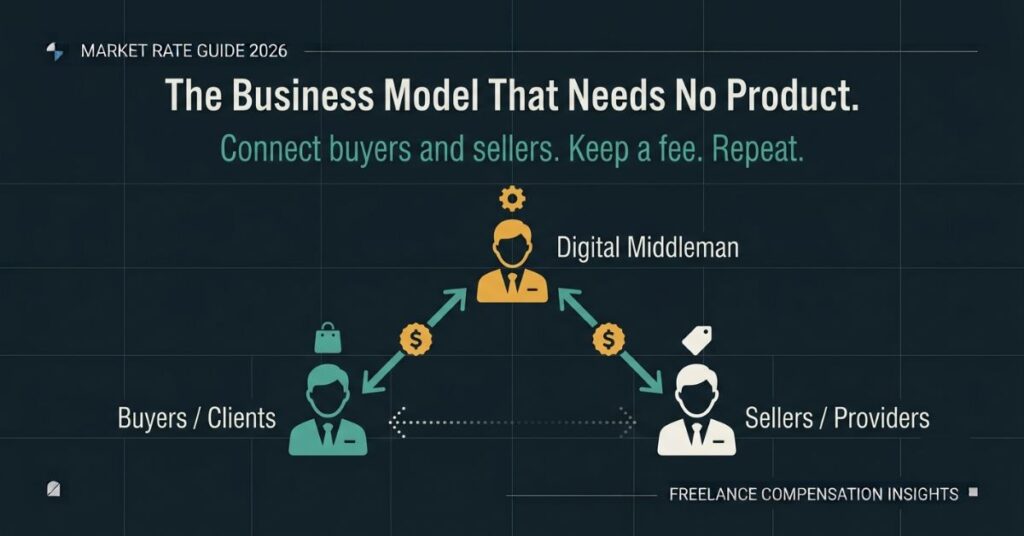
A friend of mine makes money connecting podcast hosts with guests. That is the whole business. He does not produce a podcast, he does not help anyone start one. What he do is to maintain a database of people who want to be interviewed on podcasts in specific niches, charges those people a monthly fee to be in the database and charges podcast hosts a smaller fee to search it and make contact. It only require building the database over about four months, has around 400 paying members on the guest side and spends maybe ten hours a week on it.
He created nothing and sells nothing he made. He just sits in the middle of a transaction that was going to happen anyway and gets paid for making it happen faster and more reliably than it would without him.
I had known him for two years before he told me about this. When he did, I spent about a week trying to figure out why I had never thought about building something like it.
How It Actually Works
You find people who need something and also find people who provide that thing. You connect them and take a fee, either from one side or both, either once or on a recurring basis.
That is the core. What makes it interesting is what you are not doing. You are not creating the thing being transacted. The podcast guest brings their own expertise and the podcast host brings their own platform. The freelancer in a curated directory brings their own skills while the supplier in a matching service brings their own products. You are the connective tissue not the substance.
What this changes about starting is significant. As there’s no need for inventory, portfolio or skill you need to sell. What you need is a clear picture of where the connection gap exists in a specific market, and enough credibility to be trusted by both sides while you fill it.
It sounds simple when written out like that. In practice it takes real market knowledge and real relationship building. But the starting costs, financial and technical are lower than almost any other online business model I am aware of.
Why Nobody Talks About This Model
Most online business content focuses on things you can build and own outright. A course, a product, a service based on a skill, a software tool. The middleman model gets far less coverage for reasons that are not hard to understand once you look for them.
It is harder to package into a course. “Build a curated directory in a niche you understand” is not as teachable as “learn these five copywriting frameworks.” The path depends too heavily on specific market knowledge to turn into a repeatable curriculum that sells at scale. So nobody builds the course and the model stays underexposed.
It also looks unglamorous. Running a matchmaking service for freelance developers and small tech companies does not sound as impressive as running a SaaS business or a content agency. The economics of a well-run middleman business are often better than either. But you would not know that from how infrequently it comes up in the spaces where online business ideas get discussed.
What This Looks Like in Practice
The concept makes more sense with specific examples. Here are the ones I have come across that are actually running.
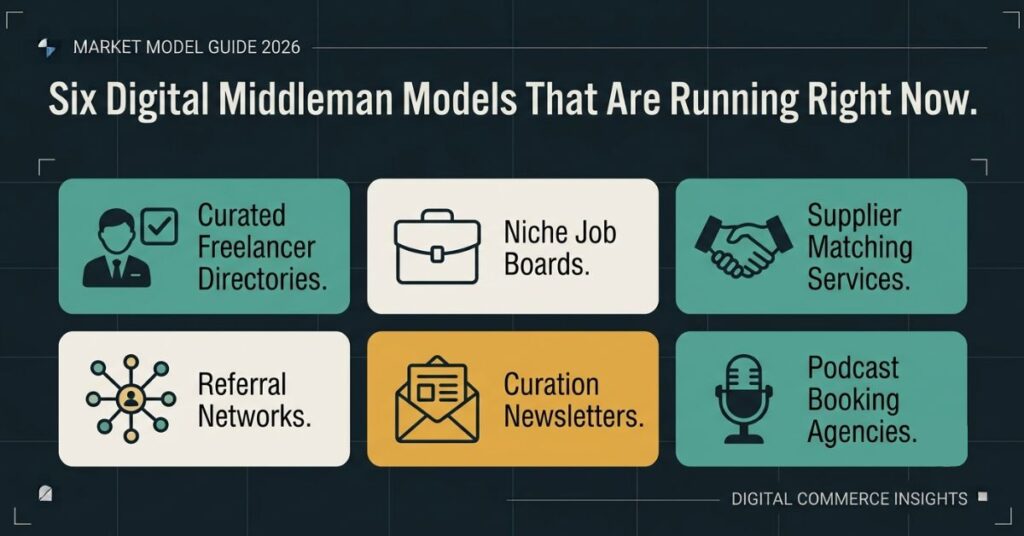
Curated freelancer directories are probably the most common version not Upwork or Fiverr. Smaller, more specific, more selective. A directory of vetted TypeScript developers for startup clients, a directory of freelance compliance writers for fintech companies and directory of bilingual marketing consultants for US companies expanding into Latin America. Clients pay for access because the vetting saves them time and reduces risk. Freelancers pay for the listing because the leads are qualified rather than competitive with thousands of strangers. The directory owner charges on both sides and does not do any of the actual work.
Niche job boards work on the same principle with a slightly different structure. A board specifically for remote jobs in climate tech, UX writing roles at B2B SaaS companies, fractional CFO opportunities, companies pay to post, candidates pay for premium alerts or early access, the specificity is the product. A climate tech job seeker would rather search one focused board than filter through hundreds of irrelevant listings on a general platform.
Supplier and buyer matching services connect two communities that have mutual need but poor visibility of each other. Small e-commerce brands looking for niche suppliers they cannot find on Alibaba. Interior designers who want to work with independent furniture makers. Independent restaurant owners looking for local food producers. The middleman builds relationships with both sides and takes a fee for introductions that lead somewhere.
Referral networks are a lighter-weight version of the directory model. A group of freelancers or service providers who refer overflow work to each other, with a percentage of the referral fee going to whoever runs and maintains the network. Less infrastructure than a directory, more relationship management. My friend’s business is close to this model, though he has formalised it more than most referral networks do.
Content and deal curation newsletters operate on a slightly different logic. A weekly email aggregating the best equipment deals for restaurant owners. A newsletter for independent pharmacists covering regulatory changes and supplier promotions. The audience pays for the curation because finding that information themselves would take more time than the subscription costs. Advertisers pay to reach the audience. The operator makes money on both sides without producing the underlying information.
Podcast and speaking booking services are an active version of what my friend runs passively. Rather than just maintaining a database, an agency pitches clients to relevant shows and events, handles the scheduling, manages the relationship with the host side. Clients pay a monthly retainer or a per-booking fee. Show hosts get a curated pipeline of relevant guests. The agency earns from the client side and sometimes takes a percentage of speaking fees.
The Financial Logic
What makes middleman businesses financially interesting is low marginal cost at scale.
Harvard Business Review published one of the clearest breakdowns of two-sided marketplace economics that explains why this model has structural advantages that single-sided businesses do not.
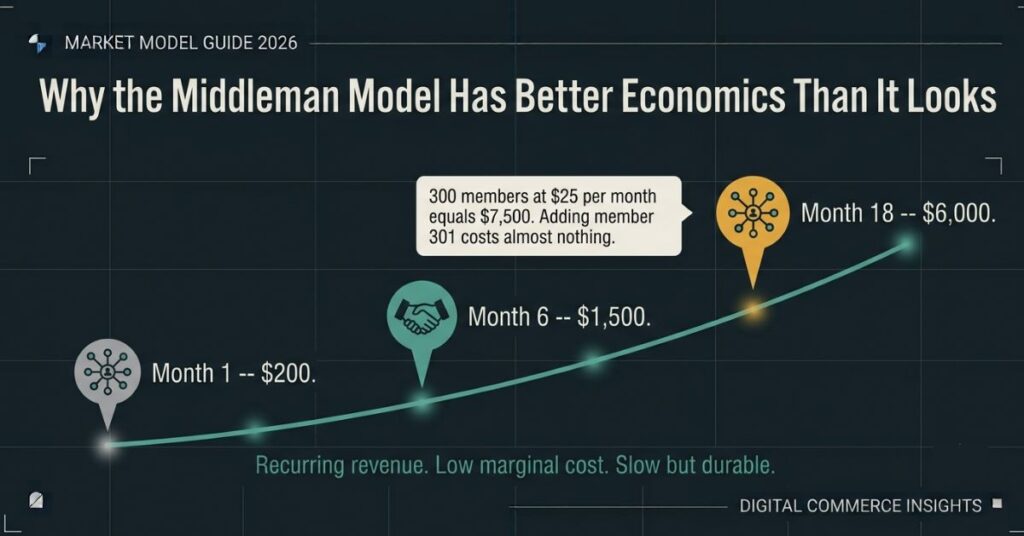
If you run a curated directory with 300 paying members at $25 per month, that is $7,500 per month. Adding a 301st member costs you almost nothing. A few minutes to review and approve a listing. Your costs do not scale with your revenue the way they do in a product business where each additional sale requires additional goods, labor or delivery.
That is the same economic structure that makes software businesses attractive, without the upfront cost of building software. A directory can run on Airtable or Notion with a Stripe payment link. Many successful early-stage middleman businesses were built entirely on free infrastructure.
The recurring revenue piece matters too. A business generating $5,000 per month in subscriptions is worth more than one generating $5,000 per month in one-off transactions because subscription revenue continues without reselling every month. Churn needs to be managed but a stable subscriber base creates a financial floor that project-based income does not provide.
Recurring subscription income is more durable than project income but collecting it reliably still requires the same discipline around payment terms and follow-up that any freelance business needs.
Honest caveat: the build is slow, unlike a product launch where the right marketing can generate significant revenue in a week, a subscription middleman business typically grows gradually. Month one might be $200, month six might be $1,500 while month eighteen might be $6,000. That trajectory is real so, is the patience it requires.
Finding a Good Opportunity
There is no formula for this as it requires knowing a market. But there are questions that reliably point toward viable opportunities.
Where is there a search problem? A search problem exists when the people who need something struggle to find the right version of it efficiently. Clients who cannot find the right kind of specialist, job seekers who cannot find the right kind of role and buyers who cannot find the right supplier. Wherever search is consistently inefficient, there is a potential middleman business.
Where is there a trust problem? Sometimes people can find the options but cannot tell which ones are good. A curated directory solves trust more than search. If you have credibility in a space and can be trusted as the person doing the vetting, that credibility is a real asset that takes time to replicate.
Where do you already have relationships on both sides? The easiest middleman business to start is one where you already know people on both sides of the market. A freelancer who knows both small business owners and other freelancers is positioned to run a referral network immediately. A person who has worked in supply chain and has relationships with buyers and suppliers can start a matching service in that niche without cold outreach to either side.
Building the First Version
Less infrastructure than you would expect.
For a directory or database: Airtable’s free tier handles hundreds of records, Notion works similarly. For a public-facing version with paid access, tools like Memberspace or Memberful or even a Carrd site with a Stripe payment link, get you to a working paid membership in a day.
A well-built Google Sheet can serve as the backend for an early-stage directory before you need anything more sophisticated, our guide to making money from Google Sheets covers the infrastructure side of that in detail.
For a niche job board: Niceboard and Jobboard.io let you launch without building anything from scratch. They handle listing management, search and payment collection from companies who post.
For a curation newsletter: a free Beehiiv or Substack account is enough to start, the newsletter is the product. You grow subscribers, then monetize through paid tiers, sponsorships from relevant suppliers or both.
For a referral network: no technology at all is required at the beginning. A shared spreadsheet, a group chat and a clear agreement on how referral fees work is enough for the first twenty members. The technology comes later when the manual version has proven the concept.
The mistake I see most often in this model is spending months building infrastructure before validating whether anyone will pay for what is being built. The better path is the simplest possible version, get ten paying participants, and use their feedback to decide what to build next.
Getting the First Ten Members
The first ten are always the hardest.
Your middleman business in month one has no proof it works, no reviews, no track record. The only reason someone joins is because they trust you personally. That means first members almost always come from your existing network, people who know you well enough to believe you will follow through even when the product is unpolished.
The chicken and egg problem is real for any two-sided platform. You need developers in the directory before clients will pay to access it and you need clients interested before developers will pay to be listed. The solution is almost always to seed one side for free, offer the first twenty developers free listings while you sell client-side access. Once you have ten developers listed, you have something to show clients. Once two or three clients are paying, you have proof to show developers that the directory generates leads.
Charge from the start, even at a small number. Free early access feels generous but it tells you nothing about whether people value the thing enough to pay. Ten people paying $15 per month tells you something real. One hundred people using something free tells you much less.
Running Both Sides
This is the operational challenge most writing about the middleman model skips. You are serving two distinct groups with different frustrations and different definitions of success.
A client who hires a freelancer from your directory and has a bad experience blames the directory. A freelancer who pays for a listing and gets no leads also blames the directory. Both are your problem even though you caused neither failure directly.
The businesses that handle this well set clear expectations on both sides upfront. Not selling the dream of what the directory might become. Telling clients exactly what they are accessing and what they are not. Telling freelancers exactly what a listing provides and what the lead generation process actually looks like in the current stage of the platform.
Quality management is the other piece. When you have ten members you know everyone and catch problems early. At three hundred members you do not. Building even simple quality systems, a review process, a complaints intake, a minimum activity threshold for listed members, before you need them is significantly easier than building them after a quality problem has already damaged your reputation with one side of the market.
Where It Goes Over Time
The middleman businesses that reach maturity tend to become self-reinforcing. More clients come because more good freelancers are listed. More freelancers pay to be listed because more clients are searching. The value of being on the platform increases as the platform grows and replicating it becomes harder because you cannot just build a better interface. You have to replicate the network, which is the part that takes years.
Most middleman businesses in the niche spaces we are talking about do not reach true marketplace scale. But they reach a point where churn is low, word of mouth drives most new members, and the owner is doing relatively little to maintain something that generates consistent monthly revenue.
My friend’s podcast guest database is at that point. He is not growing dramatically. He is not working hard to maintain it either. The members stay because the value is consistent and leaving would mean starting the search for podcast opportunities from scratch somewhere else. That is a genuinely good place to be in a business.
Risks That Are Worth Knowing About
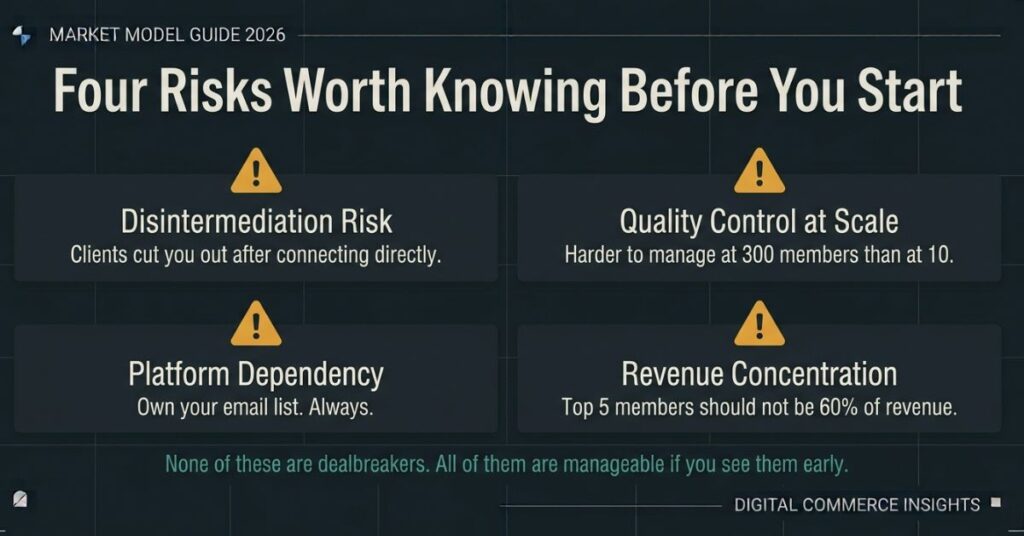
The disintermediation risk is the one specific to this model. If you connect a client and a freelancer successfully enough times, they may decide to cut you out and work directly. This is most common in referral networks where the connection is personal rather than platform-based. The defense is building enough ongoing value into the platform itself, not just the initial connection, that leaving costs more than staying. A directory with active community, regular new leads and useful resources is harder to abandon than a one-time introduction service.
Quality control gets harder at scale, at ten members it is manageable manually. At three hundred it is not and problems that get caught late cost more than problems caught early. Build simple quality systems before they feel necessary.
Platform dependency matters if your business runs on someone else’s infrastructure. A newsletter built entirely on Substack depends on Substack’s pricing and terms. A community built entirely on a Facebook group depends on Facebook’s algorithm. Own your member email list regardless of what platform you use to communicate with them. Email addresses are more durable than any platform relationship.
Revenue concentration is a quiet risk. If five paying members represent sixty percent of your revenue and two of them leave in the same month, the impact is serious. Broad distributed revenue across many smaller participants is more stable than heavy dependence on a few large ones, even if the large ones feel like they validate the model.
Frequently Asked Questions
I have no connections in the niche I want to build in. Can I still do this?
It is harder but not impossible. The starting point in that case is spending real time in the community before trying to monetize it. Join the relevant forums, LinkedIn groups, Discord servers, or industry events. Contribute genuinely for three to six months before you try to build anything on top of the relationships you develop. Middleman businesses built by outsiders who parachuted in with a platform and no existing trust almost always struggle to recruit the first side of the market. The ones that work are almost always built by someone who was already known and respected by at least one side before they started.
What is a realistic income expectation for the first year?
For most people building a niche middleman business alongside other work, reaching $1,000 to $2,000 per month by the end of the first year is achievable if the market has genuine demand and the founder has real relationships to draw from. Some do significantly better, particularly if they already have a large relevant audience. Some do worse if the market turns out to be smaller than it appeared or if the chicken-and-egg problem takes longer to solve than expected. The businesses that generate nothing after twelve months of effort are almost always ones where the founder built infrastructure before validating whether anyone on either side would actually pay.
How do I prevent people from connecting through my platform and then cutting me out?
You cannot prevent it entirely. What you can do is make the ongoing value of the platform greater than the hassle of leaving. A directory that just makes one introduction and then goes quiet is easy to abandon. A directory with active curation, regular new leads, community events or proprietary resources gives members reasons to stay that go beyond the initial connection. Recurring value is the only real defense against disintermediation in this model.
Can I run a middleman business in a market I currently work in as a freelancer?
Yes and your existing position is an advantage. You already have credibility on one side of the market. You understand the frustrations on both sides from direct experience. You have relationships to draw on for early members. The main thing to be thoughtful about is whether running a directory that includes other freelancers in your niche creates any conflict with your existing client relationships. In most cases it does not, particularly if your directory serves a slightly different client segment than your own freelance work targets.
Does this work internationally or is it mainly a US and UK opportunity?
The model works in any market where there is a genuine connection problem between two groups. Some of the most interesting niche middleman businesses I have come across serve very specific geographic or industry niches that have nothing to do with the US or UK. A supplier matching service for West African food producers and European importers. A directory of Arabic-speaking UX designers for Middle Eastern product teams. A job board for remote work opportunities in the East African tech sector. The requirement is not a US or UK market. It is a market where two sides have a connection problem and at least one of them has enough economic activity to pay to solve it.

Johnson Alaekezie is a freelancer and digital content creator with several years of experience working across writing, content strategy, and digital services. He founded IncomeGigAI to share honest, practical information about building income online without the hype that dominates most of this space. Johnson has worked with clients in the US, UK and beyond, and writes from direct experience rather than theory. He is based in Nigeria and covers the digital income topics he has personally navigated as a working freelancer.