
I started asking this question after a conversation with a reader who emailed to say she could not afford any of the AI tools she kept seeing recommended. She had been freelancing for eight months, was not yet making consistent income and every article she read about AI for freelancers assumed she had $50 to $100 per month to spend on subscriptions she had not budgeted for.
Her question was simple; can you actually run a freelance business on free AI tools alone or is the free tier just a demo that forces you to upgrade?
I did not know the answer confidently enough to just tell her. So I spent several weeks talking to freelancers who had deliberately tried to stay on free tiers, some out of financial necessity and some out of curiosity.
Free Tiers That Actually Exist in 2026
The landscape shifts regularly so it is worth being specific about what is available right now before getting into what people found when they used it.
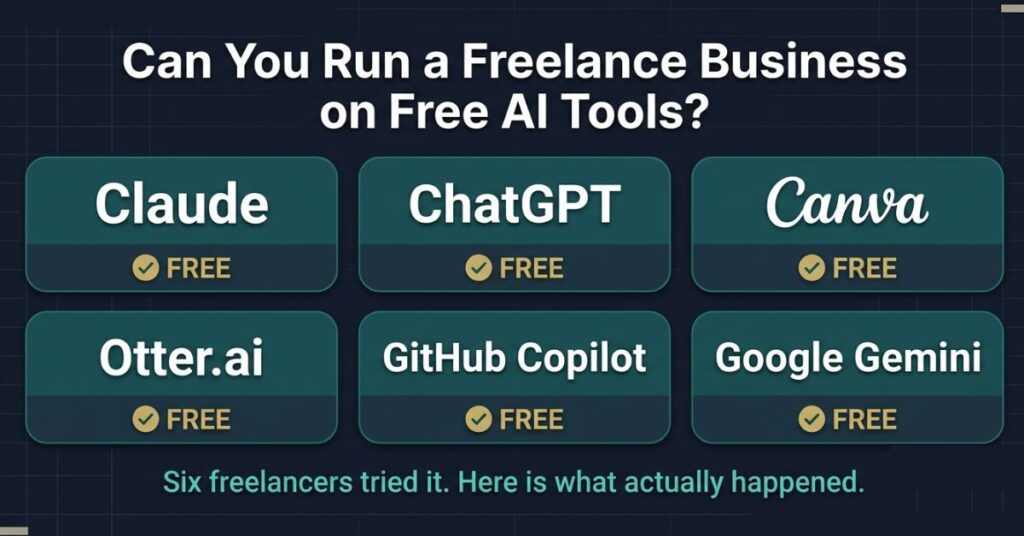
ChatGPT free gives access to GPT-4o mini with usage limits. Claude free gives access to Claude Sonnet with a rolling 5 hours window that resets 5 hours from your very first message. Google Gemini free includes Gemini 1.5 Flash. Perplexity AI’s free tier covers basic search with limited Pro searches per day. Canva free covers a substantial portion of the platform’s design functionality. Otter.ai free gives 300 transcription minutes per month. Notion free includes basic AI features for individual users. GitHub Copilot free covers 2,000 code completions per month. Grammarly free handles basic grammar and clarity.
None of these are unlimited, the question I was trying to answer is whether the restrictions make them practically useless for real work or whether they are workable with some adjustment.
What the Freelancers Actually Found
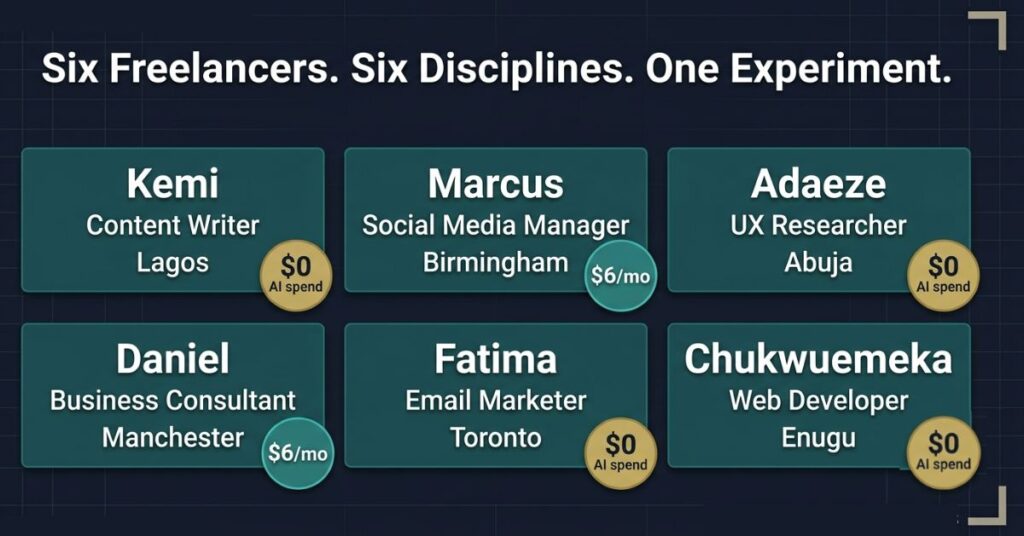
I spoke to six freelancers who had spent at least three months working deliberately within free tiers. Two were just starting out and genuinely could not afford subscriptions. Two were established freelancers who ran the experiment out of curiosity. The rest were somewhere in between, making some income but watching costs carefully.
Kemi, freelance content writer in Lagos
Kemi has been freelancing for fourteen months. She writes blog content and email sequences for small businesses, mostly US and UK clients she finds through Upwork. She has never paid for an AI tool.
Her workflow is built around Claude’s free tier for drafting and ChatGPT free tier as a backup when she hits Claude’s daily limit. She uses Grammarly free for a final pass on grammar and clarity. Canva free for any simple graphics clients ask for alongside written content.
“The daily limit on Claude is the main thing I work around,” she told me. “I learned quickly to do my most AI-intensive work in the morning when the limit has just reset. By the afternoon if I have used it heavily I switch to ChatGPT. Between the two I have never had a day where I genuinely could not do the work.”
Her honest assessment of where the free tier falls short: “When a client wants a very long piece, like 3,000 words in one session, Claude sometimes cuts me off mid-draft. I have learned to break longer projects into sections and work through them across two days. It is a workflow adjustment, not a dealbreaker.”
Her income from freelancing is around $1,400 per month at the time we spoke. Her AI tool spend is zero.
Marcus, freelance social media manager in Birmingham
Marcus manages social media for four small business clients. He schedules content, writes captions, designs simple graphics and does basic analytics reporting. He ran a deliberate three-month experiment staying entirely on free tiers after seeing how much the tool subscriptions were adding up across his business.
His stack: ChatGPT free for caption writing and content ideas, canva free for graphics, Google Gemini free for research and first-pass content planning and Buffer’s free tier for scheduling up to three social accounts.
“Canva free is the one that surprised me most,” he said. “I honestly expected to need the Pro version within the first month but I still use it for free. The template library is enormous and the features I actually use day to day, resizing, simple animations, basic brand colors are all there.”
Where he ran into the wall: “Buffer’s free tier limits you to three social accounts and I have four clients. I manage the fourth client’s scheduling manually through native platform schedulers. It is annoying but manageable.”
He upgraded exactly one tool during the experiment: he eventually paid for Buffer’s Essentials plan at $6 per month because the manual workaround for the fourth client was costing him more time than the subscription cost. Everything else stayed free.
“The honest answer to the question is yes, you can run this kind of business on free tools. But you will hit one or two specific limits that might push you to upgrade one thing. The key word is one thing, not everything.”
Adaeze, freelance UX researcher in Abuja
Adaeze conducts user research for product teams, mostly for startups in the UK and Europe. Her work involves user interviews, synthesis, and presenting findings in clear reports. She started freelancing sixteen months ago and has stayed on free tiers throughout.
Her AI stack: Otter.ai free for transcribing user interviews. Claude free for synthesising notes and drafting insight reports. Notion free for organising research and client deliverables.
The Otter.ai free tier gives her 300 transcription minutes per month. She runs roughly eight to ten user interviews per month at around thirty minutes each. That is 240 to 300 minutes of transcription, which sits right at the limit.
“In a busy month I hit the limit before the month ends,” she told me. “When that happens I switch to Google’s free transcription in Google Meet, which is less accurate but functional for taking notes. I have had a couple of months where the accuracy problem cost me extra time cleaning up transcripts.”
She has considered upgrading Otter but has not yet because the workaround, while annoying, has been manageable. Her income from freelancing at the time of our conversation was around $2,100 per month.
Her overall verdict: “Free tools got me to this income level. At some point when the business is more established I will probably pay for better transcription. But I did not need to pay to get here.”
Daniel, freelance business consultant in Manchester
Daniel is the most established freelancer in this group. He has been consulting independently for four years and ran a deliberate two-month experiment to understand what the free tier experience was like after reading an article that assumed everyone had a fully paid AI stack.
His baseline before the experiment: he was paying for Claude Pro, ChatGPT Plus and Perplexity Pro. His experiment involved switching all three to free tiers and tracking where he hit friction.
“Claude free is genuinely good for the work I do. I write a lot of documents and strategic frameworks and the quality difference between Claude free and Claude Pro for that kind of work is smaller than I expected. The limit is the issue not the capability.”
On ChatGPT: “GPT-4o mini on the free tier is noticeably less capable than GPT-4o for complex analytical tasks. When I am doing market analysis or synthesising research, I felt the difference. For writing and editing tasks, much less so.”
On Perplexity: “The free tier limits you on Pro searches, which are the ones with deeper sourcing. For quick research it is fine. For client work where I need to be confident in my sources it was not enough.”
He went back to paid tiers after the experiment, but his conclusion was nuanced. “If I were starting out, free tiers would get me through the first year without question. The gaps become significant when you are doing high-volume, research-heavy work at a senior level. At an earlier stage, those gaps are less relevant.”
Fatima, freelance email marketer, Toronto
Fatima writes email sequences and campaigns for e-commerce brands. She is fourteen months into freelancing and has used only free tools throughout.
Her stack: Claude free and ChatGPT free alternating based on daily limits. Canva free for any email template visuals. Mailchimp free tier when clients ask her to manage sending as well as writing.
Her biggest free tier frustration was not about AI writing tools at all. It was about Mailchimp. “The Mailchimp free tier limits you to 500 contacts and 1,000 emails per month. That is fine for a tiny client but one of my clients grew past that threshold and I had to tell them they needed to upgrade their own Mailchimp account. It was an awkward conversation but ultimately their account, their cost.”
On the AI writing side she had almost no complaints. “I use the tools for drafts. The limits mean I work in batches rather than continuously. It is not how I would choose to work but it is workable.”
Her income from freelancing is around $1,800 per month.
Chukwuemeka, freelance web developer in Enugu
Chukwuemeka builds websites and landing pages for small businesses. He is eleven months into freelancing and has used free tools throughout, partly out of financial caution and partly because he wanted to understand what was genuinely necessary.
His AI stack is minimal. GitHub Copilot free tier for code suggestions, Claude free for debugging help and documentation writing. Google Gemini free for research.
“GitHub Copilot’s free tier is 2,000 code completions per month,” he told me. “That sounds like a lot. I hit the limit before the end of the month pretty regularly. When I do, I use Claude to help with specific problems rather than the inline suggestion mode. The two together cover most of what I need.”
He was direct about one thing: “For complex projects with a lot of code generation, paid Copilot or a paid Claude plan would probably save me real time. But I am not at a stage where saving that time is worth the subscription cost versus what I earn. When my income doubles, my tool spend will probably double too. Right now, free is working.”
What Six Freelancers Found
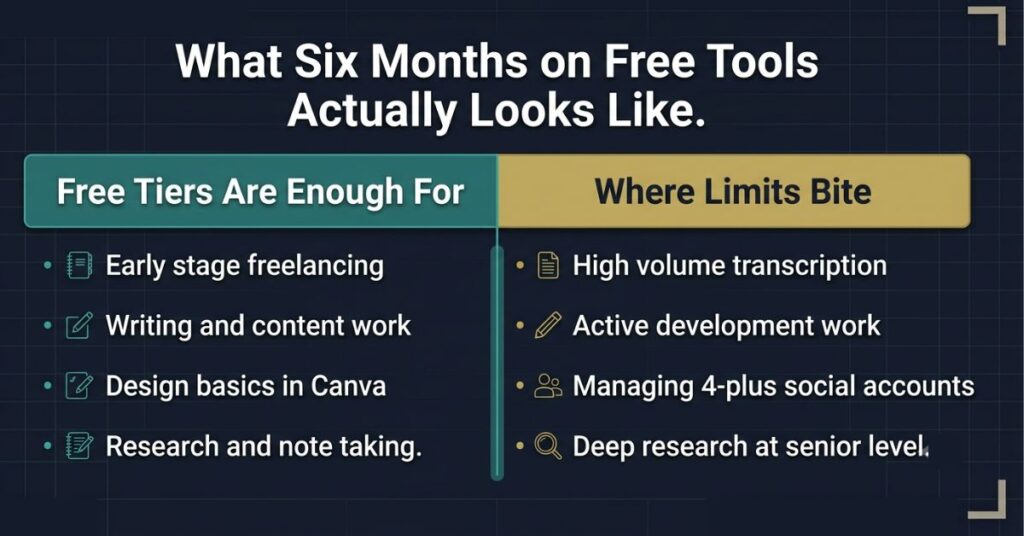
Across six different disciplines, the pattern was consistent enough to say something real about.
All six people were generating income from freelancing. None of them described free tool limitations as the thing preventing them from growing. The limits created workflow inconveniences, not business blockers, that distinction matters.
Where the limits bit hardest depended entirely on the type of work. For content writers and marketers, the daily message limits on Claude and ChatGPT were the main friction. The quality of free tier output is one dimension of this. The other is what happens to your writing when you rely on AI tools heavily over time, which we covered honestly in a separate article. Most people learn to spread heavy AI use across the day or across two tools within the first few weeks of adjusting.
For Adaeze doing interview-heavy UX research, Otter.ai’s transcription minutes were more significant than any writing tool limit. It is one of several tools covered in depth in our breakdown of the AI tools freelancers are using to increase their output, which is worth reading alongside this one if you want to understand where each tool fits in a real workflow. For Chukwuemeka doing active development work, GitHub Copilot’s monthly completion count became relevant in busy months.
Almost everyone hit one specific limit that made them consider upgrading. Most had not upgraded yet. Marcus was the exception, paying $6 per month for Buffer’s Essentials plan because the manual workaround for his fourth client was costing him more time than the subscription cost. That calculation, whether the workaround costs more than the fix, is probably the clearest decision framework for when to upgrade anything.
Daniel’s downgrade experiment is the most instructive data point for anyone further along in their freelancing. He found the free tiers adequate for starting but felt the gaps more acutely because his work volume and complexity is higher than someone in their first year. The free tiers are mostly rate-limited versions of the paid tiers not stripped-down ones. If your volume is modest, the limits often do not bite. If your volume is high they become a consistent bottleneck.
So, Can You?
Yes, the six freelancers I spoke to are building real businesses on free AI tools, at income levels between $1,400 and $2,100 per month. The workflow adjustments are real but learnable. Almost everyone finds one specific tool where the limit is genuinely painful for their work type and that is usually the one thing eventually worth paying for.
For developers specifically, AI integration skills are among the fastest growing in freelance demand right now according to Upwork’s 2026 data, which we broke down in a separate piece.
To the reader who emailed asking whether free tools were enough to start: yes. Start with what you have. Pay for something when the time savings justify the cost not because free feels somehow less legitimate.
Frequently Asked Questions
Which free AI tool is the best starting point for a complete beginner?
Claude’s free tier is the most versatile starting point for most freelance writing, content and analysis work. The output quality is high, the interface is simple and the daily limit resets every 24 hours so you are never permanently blocked. ChatGPT free is a useful backup for when you hit Claude’s limit. Between the two, most freelancers in early stages have more than enough capacity for a normal working day.
What happens when you hit the daily limit on Claude’s free tier?
The conversation window stops accepting new messages until the limit resets, which happens every 5 hours. You are not locked out of your previous conversations and you can still read them. You just cannot generate new responses. Most freelancers who hit this regularly either switch to ChatGPT free for the rest of the day or structure their work so the most AI-intensive tasks happen early in the day before the limit is reached.
Is Canva free genuinely enough or does it push you toward Pro constantly?
Canva does prompt you to upgrade regularly, particularly when you try to access Pro-only templates or features. But the free template library is large enough and the core features, resizing, basic animations, brand colours with manual input are available without paying. Marcus from this article ran a social media management business for three months entirely on Canva free. It is not the same as Pro but it is functional for most basic design work a freelancer produces for clients.
Are there any AI tools where the free tier is genuinely unusable for professional work?
Jasper and some other AI writing tools specifically designed for business content have free tiers so limited, often just a trial period rather than an ongoing free option, that they are not viable for sustained professional use without paying. Midjourney has no free tier at all as of 2026. For image generation on a free tier, Adobe Firefly’s free credits and Microsoft Designer through Bing are the most functional options, though both have usage limits. The tools with genuinely functional free tiers for freelance work are the ones covered in this article: Claude, ChatGPT, Google Gemini, Grammarly, Canva, Otter.ai, Notion and GitHub Copilot.
When should I actually upgrade from free to paid?
When a specific limit is costing you client work or a meaningful amount of time per week and the subscription price is less than what that time is worth to you. Not because you feel that paid tools are more professional or because you read that serious freelancers use paid tiers. Those are bad reasons, the good reason is that a specific thing in your specific workflow is genuinely broken by a specific limit and the fix costs less than the problem. Most people find that moment arrives for one tool, not all of them at once. Upgrade that one thing and leave the rest on free until they earn an upgrade too.

Johnson Alaekezie is a freelancer and digital content creator with several years of experience working across writing, content strategy, and digital services. He founded IncomeGigAI to share honest, practical information about building income online without the hype that dominates most of this space. Johnson has worked with clients in the US, UK and beyond, and writes from direct experience rather than theory. He is based in Nigeria and covers the digital income topics he has personally navigated as a working freelancer.