
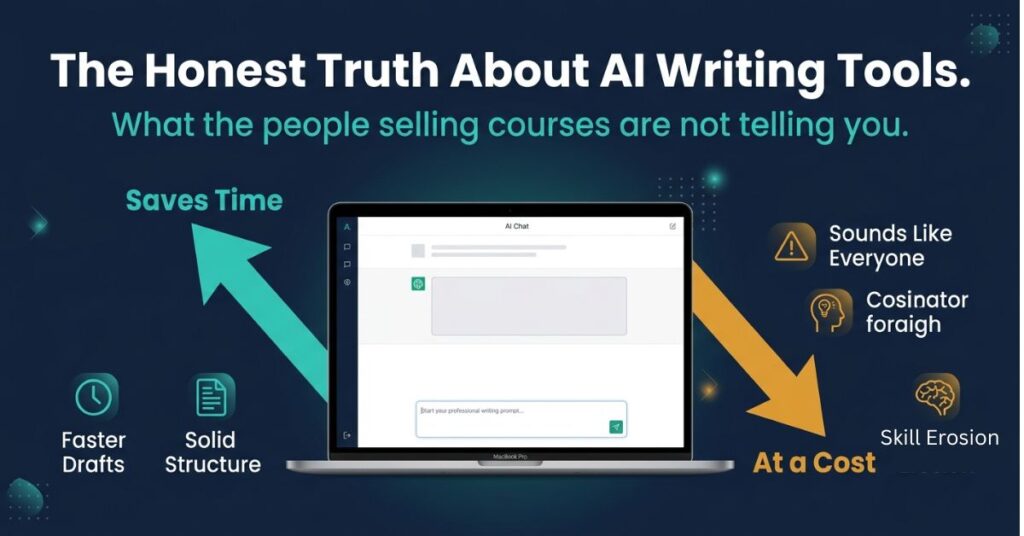
I use AI writing tools and I want to say that upfront because this article is critical of them and I do not want it to read like it is coming from someone who has never touched these things.
I have used ChatGPT, Claude, Jasper, Copy.ai and a handful of others across different projects over the past two years. Some of them have genuinely saved my time. Some produced first drafts better than what I would have written in the same time starting from scratch. I am not here to tell you AI writing tools are useless.
But there is a version of this conversation almost nobody is having honestly. The people selling AI writing courses are not having it. The tool companies are obviously not having it. Even a lot of independent creators who use these tools daily are not having it because admitting the limitations feels like admitting something about their own work.
So here it is.
The Sameness Problem
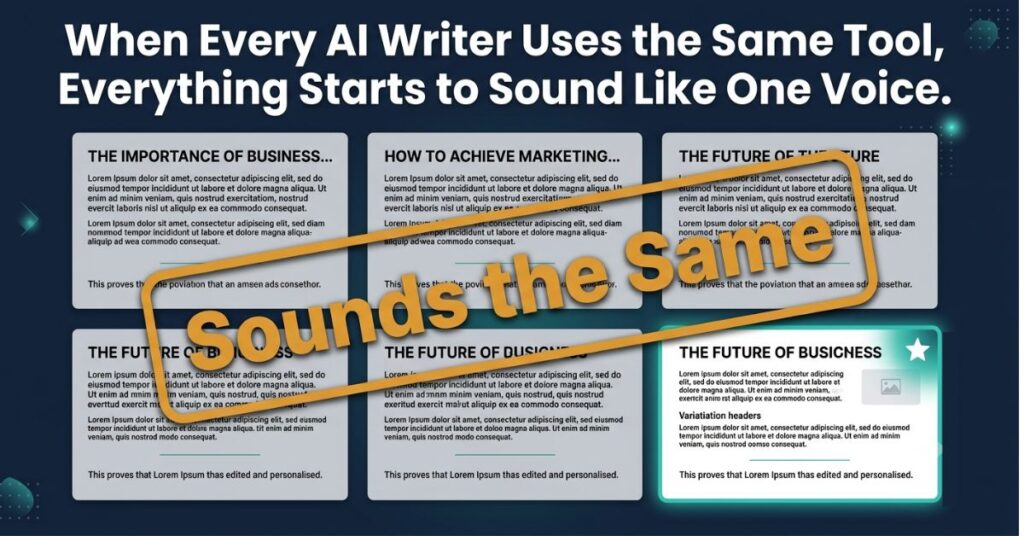
Every AI writing tool is trained on enormous amounts of text. The tools learn patterns from that text; sentence structures, transition phrases, ways of opening paragraphs and ways of building arguments. Because they all draw from overlapping training data, they reproduce the same patterns. Across every user, every tool and every output.
I noticed this in my own drafts before I noticed it anywhere else. I would read back something Claude had helped me write and think this is fine but it does not sound like me. Not because Claude had made mistakes but it’s because Claude sounds like Claude. There is a specific recognizable voice that shows up in the output regardless of what topic you ask it to write about or how you frame the prompt.
The observational opener that sets a scene before getting to the point. The section that ends with a tidy one-sentence conclusion. The subheading that describes what the section is about to prove rather than just naming the subject. These patterns are not bad in isolation, they are just patterns. The problem is that when every writer using AI produces content built on the same underlying patterns, a kind of grey uniformity settles over entire content categories.
Freelancing advice articles start reading like each other. Finance content, marketing content, productivity content within each category, the voice flattens. Regular readers feel it before they can name it. They do not say “this sounds like AI.” They say the newsletter has been feeling a bit flat lately, or they quietly stop opening it.
The fix is real editing, not light touch-ups. Editing AI output for voice takes longer than most people expect. Under time pressure, that stage gets shortened. The output goes out sounding like the tool rather than the person. And the category gets a little greyer.
What Google Is Actually Penalizing
AI content detection tools are imperfect, they flag human writing as AI and clear AI writing as human often enough that the results cannot be trusted absolutely.
Google has published official guidance making clear it does not categorically penalize AI generated content. What it penalizes is content that does not demonstrate genuine expertise or experience, content that exists to fill search results rather than genuinely help readers. The helpful content system introduced specifically to find and demote that kind of content does so regardless of whether a human or a machine wrote it.
The problem is that a lot of AI generated content used without significant editing or added personal experience, fits that description quite well. It is grammatically correct, covers the topic in a predictable way and doesn’t demonstrate that the writer has actually done the thing they are writing about. It does not have the specific details, the personal errors, the unexpected observations that come from someone who has genuinely been in the situation they are describing.
So the risk is not really about detection but about unedited or lightly edited AI content that tends to have the exact characteristics the helpful content system is built to identify. The path forward is not evading detection tools. It is producing content that has the qualities Google rewards, which is harder than generating output and publishing it.
For freelancers producing work for clients, there is an additional layer. More clients are running submitted work through AI detection tools before accepting it. A false positive on a piece you wrote entirely yourself is uncomfortable. A true positive on something you generated, lightly edited and charged full rate for is a different problem.
I know people who have lost client relationships over this, not many but some. The clients who care about it tend to care a lot.
What Happens to Your Writing Over Time
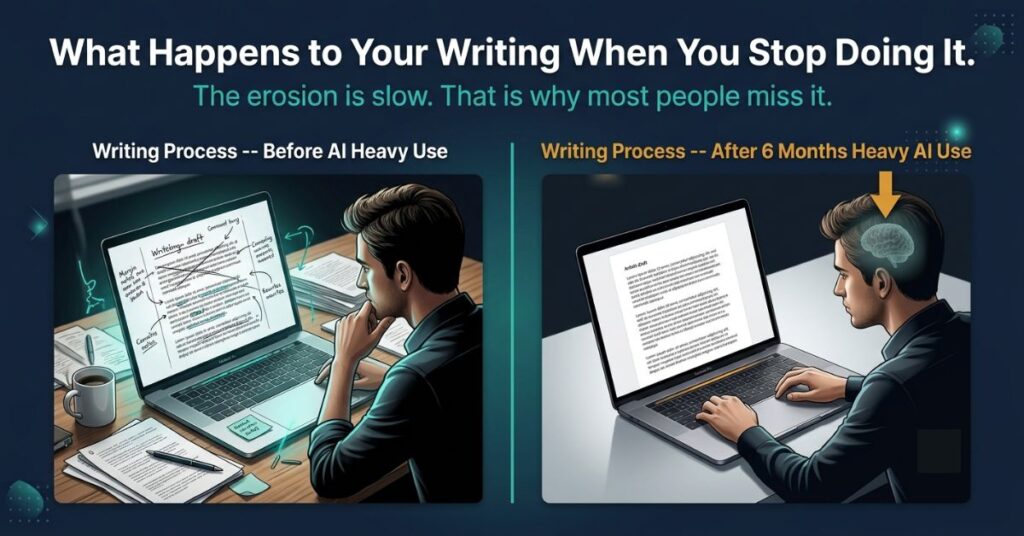
This one is slower and harder to notice, which is probably why it comes up less often.
When you sit down to write something from scratch such as a client proposal, an article or a piece of analysis. You are forced to work out what you actually think. You write a sentence and if it doesn’t capture what you mean, you try again and in trying again you figure out more precisely what you meant. The resistance of that process is uncomfortable, it is also where ideas get developed and tested and sometimes abandoned in favor of better ones.
When you hand that process to an AI tool, you would skip it and get a draft. The draft has a structure and an argument and a tone, when you read it and it seems fine you just edit slightly and publish.
But you have not worked out where you actually stand on the subject. You have not discovered through writing that your initial assumption was incomplete. You have not found the specific example from your own experience that would have made the piece genuinely yours rather than generically competent.
Over time, something starts to erode from one project to the next. But the capacity to figure out what you think by writing it down gets less exercise.
I have spoken to three content professionals over the past year who described versions of the same experience. All of them had been using AI heavily for six months or more. All of them noticed that sitting down to write something from scratch had started to feel harder than it used to. Not impossible but just slower, more effortful and less natural.
One of them was a copywriter with eight years of experience. She was not a junior writer learning to write. She described noticing that her first instinct on any piece was to reach for the tool rather than think the piece through herself first. And when she did try to think it through herself, it took longer than it used to.
She has since made a deliberate practice of writing certain things without AI assistance at all. Her own content, her own pitches, anything where the thinking is the actual product. She described it the way a surgeon might talk about operating without robotic assistance occasionally even when the robotic option is available. The skill needs use to stay sharp. She had let it get less sharp than she wanted and was working to recover it.
That is an unusual level of self-awareness. Most people do not notice the erosion until it is further along.
The Repetition Nobody Talks About
Here is something specific I have not seen written about clearly elsewhere.
When you use an AI writing tool repeatedly for the same type of content like for a weekly newsletter, a regular blog post series, a recurring client deliverable the output develops a sameness problem that goes beyond just sounding like the tool.
The tool draws on the same patterns each time. The same sentence openers, the same structural moves, the same ways of transitioning between sections. If you are editing heavily this gets buried in the editing. If you are editing lightly it starts showing up noticeably around the sixth or eighth piece.
I ran an experiment on myself for three months. One version of a weekly update using Claude as my starting point. One version from scratch each week then I compared them.
The from-scratch versions were not always better sentence by sentence. But they were more varied, more specific, and when I asked a handful of people to read both without knowing which was which, consistently more interesting to read.
The AI versions were fine, that is the honest summary. It is fine not that bad and not embarrassing. And fine becomes a ceiling when you are trying to build something people genuinely look forward to reading.
Confident About the Wrong Things
AI writing tools produce confident prose. They do not hedge unnecessarily they state things clearly and move on.
This is useful in many contexts. It is a problem when the tool is confident about something it should not be confident about.
The obvious version is factual errors where AI tools generate plausible-sounding information that is simply wrong. Incorrect statistics, misattributed quotes, events that did not happen and companies that do not exist. The error arrives in the same confident prose as the accurate information surrounding it. There is no stylistic signal that this sentence is invented, it reads exactly like the rest.
For content published without thorough fact-checking, that is a real risk. Thorough fact-checking of AI output takes time which undermines a significant part of the productivity argument for using the tools in the first place.
The subtler version is about nuance AI tools produce positions. They pick a side and argue it, this is useful for generating persuasive copy or structured arguments. But a lot of valuable writing is not persuasive, it is genuinely exploratory. It sits with a question, considers multiple answers, admits uncertainty and arrives at a tentative conclusion the reader can push back on.
That kind of writing is hard to get from a prompt. AI tools are optimized to produce coherent, structured, forward-moving text. The essay that wanders productively, that contradicts itself in interesting ways, that arrives somewhere the writer did not expect when they started that almost never comes out of a prompt.
Why Nobody Says This Out Loud
The AI writing tool conversation has a financial ecosystem around it. The same financial ecosystem dynamic shapes how AI business tools get written about most of what you read about building businesses on top of AI APIs has the same structural bias toward the upside. Courses on building content businesses using AI, newsletters covering AI productivity and affiliate arrangements where content about AI tools links to those tools through referral programs.
None of that is inherently corrupt as people teaching useful things deserve to earn from it. But it creates a structural incentive to emphasize the upside and minimize the downside. A course on using AI to write faster doesn’t sell as well if the first module is a detailed look at what you lose when you use AI to write faster.
The result is a public conversation significantly more positive than the private conversations I have with people who use these tools seriously. In private, the limitations I have described here come up regularly. The sameness, the skill erosion, the client risk, the confidence problem. People who use these tools seriously are aware of all of it.
They just do not say it in public very often because the incentives point in the other direction.
How People Are Actually Using These Well
I am not going to tell you to stop using AI writing tools. That is not where two years of using them and watching other people use them has left me.
The people getting the most genuine value from them are using them to accelerate a process that starts in their own head. They use AI to expand an outline they have already thought through. To generate options for a sentence they already know the shape of. To check a draft they have written for gaps in the argument. And to produce a rough first draft on a topic where they have real knowledge and plan to edit heavily toward their own voice.
The tools that tend to sit most comfortably in that additive role are not always the obvious ones, the breakdown of the AI tools freelancers are using to increase output covers several that most people have not considered.
For freelancers concerned about client confidentiality when using these tools, it is worth reading each platform’s data policy before pasting client material into any prompt. Anthropic publishes Claude’s data use policy clearly.
What they are careful about is handing over the thinking. Not opening a blank prompt and asking the tool what to write about. Or taking the first draft and publishing it with light edits. Not building a content calendar from AI suggestions and executing it with AI drafts and calling it content strategy.
The drift from the first mode to the second is easy, especially under time pressure or when a client needs something fast. The drift is gradual. The costs are also gradual. By the time you notice that your content sounds like everyone else’s content, that clients are asking questions, that writing from scratch feels harder than it used to and the drift has usually been happening for a while.
Frequently Asked Questions
I started using AI tools recently and everything seems fine. Should I be worried?
Not immediately, the problems described in this article are mostly slow-moving. Content sameness builds up over many pieces, not one. Skill erosion takes months of heavy reliance before it becomes noticeable. Client concerns about AI content are still unevenly distributed across industries. The short-term experience of using AI writing tools is often genuinely positive they save time, the output is competent, clients are happy but the issues surface later. Knowing that they surface later and building habits now that prevent the worst versions of them, is a better position than finding out through experience.
I am a non-native English speaker and AI helps me write more fluently. Is this criticism relevant to me?
Partly yes and partly no. Using AI to improve grammar, flow and clarity is a different use case from using AI to generate content you publish as your own thinking. For non-native speakers the tool is acting more like an advanced editor than a ghostwriter. The skill erosion concern applies differently because you are still doing the primary thinking and the AI is assisting with the language layer. The sameness problem still applies to some extent the edited prose will carry some AI characteristics but it is less significant when the underlying ideas and structure are genuinely yours.
My client has not mentioned AI at all. Do I need to bring it up?
Depends on how you are using it and what your contract says. If your contract has an AI clause, follow it. If it does not, and you are generating drafts rather than just using AI for research or light editing, having that conversation proactively is worth considering before the client asks. Most clients who have a strong view on this feel more strongly about discovering it later than about being told upfront. The industry is moving toward more explicit expectations and getting ahead of that conversation is generally a better position than responding to it.
Does any of this apply to using AI for things other than writing like email, social posts or short copy?
Yes but to a lesser degree. The skill erosion concern is most serious for longer-form writing where the thinking process matters most. For short copy and social posts the AI is often genuinely more efficient and the personal voice dimension matters less. The client disclosure question is also less fraught for short-form work in most industries. The main risk that carries across all formats is factual accuracy AI tools hallucinate in short copy just as readily as in long articles and a wrong statistic in a social post can cause its own problems.
What should I actually do differently starting today?
One practical thing: next time you sit down to write something, spend fifteen minutes writing your own rough version before you open any AI tool. It does not have to be good. It just has to be yours. That rough version even if you end up not using a single sentence of it gives the AI something real to work with and gives you something to edit toward. The people who use these tools best almost always start from their own thinking, however rough, rather than from a blank prompt. It also keeps the writing muscle active, which is worth doing deliberately if you are using AI tools heavily.

Johnson Alaekezie is a freelancer and digital content creator with several years of experience working across writing, content strategy, and digital services. He founded IncomeGigAI to share honest, practical information about building income online without the hype that dominates most of this space. Johnson has worked with clients in the US, UK and beyond, and writes from direct experience rather than theory. He is based in Nigeria and covers the digital income topics he has personally navigated as a working freelancer.