
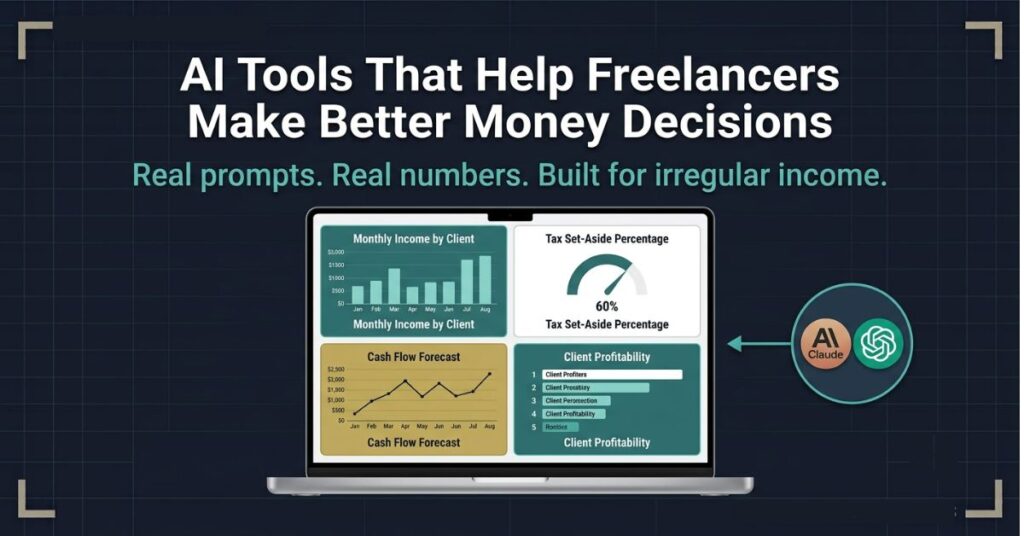
Two years into freelancing I owed more tax than I had saved. Not by a little but enough that I had to call in a favor from a family member to cover the gap while I sorted it out. I was not spending recklessly I just had no system. I invoiced, received money and spent some of it, I saved what was left and I told myself I would figure out the tax thing properly next year.
The person who helped me actually sort it out was not a financial advisor. It was a freelancer I met through a client who asked me one specific question: do you know what percentage of every invoice you should be setting aside for tax? I did not. She showed me a spreadsheet she had built using prompts from ChatGPT and it took me about twenty minutes to understand why I had been underpreparing for two years.
That conversation changed how I thought about AI and money together. Not AI as a replacement for professional advice, which it is not. As a tool for understanding your own numbers clearly enough to stop guessing.
Freelance Finance Is Not the Same Problem
Salaried workers have their tax handled automatically because their income is predictable. Retirement contributions are often prompted, if not matched. Business and personal expenses do not blur together. None of that is true for freelancers and the standard financial advice built for salaried people does not map onto the freelance situation cleanly.
A freelancer doing good work and earning reasonable money can still end up with an underfunded tax bill, no retirement savings and a cash flow crisis that looks like a revenue problem but is really a timing problem. The complexity compounds quietly and the consequences show up months later in a lump, which is exactly what makes it so easy to ignore until it is urgent.
What I have found is that AI tools make it easier to engage with the financial side regularly rather than avoiding it entirely. They do not solve the complexity rather make it less intimidating to look at it.
Getting a Clear Picture of Where You Actually Stand
The first thing I learned to use AI for was understanding my own financial position at any given moment in plain language.
Most freelancers have their transaction history sitting in a bank account or an accounting tool. What they usually lack is any habit of reading it with analytical attention. The data exists, but the interpretation does not happen.
A prompt that I use and have shared with others in the freelancing community:
“I am a freelancer. Here is my income and expense data for the past three months: [paste data]. Please help me understand: which months were most profitable, what my average monthly net income was, what my largest expense categories are and whether there are any spending patterns I should pay attention to.”
The reason this is useful is not that it is complicated. It is that most people, given the same data, will glance at it and form vague impressions. A structured response names specific numbers, identifies specific categories and sometimes surfaces things that were hiding in plain sight. A freelance copywriter I know found through this kind of prompt that her software subscription costs had grown to nearly 18 percent of her monthly expenses. She had not noticed because each individual subscription felt small.
The data you paste in determines the quality of what comes back. Specific numbers produce useful analysis, vague descriptions produce vague responses.
Tax Estimation Without the Year-End Shock
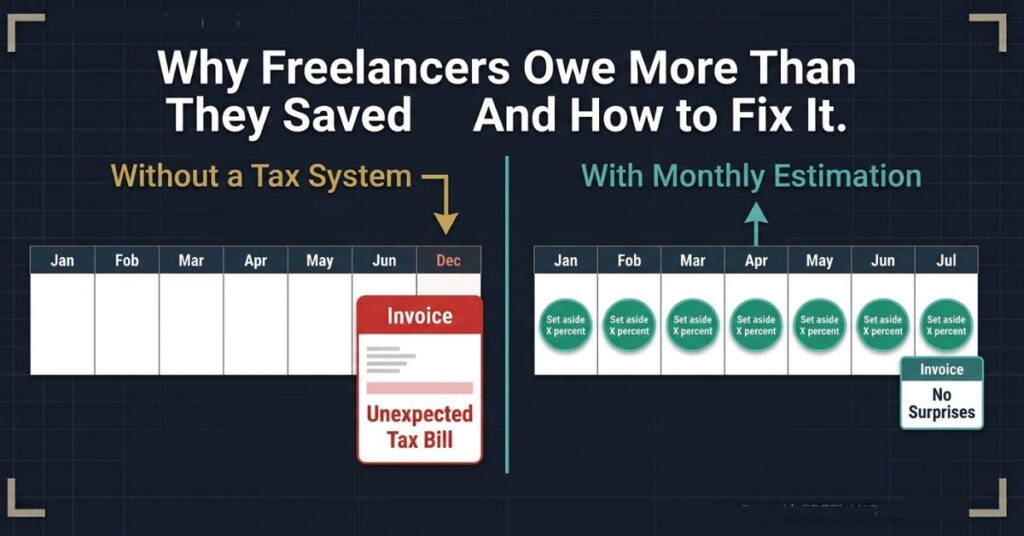
The situation I described at the start of this article, owing more than I had saved, is the most common financial mistake in freelancing. It is also the most preventable.
Let me be direct about something before going further: AI tools cannot replace a tax professional. Tax law is jurisdiction-specific, complex and changes. An AI calculation error does not reduce your liability. For your actual tax filing you need a professional.
What AI is genuinely useful for is the ongoing awareness piece. Building a rough model of how much to set aside so the annual calculation is not a surprise.
A prompt I have used:
“I am a self-employed freelancer based in [country and state if relevant]. My income for the last three months was (amounts). My business expenses that are likely deductible include (categories and rough amounts). I am trying to estimate how much I should be setting aside each month for tax. Please help me understand the rough calculation for my situation, noting any assumptions you are making and where I should verify with a tax professional.”
The response is not a tax return, it is a walkthrough of the logic. For someone who has never understood why they owe what they owe, seeing the structure laid out clearly is often the first time the management of it feels controllable rather than arbitrary.
One specific habit that has helped me is that after any large invoice or unexpectedly good month, I ask Claude to help me recalculate my year to date estimated tax liability given the new number. This keeps my set-aside calibrated through the year rather than fixed in January and never updated.
Making the Cash Flow Timing Visible
Cash flow is the freelance financial problem that gets discussed most and understood least clearly by most people experiencing it.
A freelancer doing $6,000 of work in a month might have $800 in their account on the 15th because three invoices are all in the net-30 window at once. They are not in trouble financially they are just experiencing a timing mismatch that is normal in project-based income and entirely predictable if you have visibility of it in advance.
The cash flow problem is made worse when clients pay late, our guide to getting paid on time covers the invoicing system that reduces that timing gap.
A prompt that helps:
“I am a freelancer with the following income pattern: (describe your typical invoice timing, payment terms, and monthly amounts). My fixed monthly expenses are (list them). My variable expenses typically run around (amount). Please help me build a simple four weeks cash flow forecast showing when I am likely to have shortfalls and when I have surplus.”
The forecast you get is rough, the value is not its precision. It is having a timeline at all rather than discovering a gap when the rent comes out. The more useful version of this is updating it monthly as real numbers develop. Confirmed payments arrive, new invoices are raised, the picture sharpens. Done consistently, this is the kind of visibility that separates freelancers who feel in control of their money from those who always feel slightly anxious about it regardless of how much they earn.
What Your Rate Actually Needs to Cover
Most freelancers calculate their rate by thinking about what they want to earn per hour and what the market will bear. They do not systematically account for what a salaried equivalent would receive that they are now funding themselves.
I went through this calculation with Claude about two years ago and the result was higher than I expected. Not because the prompt was generous. Because when you list everything a salary implicitly covers, the number required to match it is larger than most people intuitively assume.
The prompt I used:
“I am a freelancer trying to calculate what my minimum viable rate needs to be to match the effective income of a salaried employee earning (target annual income). Please help me account for unpaid time including holidays and sick days, self-employment tax in (country), health insurance I am paying independently, retirement savings I need to fund myself, business expenses including tools and subscriptions and a reasonable buffer for slow months. Assume a realistic number of billable hours per year.”
A freelance graphic designer I spoke to did this calculation and found her minimum viable rate was 35 percent higher than what she was currently charging. Not because the market would not pay more but because she had never done the full calculation and was essentially subsidizing her clients without knowing it.
Once you know what your rate needs to be to actually work, our geo-pricing guide covers what different markets will actually pay for it.
Investment and Savings When Income Is Irregular
The financial advice available to freelancers is mostly designed for people with regular monthly income. Dollar cost averaging works elegantly when the amount is consistent. When your income swings from $2,000 to $8,000 depending on the month, the standard advice needs adapting.
I am not suggesting you use AI for specific investment recommendations. That is not what these tools are for and treating them that way would be a mistake. What they are useful for is understanding concepts and strategies in the context of your specific situation, as preparation for a professional conversation rather than a replacement for one.
Questions that work well:
“I am self-employed with irregular income in a range of (amounts). I want to build an emergency fund and start investing for retirement. How should I think about structuring savings for irregular income differently from the standard advice designed for salaried workers?”
The response covers things like setting aside a percentage of each payment rather than a fixed amount, building a larger emergency fund than the standard three months because income variability makes that recommendation inadequate, and structuring contributions to allow for pauses in slow months without derailing the plan. None of this is complicated but it is not what standard financial content covers because standard content is written for different circumstances.
A freelance photographer I know used exactly this kind of conversation with Claude to understand the difference between a Roth IRA and a SEP-IRA for self-employed people in the US before talking to a financial advisor. He arrived at the professional conversation with a clear question rather than needing to be educated from scratch, which made the meeting shorter and more useful. That is the right model for AI in this context.
Which Clients Are Actually Making You Money
This is one I had not thought about until a consultant I know mentioned it and I realized it was something I should have been doing for years.
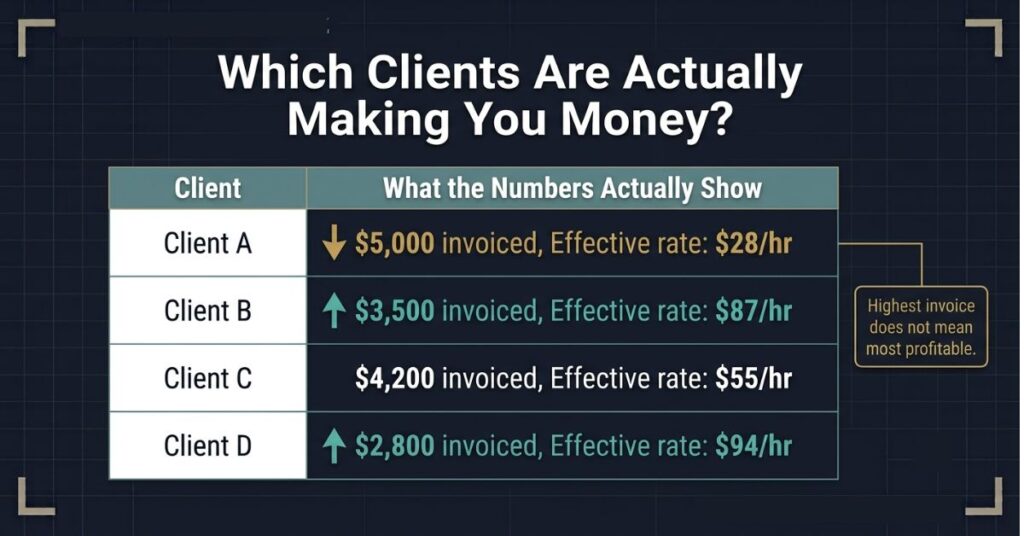
Different clients are not equally profitable even when they pay the same rate. A client who pays $5,000 per project but requires three revision rounds, extensive calls, detailed reporting and emotionally draining communication is less profitable than a client who pays $3,500 per project, gives clear briefs, approves work promptly and communicates twice a week by email. Most freelancers have a vague sense of which clients feel easy and which feel hard. Very few have actually calculated the difference.
The prompt:
“Here is data about my clients for the last six months: (list each client, total billed, and your best estimate of total hours including unbillable time). Please calculate effective hourly rate per client and identify which are most and least profitable on this basis.”
The results from this kind of analysis are often counterintuitive. The consultant I mentioned found her three highest-paying clients by total invoice value were also her three least profitable by effective hourly rate. She spent the following two quarters restructuring her client mix based on what the numbers showed rather than what she had assumed. Her income stayed roughly the same and available time increased significantly.
Building a Dashboard That Actually Fits Your Situation
Most personal finance apps are designed for salaried people. They assume regular income, simple tax and clean separation between business and personal spending. None of those assumptions apply to most freelancers.
You can use Claude or ChatGPT to design a Google Sheets or Notion-based financial dashboard specifically built for your situation rather than adapting a generic template that was not designed for it.
The prompt:
“I am a freelancer with irregular income. I want to build a simple financial dashboard in Google Sheets to track: monthly income by client, tax set-aside as a percentage of each payment, business expenses by category, personal expenses, net cash position after tax set-aside and a rolling three months income average. Please help me design the structure including the formulas I would need for each calculation.”
I built a version of this about eighteen months ago, it only took one afternoon to set up. About twenty minutes per week to maintain. The clarity it gives me about my own finances is better than anything I had in the first few years of freelancing and it exists because AI made the setup practical enough that I actually did it instead of putting it off.
If you want to go further with Google Sheets as a financial tool, our guide to making money from Google Sheets covers the formula and structure side in more detail and the principles apply to a financial dashboard just as much as a commercial template.
Where AI Gets This Wrong
Numbers are where AI is most likely to make mistakes, which is exactly the context where mistakes matter most. I have had Claude produce a financial calculation that was confidently presented and wrong, I caught it because I ran the numbers myself. For anything that affects a decision you will act on, check the arithmetic independently.
Local tax rules are where AI is most likely to give you inaccurate guidance. Tax law varies by country, by state or province, by income type, by your specific situation. A response that is accurate for someone in California might be seriously wrong for someone in Nigeria or Germany. Use AI to understand the structure and logic of your tax situation. Use a qualified professional for actual calculations and filings.
For US-based freelancers, the IRS self-employment tax center is the right starting point for understanding what you owe and when. For UK based freelancers, HMRC’s self assessment guidance covers the same ground for the UK context.
Income forecasting through AI is only as good as the estimates you put in. If your income estimates are optimistic and your expense estimates are incomplete, the forecast will be wrong in ways that create real problems. This is not an AI limitation specifically it’s just arithmetic. Wrong inputs produce wrong outputs.
The habits are still yours to build. Understanding your finances better through AI conversations is useful. It is not the same as actually reviewing your numbers regularly, setting aside tax consistently and making active decisions about your money. The tool does not replace the practice.
Frequently Asked Questions
Is it safe to share income and expense figures with Claude or ChatGPT?
The main risk is not with income figures, which in isolation are not particularly sensitive. The risk is with identifiable details like client names, bank account numbers, tax identification numbers, passwords. None of those should go into a public AI tool. Several freelancers I know anonymize their data before pasting it, replacing client names with labels like Client A and Client B. For the income and expense numbers themselves without identifying details, the privacy risk is low, but read each platform’s data policy and make your own judgment about what you are comfortable sharing.
The article says AI cannot replace an accountant. What can it actually help with then?
The distinction is between understanding and filing. AI is useful for helping you understand your financial position, build rough tax estimates, plan cash flow and think through financial strategy. It is not useful for producing accurate tax filings, taking professional responsibility for your accounts, or providing jurisdiction specific tax advice you can rely on legally. Think of it as the difference between reading about medicine to understand your symptoms versus getting an actual diagnosis and prescription. Both have their place and one does not substitute for the other.
What accounting tool should I use to keep my data clean enough for AI analysis?
Wave has a free tier that handles income and expense tracking cleanly for most solo freelancers. QuickBooks Self-Employed is worth the cost if you need slightly more structure around tax estimation and mileage. Both are significantly better than a spreadsheet you maintain manually, because the automatic categorization means your data is consistently labelled rather than described differently every month. Whatever tool you use, the key habits are: separate business and personal accounts, use a dedicated card for business expenses, and review and correct category assignments weekly rather than leaving it to accumulate.
I have been freelancing for a few years and my finances are already a mess. Where do I start?
Start with one month of data not everything at once. Take last month’s transactions, categorize them as best you can and run the financial position prompt from the first section of this article. See what it tells you. The insight from one month of clean data is more useful than a vague anxiety about the whole picture. Once you have done one month you have the process. The second month is faster. Three months in and you have enough data to start seeing patterns. Do not let the size of the historical mess stop you from starting with what is current.
I work with clients in multiple currencies. How do I handle the AI financial analysis for that?
Convert everything to a single currency before pasting data for analysis. Pick one, usually your home currency or USD if you work internationally, and convert all figures at the exchange rate at the time of payment. This is also the right approach for your own accounting rather than leaving it in mixed currencies, because exchange rate movements can otherwise make your financial picture look distorted. If currency conversion is a significant part of your business, mention it explicitly in the prompt so the AI accounts for it in any cash flow or profitability analysis.

Johnson Alaekezie is a freelancer and digital content creator with several years of experience working across writing, content strategy, and digital services. He founded IncomeGigAI to share honest, practical information about building income online without the hype that dominates most of this space. Johnson has worked with clients in the US, UK and beyond, and writes from direct experience rather than theory. He is based in Nigeria and covers the digital income topics he has personally navigated as a working freelancer.