
Three years into freelancing I had a conversation that genuinely annoyed me.
A friend who had been consulting for about six months told me he had just made $400 from a single one hour call. Not even a project or deliverable but just a conversation. Someone had found him on a platform called Clarity.fm, booked a call and paid by the minute while they talked. He answered questions about email marketing for an e-commerce brand. The call ran sixty-two minutes. He made $400 sitting at his kitchen table.
I had never heard of Clarity.fm and I had been freelancing long enough that I should have.
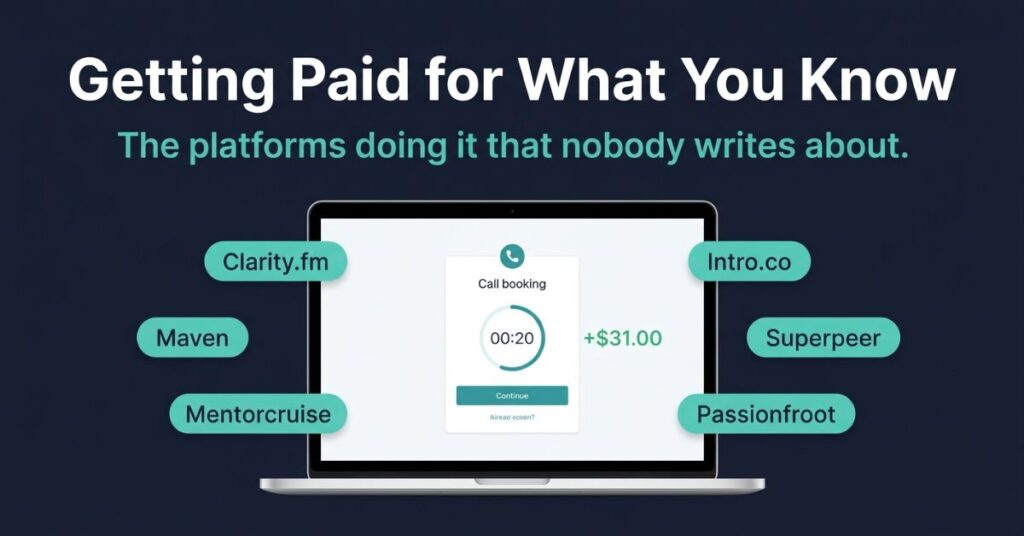
That conversation sent me down a rabbit hole. Clarity led to Maven, which led to Mentorcruise, Intro.co, Superpeer, Passionfroot. Platforms that do not show up in the usual “how to make money online” roundups because they do not have the marketing budgets that Udemy and Teachable and Gumroad have. But the economics on some of them are genuinely better. Less competition, more targeted audiences, higher per-hour rates than most freelance work I was doing at the time.
This is what I found after spending time on each of them and talking to people who are actually earning from them.
Why Calls Before Courses
Most people who want to get paid for their expertise immediately think about building a course. The pitch is attractive; build it once, sell it passively, scale without trading time for money and courses do work. But they take months to build properly, require marketing to an audience you may not have yet and the numbers on most course platforms are sobering. The average course on Udemy earns under $200 lifetime. That is not a rounding error, that is the actual median.
Getting paid for a direct conversation is faster to start, lower effort to set up and often more lucrative per hour than anything you will build in your first year. A one-hour call at $200 earns the same as selling forty copies of a $5 course. One call requires no curriculum to build, no video to record and no sales funnel to design.
The platforms in the first half of this article are built for paid calls and direct expert access. The second half covers cohort courses and structured teaching. Both are worth knowing about, because calls are where most people should start.
Clarity.fm
Clarity is the platform my friend used. You create a profile, set a per-minute rate and people book calls with you. You talk, the clock runs, you get paid.
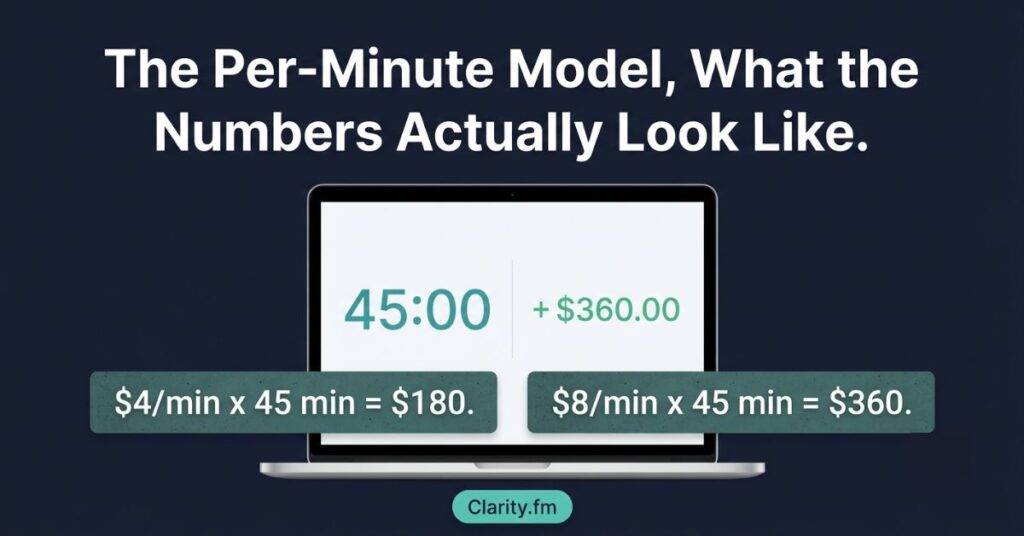
The per-minute pricing sounds odd until you run the numbers. Experts on Clarity charge anywhere from $1 per minute to $16 or more at the high end. At $4 per minute, which is a reasonable rate for someone with solid domain experience, a forty-five minute call earns $180. At $8 per minute the same call is $360. My friend was charging $6.50 when he made that $400 call.
Topics people actually pay for on Clarity: marketing strategy, SaaS growth, fundraising, legal questions, hiring decisions, sales process, content strategy, financial modelling, immigration. Browsing Clarity’s active expert categories gives a real sense of what demand actually looks like on the platform. Basically any area where someone with a specific problem wants to talk to someone who has solved it before rather than spending three hours reading conflicting blog posts.
The typical person booking calls on Clarity is a founder or early-stage entrepreneur. They have a specific question. They do not want a three-month consulting engagement. They want forty-five minutes with someone who has been where they are.
I spoke to a freelance marketer who joined Clarity about two years ago. She started at $3.50 per minute, raised her rate twice and is now at $6. She does between four and eight calls a month. Not her main income but several hundred dollars monthly from conversations she was already having for free with people who emailed her through LinkedIn.
The thing she told me about getting started has stuck with me. Your first three reviews are the whole game on Clarity. The platform shows your review count and average rating prominently and a profile with zero reviews gets almost no organic bookings regardless of how strong the bio is. She reached out to two former clients and one peer she had helped informally and asked them to book a short call. Fifteen minutes, heavily discounted purely to get those first reviews in place before she promoted her profile to anyone else.
It felt slightly tactical when she described it. But it is just understanding how the platform works. Nobody books a restaurant with zero reviews when there are restaurants nearby with fifty.
Platform cut: 15 percent, you keep 85. Payouts via PayPal.
Who it suits: Business, marketing, tech, legal, finance. Less suited to creative fields where clients want to see your portfolio rather than talk about your process.
The real limitation: Organic discovery on Clarity is slow without external traffic. The people earning consistently from it are not getting found through Clarity’s internal search. They are dropping their Clarity link in their newsletter, their LinkedIn bio, their email signature and letting the platform handle the rest. If you have no existing professional presence to drive traffic from, the platform will be quiet for a long time.
Intro.co
Intro does what Clarity does with a slightly different focus and a cleaner interface. Newer platform, smaller user base, but tends to attract more personal finance, career coaching and creator economy topics alongside the startup and business categories that dominate Clarity.
The model is hourly rather than per minute, which some people prefer. Cleaner to price and easier to explain to clients who are not used to per minute billing.
A career coach I spoke to runs profiles on both simultaneously. She finds the audiences noticeably different, clarity skews toward people building businesses. Intro skews toward professionals navigating career moves, salary negotiations, job searches. Her expertise is relevant to both so maintaining both profiles costs her no extra time and adds a meaningful income stream.
Her Intro rate is $150 per hour. Her Clarity rate is $3 per minute, which works out to $180 per hour. She does roughly equal call volume through each platform each month.
The feature that sets Intro apart from Clarity is what they call Async, recorded video answers to written questions. Someone submits a question and pays a fee. You record a three to ten minute video response, deliver it through the platform, get paid. No scheduling, live call and no back and forth timing. For people who want to monetize knowledge without the friction of live calls this is genuinely useful and I have not seen it done as cleanly on any other platform.
Platform cut: Around 20 percent payouts via Stripe.
The real limitation: Smaller user base means less organic discovery than Clarity. The async feature requires being comfortable on camera for short video, which is not everyone.
Mentorcruise
Mentorcruise is built around ongoing monthly relationships rather than one-off calls. A mentee subscribes to a mentor’s plan and gets recurring access, typically one or two video calls per month plus async messaging. The mentor earns a recurring monthly fee for as long as the relationship continues.
Mentor rates run from around $50 per month at the low end to several hundred at the top. The middle of the market is somewhere around $150 to $200 per month per mentee. A mentor with ten active mentees at $150 per month is earning $1,500 per month in recurring income from a commitment of roughly eight hours of actual time.
The fields with the deepest demand on Mentorcruise are software engineering, product management, UX design and data science. If your background is in any of those the platform has a real and active audience already looking for what you offer. Marketing, finance and entrepreneurship are growing but the tech categories are where the clearest demand exists right now.
I spoke to a senior software engineer who has been on the platform about eighteen months. He currently has fourteen active mentees and earns around $2,100 per month from Mentorcruise. He spends roughly eight hours a month on it. That works out to around $260 per hour, which is meaningfully higher than most freelance engineering rates.
He told me something about retention that surprised him going in. He expected mentees to drop off after a month or two once they got their immediate questions answered. Most of his have stayed for six months or longer and some for over a year. The relationships become genuinely valuable in ways that neither party fully anticipated at the start, which is what drives the retention.
Mentorcruise requires an application, the platform reviews mentors before approving profiles. LinkedIn, GitHub for technical mentors, evidence of real experience. The process is real and not everyone gets through on the first application. If your profile is thin or your experience is hard to verify, that is worth addressing before you apply.
Platform cut: 20 percent of monthly subscription revenue.
Who it suits: Tech professionals primarily. Product managers, designers, data practitioners. Growing in other fields but the demand is deepest in tech right now.
The real limitation: The application process takes time and some applications are rejected. Taking on too many mentees too fast is also a quality trap, the engineers doing best on the platform are deliberate about their mentee cap and stay well within what they can genuinely serve.
Maven
Maven is where this shifts from calls to structured teaching. It is a platform built specifically for cohort-based courses like live, time limited programs where a group of students go through material together over several weeks, with the creator teaching live rather than through pre-recorded video.
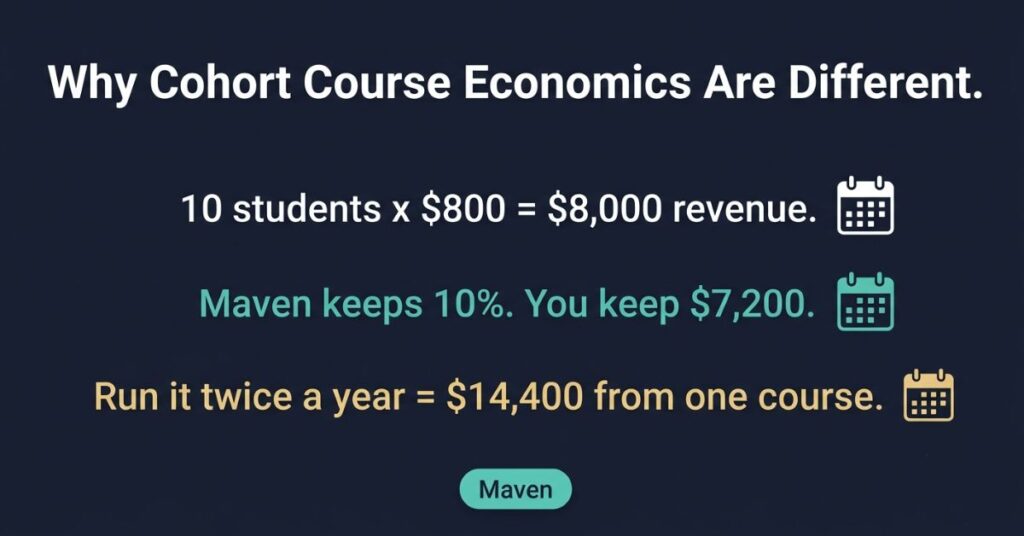
The economics of cohort courses are dramatically better than self-paced recorded courses. A well-run Maven cohort can charge $500, $1,000, $2,000 or more per student because the live interaction, the community and the accountability are worth real money to people who are serious about learning something. Maven’s cut is around 10 percent, which means the creator keeps 90 percent of revenue. Ten student cohort at $800 per student puts $7,200 in the creator’s pocket from a four week course.
The courses doing well on Maven are not broad topic introductions. They are specific and outcome focused. “Product Analytics for Early Stage Startups” not “Introduction to Analytics.” “Getting Your First 1,000 Newsletter Subscribers” not “How to Write a Newsletter.” The specificity signals genuine expertise and attracts students willing to pay serious money because they can see exactly what they are getting and why it matters to them specifically.
A freelance growth consultant I spoke to ran her first Maven cohort about a year ago. Twenty students at $650 each. She kept $11,700 from a four week course she ran in the evenings around her existing client work. The prep took about three weeks outlining the curriculum, building slides, writing exercises. The second run took a few hours of updates. By the third run she was mostly just showing up to facilitate something that had already found its shape.
She has now run it four times, raised the price to $850 and says the most time consuming thing about it is the two weeks before each launch when she is doing outreach to fill enrolment.
Maven has a free program called the Maven Accelerator for first-time course creators that covers curriculum design, pricing, marketing and launch strategy. Several people I spoke to said it was what actually got them to launch after sitting on the idea for months. Worth going through before you try to build and fill a cohort on your own.
The distribution problem that kills most AI wrapper businesses is the same one that stops most first-time course creators from filling their first cohort.
Platform cut: Around 10 percent significantly lower than most competitors.
Who it suits: Anyone with genuine expertise and a clear learning outcome to teach toward. Strong in tech, marketing, product, design, writing and entrepreneurship. The key is specificity not fame.
The real limitation: Every cohort run requires active marketing. Unlike a self-paced course that can sell while you sleep, a cohort has a start date and an enrolment deadline. If you do not have an audience or a clear way to reach potential students, filling the first cohort is genuinely the hard part. Maven provides some discovery but most successful creators on the platform are driving the majority of their own enrolments through their own network and content.
Passionfroot
Passionfroot is less known than the others here and useful for a specific type of person.
It is a platform that lets creators offer multiple paid products in one place one-on-one calls, async video responses, newsletter sponsorships, digital downloads and all from a single profile page. A monetization hub for people who already have an audience and want a clean way to offer paid access without building custom booking and payment infrastructure.
A newsletter writer I know covers SaaS marketing and has around 8,000 subscribers and newsletter writers who have already built an audience around a specific topic are in the best position to monetize it directly, something we covered in detail in our piece on how small businesses are using AI day to day.
She uses Passionfroot to offer a 45-minute strategy call at $200 and a written audit of a subscriber’s current marketing setup at $150. She gets two to four bookings per month with almost no active promotion, the link sits at the bottom of her newsletter and converts quietly. Around $500 to $800 per month from her existing audience without any meaningful extra work.
She told me she had been giving that access away for free in her DMs for two years before she started charging for it. The demand was always there she just had not built a clean way to monetize it.
Platform cut: Around 10 percent of transactions.
Who it suits: Newsletter writers, podcasters, content creators with an engaged existing audience. It is a monetisation layer on top of something you have already built, not a discovery platform.
The real limitation: Passionfroot will not send you clients. It handles the transaction once the client finds you. If you are starting from zero audience this is not the right first platform.
Superpeer
Superpeer supports one-on-one paid calls and paid group video sessions. The group session model opens up different economics worth understanding.
You can run a paid live workshop for twenty people simultaneously, charge each of them $30 and earn $600 from one ninety-minute session. That looks very different from a one-on-one call at the same hourly rate.
Superpeer also has a tipping feature after a session, attendees can tip the host through the platform. A few people I looked into mentioned tips as a meaningful additional revenue source on popular group sessions where audience members who got a lot of value wanted to express that beyond the ticket price. Not a primary income stream but real.
A productivity coach runs a weekly group session called “Deep Work Fridays.” Thirty minutes, $12 per person, capped at 25 attendees. Around twenty people typically show up. That is $240 per week, roughly $960 per month, from a thirty-minute weekly commitment. He has been running it for eight months.
He was direct about what the first six weeks looked like. Poorly attended. He almost stopped after week four. The regular audience built slowly through word of mouth and occasional social posts and did not feel established until month three. Consistency through the quiet period is what made everything after it possible.
Platform cut: Around 20 percent of paid session revenue.
Who it suits: Coaches, teachers and subject matter experts comfortable on camera who want live sessions with real time interaction rather than recorded content.
The real limitation: Building a regular live audience takes sustained consistency. Expecting immediate attendance on a weekly session is the mistake most people make when they start.
Which One to Actually Start With
This depends on where you are right now. No audience yet but real domain expertise and a professional track record?
Start with Clarity, get your profile set up, engineer your first three reviews the way the marketer I spoke to described and promote your link through your existing professional network. The per minute model means even modest traffic converts into income.
Have an existing audience already; a newsletter, a podcast or any engaged following? Passionfroot. Set it up in an afternoon, mention it to your audience once, see what converts. The demand is usually already there in your DMs.
Background in tech, product, design or data and want predictable monthly income? Apply to Mentorcruise, if your LinkedIn reflects genuine experience the application is straightforward. Build to ten mentees and you have a real recurring income stream from eight hours of actual monthly work.
If you are still working out what to charge for your expertise, the freelance rates article covers the confidence and framing side of that question.
Have taught or presented before and willing to invest three weeks building something? Maven has the highest earning ceiling of anything in this article. A well-priced cohort run twice a year beats the per-hour rate of most freelance work once the course is built.
One platform first with ninety days of genuine effort. Then decide whether to add a second. Every person I spoke to who is earning meaningfully from these platforms started with one, made it actually work and built from there. The ones who tried three simultaneously in the first month made nothing from any of them.
The Thing That Stops Most People
It is not expertise. Almost everyone I have spoken to about these platforms has underestimated what they actually know.
Most people who have worked seriously in a field for three or more years have knowledge that someone earlier in that path would pay real money for. A freelancer who has built a stable client base over four years knows things a person six months in would genuinely benefit from. A developer who has shipped three products knows things a first-time founder building their first one needs right now.
The thing I kept hearing from people who eventually got on one of these platforms was some version of: “I just did not think what I knew was enough.” And then they got on a call and the person on the other end was relieved to be talking to them. Not because they are impressed by credentials. Just relieved to be talking to someone who had actually done the thing they were trying to figure out.
My friend on Clarity told me his first three calls were awkward. He talked too much, tried to give too much information too fast, was not sure when to stop. By call six he had found a rhythm, by call fifteen it felt easy. The first few uncomfortable ones were just the cost of figuring out how to do something new.
Nothing about that is unique to him.
Frequently Asked Questions
I do not have a degree or formal credentials in my field. Will that matter on these platforms?
On Clarity, Intro, Superpeer and Passionfroot, there is no credential review. Your profile, your track record, and your reviews do the work. On Mentorcruise there is an application review but the evaluators are looking at your professional history and evidence of real experience not your educational background. On Maven your credibility comes entirely from the specificity of what you teach and your ability to deliver outcomes, a course on “how I grew my newsletter from 0 to 10,000 subscribers in eight months” does not require a degree. What you have actually done matters far more than where you studied on any of these platforms.
Can I use these platforms if I am based outside the US or UK?
Yes for most of them. Clarity, Maven and Mentorcruise all have international creators and international clients. Intro and Passionfroot are also accessible from most countries. The main practical issue is payout PayPal, Stripe and Wise are the primary payment processors across these platforms and availability varies by country. Check whether payouts work in your specific location before investing significant time in building a profile. Some creators in markets with limited PayPal or Stripe support use a business account registered in a supported country, which is worth researching if your local options are limited.
What rate should I charge when I am just starting out?
Lower than you eventually want but not so low it signals you do not value your own time. On Clarity, $2 to $3 per minute is a reasonable starting range for someone with solid experience but no reviews yet. On hourly platforms like Intro, $100 to $150 per hour is a sensible entry point in most business and professional fields. On Mentorcruise, $100 to $150 per month per mentee is common for approved mentors in the early months. The strategy most people described to me was starting at a rate that felt slightly uncomfortable to charge not one that felt comfortable. Rates that feel too low attract clients who treat the relationship accordingly.
How do I handle taxes on income from these platforms?
Every platform here pays you as an independent contractor. In the US you will receive a 1099 if you earn over $600 from any single platform in a calendar year and you are responsible for self-employment tax on top of income tax. In the UK these earnings go on your Self Assessment as self-employment income. The number most freelancers I know use as a rough guide is setting aside 25 to 30 percent of every payment from day one into a separate account that does not get touched for anything else. Finding out in January that you owe several thousand in tax on money you already spent is a genuinely unpleasant experience and entirely avoidable.
Is there a risk that these platforms shut down or change their terms in ways that affect my income?
Yes and it is worth thinking about seriously. Superpeer has gone through significant product changes in the past two years. Platforms in this space raise funding, pivot, change fee structures, or occasionally shut down. The freelancers I spoke to who are least worried about this are the ones who treat each platform as a channel rather than a home base. They own their client relationships. They have email addresses or ways to reach their best clients directly outside the platform. If a platform disappeared tomorrow they could move those relationships to a different tool or to direct invoicing without losing the income. Building that portability in from the start is not paranoia, it is just sensible.

Johnson Alaekezie is a freelancer and digital content creator with several years of experience working across writing, content strategy, and digital services. He founded IncomeGigAI to share honest, practical information about building income online without the hype that dominates most of this space. Johnson has worked with clients in the US, UK and beyond, and writes from direct experience rather than theory. He is based in Nigeria and covers the digital income topics he has personally navigated as a working freelancer.