
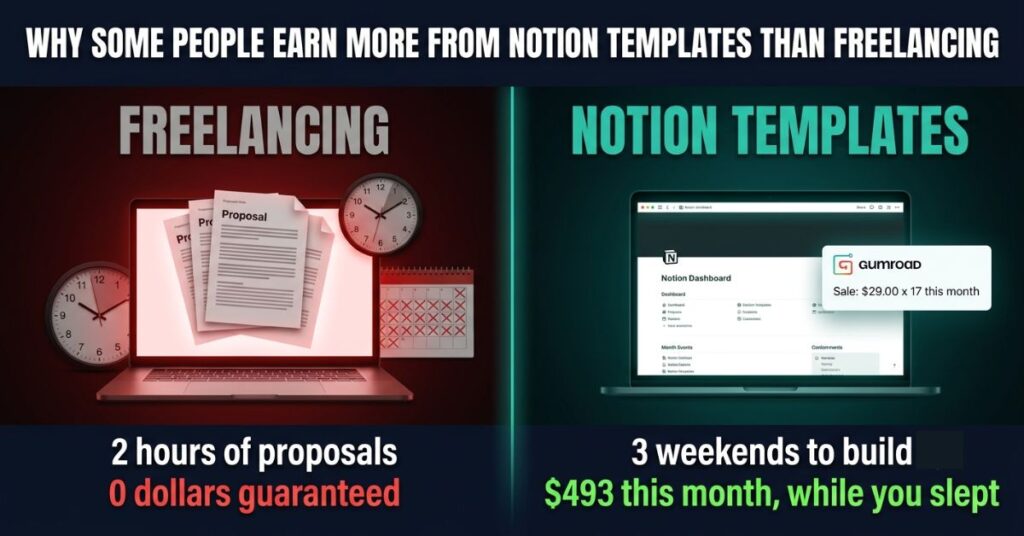
I did the calculation on a Tuesday afternoon when I was fed up with proposals.
Three Upwork proposals that morning. About forty minutes each to research and write properly. Two hours gone and nothing to show for it yet. Just three pending conversations that might or might not turn into work. I had been freelancing long enough with experiences. I know that the expected value of that particular morning was somewhere between zero and one small project.
Then I found a Reddit thread where someone had shared their Gumroad dashboard. A Notion template for freelance client management priced at $29. Selling fifteen to twenty copies a month. They had built it across three weekends and it was now generating $435 to $580 per month without any of the things that had consumed my morning; no proposals, no waiting, no revision conversations at 11pm, no clients changing their minds on the final delivery.
I sat with that for a while.
Three weekends of work against the indefinite churn of proposal-writing. And the template was winning on every measure that mattered to me at that moment. Not because template income is inherently better than freelance income, but because the structure of the economics is fundamentally different. I had never properly compared them before that afternoon.
That is what this article is actually about, not a promise that Notion templates will make you rich. Several people have made extraordinary income from them and those numbers are real. But the more interesting question is what happens when you honestly compare the two models at the level that most people reading this are actually working at. Somewhere in the middle not at the exceptional outcomes but at the realistic ones.
The Cost of Freelancing That Does Not Appear on an Invoice
Freelancing pays well until the math stops working.
The ceiling arrives in different ways for different people but it always arrives. You run out of hours to sell. The client development work between projects takes longer than the projects themselves. A rate increase that seems justified loses you the clients who were paying the old rate and the replacement clients take time to find. These are structural limits, not performance problems, they exist regardless of how skilled you are.
What compounds the problem is something harder to quantify. The emotional overhead of client work accumulates differently from the time cost. A proposal that does not get a response and a revision request that arrives three days after the final delivery was supposed to be final. A client who disputes the scope of what was agreed after the work is done, none of these are catastrophes individually. Across a year they add up to something that starts to feel heavier than the income justifies.
I am not saying this to make freelancing sound bad. It is a legitimate business model and I still do it. What I am saying is that the honest version of the comparison includes these costs, not just the hourly rate versus the per-sale revenue.
Notion templates do not have revision requests, they do not have scope disputes. A buyer either finds the template useful or they do not and the interaction is largely over either way within a day of the purchase. The emotional texture of that model is genuinely different from the emotional texture of service work, in ways that do not show up in any income comparison but that matter significantly to anyone who has been doing client work for a few years.
Many creators earn $500 to $5,000 or more monthly from Notion templates. According to data compiled across multiple creator economy platforms in 2026.
Creator Easlo made over $500,000 from Notion templates, Thomas Frank crossed $1 million and Nick Lafferty earned $80,000 in a single year. These require context; all three had established audiences before the income scaled and audience is the variable that template income advice most reliably skips over.
But there is a meaningful middle of this market that most people ignore because the headline numbers are more interesting. A creator with a specific product in a specific niche can realistically reach $500 to $1,500 per month within six months according to creator economy research from 2026. That does not require an existing audience, it requires a specific product that solves a specific problem for people who are already looking for it.
Specific Beats Pretty Every Single Time
The gap between a Notion template earning $50 total and one earning $5,000 in a year is almost never design quality. It is almost always how specifically it describes who it is for.
A template called “productivity system” sits alongside hundreds of others called variations of the same thing. A buyer who lands on it has no particular reason to choose it over any of the alternatives. The name communicates nothing about whether this was built for their specific situation, so they move on.
A template called “freelance graphic designer client onboarding system” finds a different type of buyer. Someone who is a freelance graphic designer, who is specifically struggling with client onboarding, who searches for exactly that phrase. The template name tells them immediately that this was built for people like them. The conversion rate from that encounter is dramatically higher than from generic template browsing, because the buyer feels understood before they have opened the product page.
The categories performing best in 2026, based on data from SendOwl’s template sales analysis and Kupkaike’s creator economy research, all share this characteristic. They are specific enough that the right buyer recognizes themselves in the title.
Content creator management systems do well because content creators who are growing their output understand that disorganisation costs them money directly. A template covering content calendar, sponsorship tracking and multi-platform scheduling, priced at $10 to $35, sells consistently to buyers who are already feeling the pain it solves.
Freelance business management templates do well because a large population of freelancers is managing client relationships, pipeline and invoicing through a combination of spreadsheets, email threads and memory. A well-built freelancer CRM with client history and pipeline tracking, priced at $29 to $39, is selling against the buyer’s current system which is painful enough that they will pay to replace it.
Student academic planners have an enormous recurring audience. Every new academic year brings a fresh cohort of students who did not have this problem last year and now do. The product does not need to be updated to reach a new buyer, the buyer is created by the calendar.
Personal finance trackers spike in January and around tax season and sell steadily the rest of the year because the underlying problem, understanding where money is going, does not go away.
The pattern in all of these is a specific person with a specific ongoing problem who will use the template regularly. Daily use generates word of mouth, one-time purchases do not.
Running the Numbers Properly
A $29 template selling fifteen copies a month generates $435 gross. Gumroad takes 3.5% plus $0.30 per transaction, leaving roughly $27.68 net per sale. Fifteen sales produces approximately $415 per month after fees.
Compare that to fifteen hours of freelance work at $29 per hour, which is the same gross revenue but requires fifteen hours of active work every month to maintain. The template required twenty to twenty-four hours of work to build across a few weekends. It requires perhaps two to four hours per month for occasional maintenance, documentation updates and answering support questions.
At month six the comparison looks like this: the freelancer has delivered fifteen hours of work per month for six months, totalling ninety hours of active labour. The template creator has delivered twenty-four hours of initial build time plus perhaps fifteen hours of maintenance across six months, totalling thirty-nine hours. Both have generated roughly the same monthly revenue in month six. The template creator got there with less than half the hours.
The point is not that templates are always better, it is that the comparison is almost never made properly. The time investment to create the product is compared unfavorably to the immediate income of a freelance project without accounting for the months of recurring sales that follow.
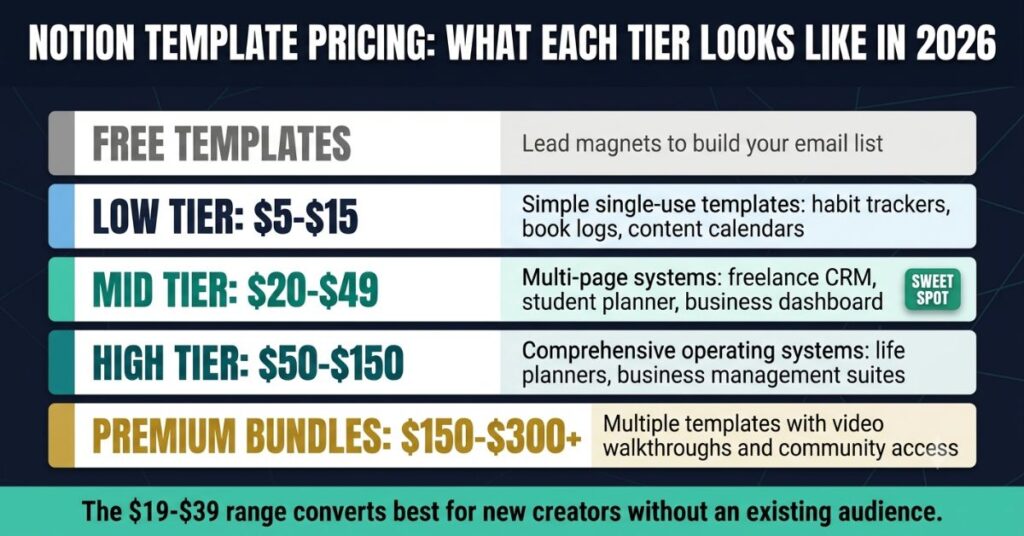
The pricing structure worth understanding before setting a price; free templates as lead magnets to build an email list, simple single-purpose templates at $5 to $15, multi-page systems at $20 to $49, comprehensive operating systems at $50 to $150 and premium bundles with video walkthroughs and community access at $150 to $300 or above. The conversion sweet spot for most new creators without an existing audience is $19 to $39 which is high enough to signal quality and low enough that buyers make the decision without lengthy deliberation.
Etsy, Gumroad or Your Own Site
Three platforms dominate this market and each one works differently enough that choosing the wrong one for your situation costs real money.
Gumroad has the simplest setup, the fee is 3.5% plus $0.30 per transaction. The built-in discovery is limited, which means most of your sales come from traffic you send there rather than from Gumroad surfacing your product to buyers browsing the platform. The affiliate program is genuinely useful for getting other creators to recommend your template to their audiences. If you have an existing audience or a specific community you are marketing to, Gumroad is the simplest infrastructure choice.
Etsy charges a $0.20 listing fee plus 6.5% transaction fee but offers significantly better passive discovery. People actively search Etsy for Notion templates and the search algorithm surfaces relevant listings to buyers with that intent. A well-optimised Etsy listing can generate consistent organic sales without the creator sending external traffic, which changes the economics significantly for someone starting without an audience. The higher fee is worth it if the alternative is paying for traffic through other means.
Your own site, with Gumroad or Lemon Squeezy as the payment processor, gives you the best economics and the best long-term ownership of the customer relationship. It also requires you to build your own traffic, which is the slowest part of the equation. The right progression for most people is Etsy first for organic discovery, Gumroad alongside it for community and social traffic, and an owned site once the product is proven and a small audience exists.
Why the First Template Fails and What Changes the Second Time
Almost every first-time template creator starts with the design, the aesthetic, what they want it to look like. This is the sequence that produces products that nobody buys, not because they are ugly but because they were built from inspiration rather than from demand.
The process that produces templates with consistent sales starts before any design is done. It starts in the communities where the target buyer already exists.
The Notion subreddit, Facebook groups for the profession you are targeting and communities for content creators or freelancers or students or whoever your buyer is. The question to bring to those spaces is not what would a useful template look like but what are people in here doing manually that is clearly painful and that a well-built system would help them stop doing manually.
The answers that come back are product briefs not features you want to build. Problems the buyer already knows they have and is already looking for solutions to. A template built to solve a problem that people are already articulating in community posts does not need the creator to convince anyone the problem exists. The buyer arrives already convinced.
Build the simplest version that solves that problem well, the instinct is to be comprehensive. The market rewards clarity. A template that does three things well outsells one that claims to do twenty things adequately, because the buyer can immediately see what the focused one is for and cannot see through the complexity of the ambitious one.
AI tools can significantly reduce the time it takes to produce good documentation, create template cover images and write product descriptions. This article covers specifically how to deploy AI in an online income workflow without wasting time on the wrong tasks.
Documentation is the part most first-time creators skip and most buyers notice. A template that requires significant effort to understand before it can be used will generate negative reviews, support requests and refunds in roughly equal measure. A short written setup guide, a brief video walkthrough and clear section descriptions add three to four hours to the build time and substantially change what the first-month review profile looks like.
Getting to the First Twenty Sales
If you have not yet made your first dollar online, the framework in this guide applies before this one.
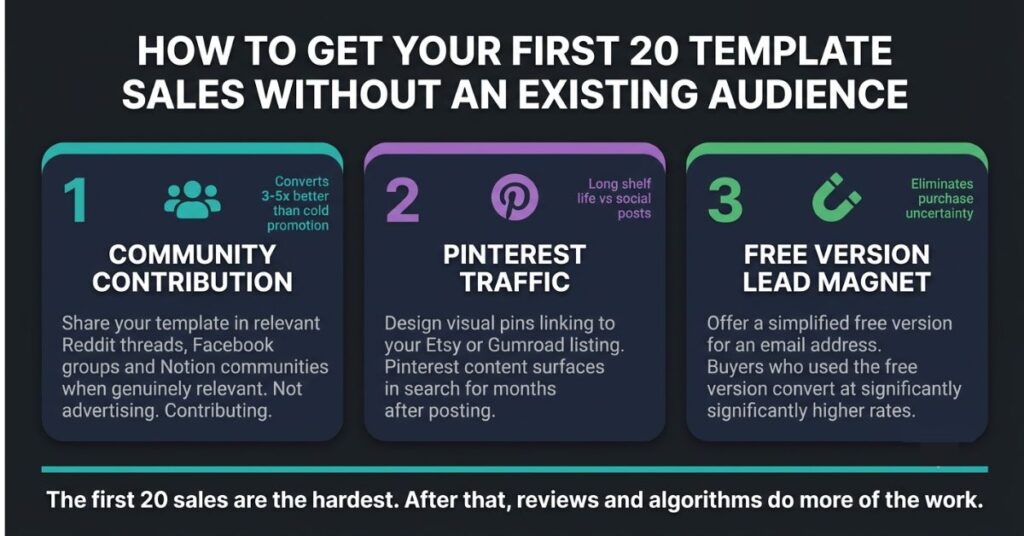
The first ten to twenty sales are the hardest because the platform has no data about your product, no reviews to surface and no reason to show it to buyers over competing products with a longer track record.
The communities where your target buyer already spends time are the most direct route through this early period. Not advertising in those communities. Contributing genuinely and mentioning the template when it is actually relevant to a specific conversation. The distinction matters both ethically and practically, a resource shared in a relevant context gets clicks and conversions. An advertisement in the same context gets flagged or ignored.
Pinterest is underused for this specific type of product. Notion templates are inherently visual and Pinterest serves visual content to users with search intent in a way that other platforms do not. A well-designed pin linking to an Etsy or Gumroad listing generates traffic consistently over months, because pins surface in search results for a long time after they are posted. The shelf life of Pinterest content is longer than almost any other platform’s, which means the time invested in creating good pins pays forward for longer.
The free version as lead magnet approach changes the dynamic for buyers who are uncertain. A simplified free version of the same template, offered in exchange for an email address, introduces the product to the buyer without requiring them to make a purchase decision. Someone who downloads the free version, uses it and finds it genuinely useful has already experienced the value. The conversion from free to paid is significantly higher than cold conversion because the uncertainty that prevents most digital product purchases has been eliminated.
What the Honest Version of This Looks Like
The passive income framing that surrounds digital product content is misleading in a specific way that costs people time and money when they discover the reality.
If you want the full picture of what passive income actually means and what it costs to build, this article covers it honestly.
Building the template is active work, typically twenty to thirty hours for a well built mid-tier product. Marketing it in the early period is active work and also maintaining it when Notion updates its features is active work. Handling customer questions and the occasional refund is active work as well. None of this is heavy or time-consuming relative to client work. But it is not passive and calling it that sets up expectations that the actual experience does not meet.
The six-month timeline to $500 to $1,500 per month from Kupkaike’s creator data assumes consistent effort across that period. Someone who builds one template, lists it and does nothing further will generate some organic sales. Whether those sales add up to anything meaningful depends on the platform, the niche and algorithmic factors that are genuinely hard to predict.
The model that actually works for most people who build meaningful template income is running it alongside freelancing rather than instead of it. Freelancing provides income during the months when template sales are building. The expertise that comes from client work produces better, more specific templates because you understand the buyer’s problem from direct professional contact rather than from assumption. The two compound each other in ways that most template-only advice does not capture because most template advice is written by people who already had an audience when they started.
Frequently Asked Questions
How do I duplicate a Notion template I have built so buyers receive their own copy rather than accessing mine?
Notion has a built-in share mechanism for templates. When your template is ready to sell, go to the Share settings and enable the option to allow others to duplicate it. This creates a shareable link that buyers use to add a copy of the template to their own Notion workspace. They get a full editable copy. You retain the original. Your content and structure cannot be edited by the buyer because they are working in their own duplicate. This is the standard delivery mechanism for Notion templates and the link you generate is what you upload as the product file on Gumroad or Etsy.
Can I build a Notion template business without ever showing my face on video?
Yes. The most effective early marketing channels for Notion templates, community contributions and Etsy optimization, do not require video content. Pinterest marketing is visual but does not require the creator to appear in the content. An email list built through a free template lead magnet communicates entirely through written newsletters. Creators who have built to $1,000 per month without any video presence exist across the market. The creators who scale beyond that typically do use video because a walkthrough of the template is one of the most effective purchase conversion tools available. But video is not a prerequisite for building meaningful income from templates at the level most people are aiming for initially.
What is the difference between selling on Gumroad versus building my own Notion template website?
On Gumroad you benefit from their existing payment infrastructure, affiliate program and a small amount of platform discovery. You pay 3.5% plus $0.30 per transaction and you do not own the relationship with your customers in the fullest sense, because Gumroad controls the platform. On your own site using a payment processor like Lemon Squeezy embedded, you keep a higher percentage of each sale and you own the customer relationship entirely. The cost is that you need to build your own traffic because no one discovers your products through your site by browsing. Most successful template creators use both Gumroad or Etsy for discovery and transactions early on, an owned site as the primary hub once the audience and reputation are established.
How do I know whether my template idea will sell before I spend twenty hours building it?
Search for the problem your template solves, not for the template itself. Look on Etsy for existing templates in the same category and check whether there are products with reviews, which confirms buyer demand exists. Check Google Trends for the search query your target buyer would use. Look at the Notion subreddit and relevant Facebook groups to see whether people are asking for help with the problem your template addresses. If existing products have reviews, searches return results and community posts mention the problem, the demand exists. If none of those signals appear, the problem may not be painful enough or common enough to support meaningful template sales.
What if I build the template and then discover a competitor already built the same thing?
Competition is evidence of a market. A category with no competing templates is more likely to indicate absent demand than an untapped opportunity. The question is not whether competition exists but whether your version is meaningfully better for a specific sub-audience. A freelance client management template that is specifically optimized for designers is a different product from one optimized for consultants, even if the underlying functionality looks similar. Finding the specific angle that makes your version the most relevant option for a specific type of buyer is more valuable than trying to build in a category where nobody else has gone.

Johnson Alaekezie is a freelancer and digital content creator with several years of experience working across writing, content strategy, and digital services. He founded IncomeGigAI to share honest, practical information about building income online without the hype that dominates most of this space. Johnson has worked with clients in the US, UK and beyond, and writes from direct experience rather than theory. He is based in Nigeria and covers the digital income topics he has personally navigated as a working freelancer.