
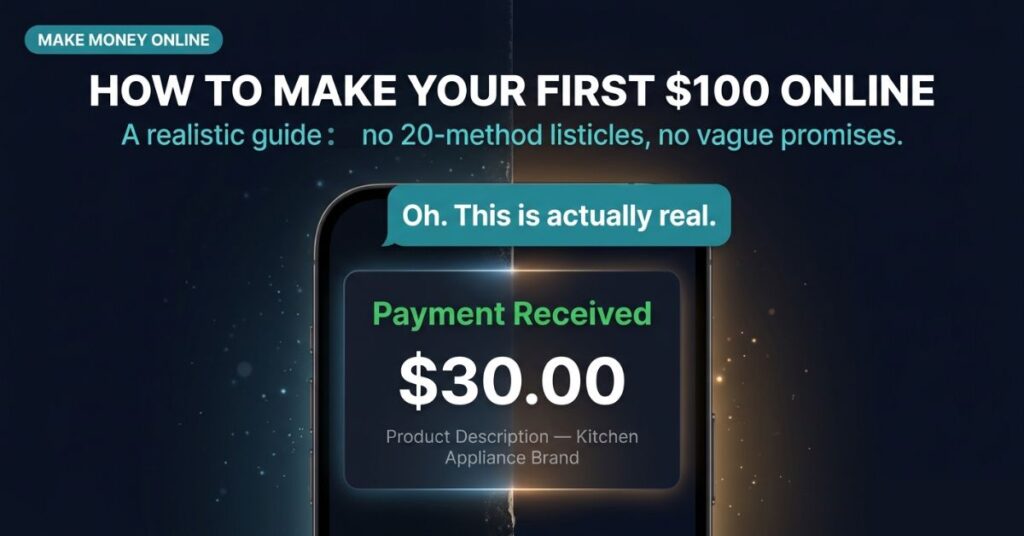
My first $100 online came from writing product descriptions for a kitchen appliance brand I had never heard of.
Four descriptions and the buyer paid around $25 each. The brief for each one was about three sentences. The first took me almost an hour because I kept second-guessing the tone. The second took forty minutes. By the time I wrote the fourth I had settled into a rhythm and it took about twenty-five minutes. Total time spent across all four is maybe three and a half hours.
I remember checking my account that evening and seeing the money sitting there. Not a lot but the specific feeling I had was not about the money at all. It was something more like: oh, this is actually real. I was supper excited, what do you expect, it’s my first pay in $$$.
Before that week, I had read enough about making money online to know what was theoretically possible. After it I had done it. A stranger had found my profile, liked what they saw, paid me and gone away satisfied. That loop had completed and something about having completed it once made everything else feel different, because the question was no longer whether it was possible but what to do next.
Most guides about making your first $100 online spend almost no time on that distinction. They treat the $100 as a financial goal and give you a list of methods to reach it. The list is usually long. Surveys, dropshipping, affiliate marketing, print on demand, starting a blog, YouTube, selling crafts on Etsy, taking photos for stock sites. Twenty options and you are supposed to pick one.
The problem with that approach is that most of those methods are not designed to produce income quickly. They are designed to produce income eventually. A blog needs months of published content before it ranks well enough to earn anything from advertising. Affiliate marketing needs an audience to market to. YouTube does not pay creators directly until they hit 1,000 subscribers and 4,000 watch hours. Print on demand requires enough traffic to test products and enough sales to build momentum.
None of those are bad directions to go. But they are terrible answers to the question of how to make your first $100, because the answer to that question has a specific constraint the others do not: it needs to work before you have an audience, before anyone knows who you are, before you have a track record on any platform. Strip out everything that requires those things first and you end up with a much shorter list than most guides present.
Just Sell Something to One Person.
The fastest path to a first $100 is finding one person who will pay you for something you can already do. That is it, not building a store, creating content or setting up funnels. One person, one transaction.
The reason this works when everything else is slow is that it does not require infrastructure. No audience or following. No proof of past performance beyond your ability to describe what you are offering clearly. Just a skill offered on a platform where buyers are already looking.
When I put up my first service listing I was not confident about it. The description was decent but I had no reviews, no portfolio, no track record on the platform. I priced it low, around $25, because that felt honest given what I was bringing to it. And I got a buyer within the first week.
That price felt almost embarrassingly low at the time. Looking back, it was exactly right. The platform runs on social proof. Buyers need reviews before they trust you with anything significant. Your first few sales are not really about the money. They are about accumulating the reviews that make the next sale easier and justify a higher rate.
Fiverr and Upwork are the platforms most likely to generate a first sale quickly for someone starting from zero.
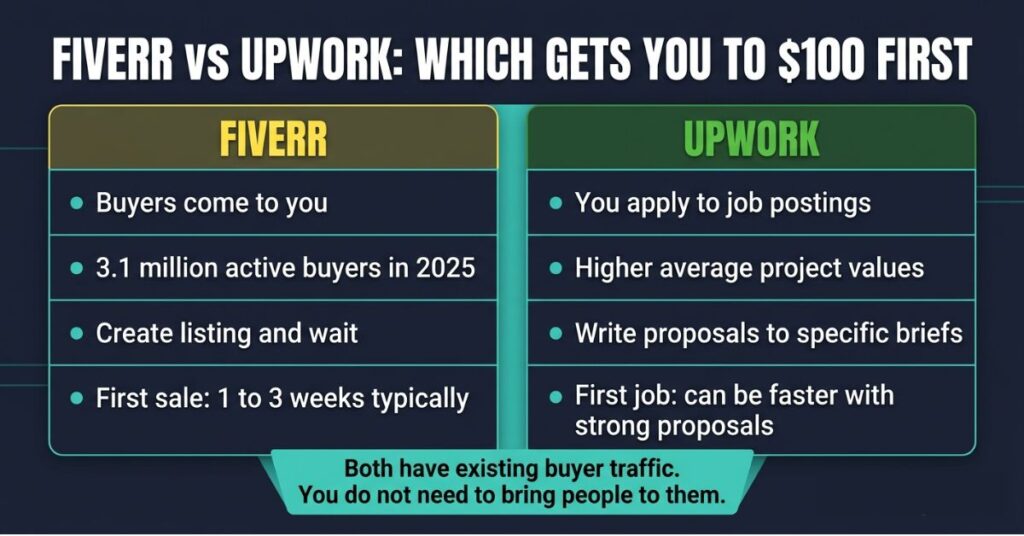
Fiverr alone has 3.1 million active buyers across more than 700 service categories, and 67% of its revenue comes from repeat buyers, meaning the clients using the platform are committed to it, not just browsing once.
Fiverr works by creating a listing and waiting for buyers to find you. Upwork works by browsing job postings and sending proposals to specific clients. Both have real buyer traffic. You do not need to bring people to them the people are already there.
On Fiverr, a clearly written listing from a new account with a competitive price generates a first sale somewhere between one week and three weeks for most people. On Upwork, the timeline depends on how quickly you can find jobs that genuinely match what you offer and write proposals that speak directly to the client’s specific problem rather than just listing your credentials.
The thing about proposals on Upwork that most beginners get wrong: read the job description carefully enough to mention something specific from it in your response. Something that shows you actually read it. Most proposals are generic enough that a specific one stands out immediately.
What Counts as a Skill Worth Selling
Most people underestimate what qualifies as a sellable skill. They assume it means something technically impressive or years of professional training.
It does not. A skill, for the purpose of getting your first $100, is anything you can do that would either save someone time or produce something they cannot easily produce themselves. Writing a coherent paragraph is a skill, formatting a document properly is a skill, transcribing audio accurately is a skill, Finding information through research is a skill. Also, if you can manage someone’s email inbox, create a basic slide deck, edit video with tools like CapCut or translate between two languages you actually speak are professional skills.
I spent three years working in an office before I started freelancing. In that time I became reasonably good at things that felt completely ordinary to me, like writing clear internal communications, building spreadsheets that did not confuse people, formatting reports so they were easy to read. None of that felt special. All of it was, to somebody who did not have it and needed it done.
The exercise I would suggest is simple. Think about the last time someone asked for your help with a task and you helped them. What was the task? How long did it take you versus how long it would have taken them? If your answer is that it would have taken them significantly longer or they would not have done it as well, you have a sellable skill right there.
Write down five things like that. Then look at each one and ask: is there a business owner or busy professional who would pay to have this done rather than do it themselves? The answer is almost always yes more often than the list suggests.
The Three Reasons New Service Listings Fail
Most people who set up a first service listing and get no buyers are making one of three mistakes.
Pricing too high before having reviews is the most common. On platforms like Fiverr, buyers make decisions based on a combination of price, reviews and how clearly the listing communicates what they will get. A new account has no reviews. That is a real disadvantage and pricing needs to account for it. Charging $150 for something experienced sellers with hundreds of reviews charge $200 for will lose almost every time. Charging $30 for the same thing is uncomfortable but it generates the first sales, which generate the first reviews, which make the next sales easier. The goal at the start is not the best rate. It is the first transaction.
Writing about yourself instead of the client is the second mistake. Every word in a service listing should answer the question the buyer is silently asking: what will I actually have when this is done? Not how long you have been writing, not how passionate you are about design, not what qualifications you hold. Those things matter less than a clear answer to what problem does this solve and what does the finished result look like?
Offering too many things is the third. A listing that says “writing, editing, proofreading, research, social media and more” is not appealing to the buyer looking for someone to edit their newsletter. It looks unfocused. A listing that says specifically “newsletter editing for small business owners” gets fewer impressions but converts much better among the people it does reach. The narrow listing finds its buyers. The broad one mostly gets ignored.
The Starting Points People Overlook
Virtual assistant work is the most underrated path to a first $100 for people who are not sure what skill to sell.
The work itself is not glamorous: organizing email inboxes, scheduling appointments, formatting documents, uploading content, managing spreadsheets, doing basic research. But the pay is real, the demand is consistent and the barrier to entry is lower than almost anything else. Basic VA rates run from $20 to $50 per hour. At $25 per hour, four hours of work gets you to your first $100. What the work requires is not a rare skill. It requires reliability and following instructions carefully. Responding promptly. Doing what you said you would do by the time you said you would do it. Those qualities are worth real money to people who are too busy to do the tasks themselves.
Tutoring is another path that gets people to their first $100 faster than most realize. Platforms like Wyzant, Chegg Tutors and Preply connect tutors with students without requiring any marketing on your part. If you did reasonably well in any academic subject or have genuine proficiency in a second language, there is demand for sessions in it. Test preparation pays $40 to $100 per hour. English as a second language tutoring pays $15 to $35 per session. Two sessions of test prep tutoring and you are at $100.
Transcription is worth mentioning specifically because it has the lowest skill barrier of any method that pays a decent rate. Platforms like Rev pay per audio minute for transcription work. Rev’s current transcription rates sit at $1.99 per audio minute for human-verified work, meaning two hours of audio transcribed accurately generates close to $240 at the human rate. The bottleneck is typing speed and accuracy, not experience or credentials. The application and test process for Rev takes about a day. Work is available whenever you want it.
None of these are exciting, I want to be honest about that. They are not the income streams that make for a great screenshot or a compelling story at a dinner party. But they are the ones most likely to put $100 in your account before the month is out and that first $100 is the one that changes how you think about what you can actually build.
The Thing That Delays People the Most
I have sat next to people building their first online income and watched the pattern enough times to say this with confidence. The thing that delays the first $100 more than anything else is preparation that replaces action rather than preceding it.
Spending two weeks getting the Fiverr profile exactly right before publishing it. Watching twelve hours of Upwork tutorials before sending the first proposal. Reading every article about the best freelance niche before offering anything. Starting three different courses on how to become a virtual assistant before responding to a single job posting.
None of that work is worthless. But it produces zero dollars and teaches you almost nothing that the first actual sale would not have taught you more directly.
The information required to start is genuinely small. What are you offering? Who would want it? Where can you reach them? Three answers. That is enough to begin.
Everything you actually need to learn, how to price competitively, how to write a proposal that converts, how to communicate with a client in a way that makes them want to work with you again, comes from doing the thing. Not from preparing to do the thing. The preparation feels productive. The first sale actually is productive.
One imperfect listing published today will teach you more than ten perfectly researched ones you have not published yet.
After the First $100 Lands
This is where most guides end and where I think some of the most important thinking actually begins.
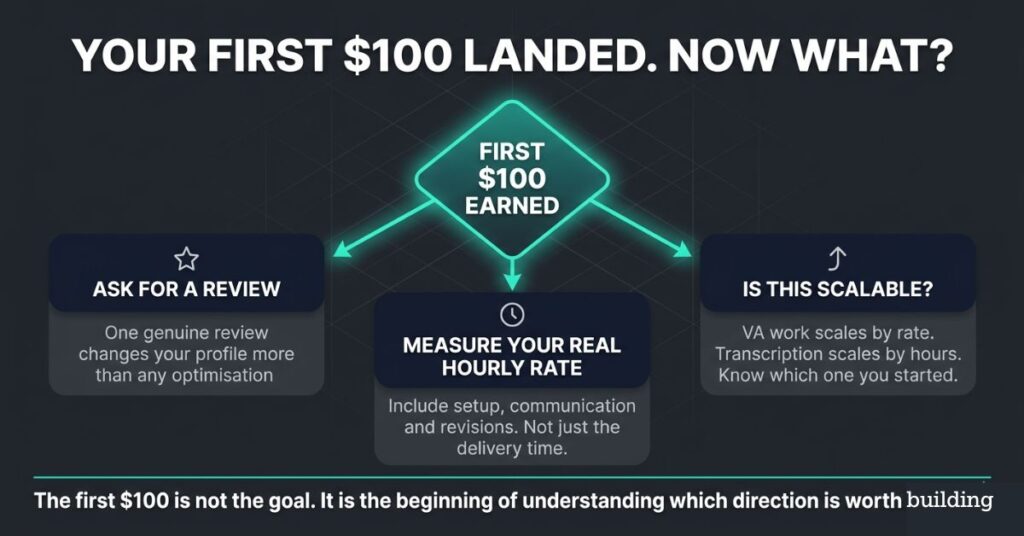
The first question worth asking after the first $100 is not how to make the second $100. It is: what specifically just happened? What did I offer, to whom, on which platform, at what price and how long did the whole thing take including the time spent setting up, communicating and delivering?
That breakdown tells you the actual hourly return on your first sale, which is almost always different from the headline rate. A $30 product description that took forty minutes of writing sounds like $45 per hour. Add in the thirty minutes of back-and-forth with the client, the fifteen minutes to set up the listing and the revision request that took another twenty minutes and the real rate is closer to $17.
That is not necessarily bad. It is just the honest number and knowing the honest number is what helps you decide whether this is worth developing or whether a different method would use your time more efficiently.
The second question is whether the method scales. VA work scales by raising rates as you build a reputation, specializing into higher-value tasks and eventually building an ongoing relationship with one or two clients who give you consistent hours. Transcription does not scale much beyond working more hours. Tutoring scales by moving into higher-demand subjects or higher-rate formats like intensive test preparation packages.
Understanding the ceiling of what you started with helps you decide how much energy to put into developing it versus when to start building something alongside it.
Once you have consistent freelance income, niching down as a freelancer changes everything about rates and client quality in ways worth understanding before you plateau.
Ask the client who paid you for a review. One genuine review from a real client changes what happens to your profile in ways that are hard to overstate when you are starting from zero. If the client was satisfied, asking is not awkward. It is just a professional follow-up, most happy clients are glad to leave one.
How Long This Actually Takes
Rather than a single timeline that may not fit your situation, here is what different methods actually look like in terms of getting to $100.
Freelance services through Fiverr or Upwork: the range for a first sale runs from three days at the fastest to three weeks at the more typical end. Three days requires a strong listing, competitive pricing and some fortunate timing. Three weeks is normal for someone still figuring out the platform. A first $100 within thirty days through freelance services is realistic for almost anyone with something specific to offer and a willingness to price for their current track record rather than their desired rate.
Once your first clients come through a platform, the next step worth planning for is getting freelance clients without depending on platforms for every new project.
Tutoring: if you are active on a platform and available for sessions, a first booking can come within a week. Getting to $100 requires two to four sessions depending on the subject and rate. STEM subjects, test preparation and English as a second language move fastest.
Transcription through Rev or TranscribeMe: the application takes one to two days. Work is available on demand once you are accepted. Getting to $100 requires two to three hours of audio at Rev’s typical rates. The ceiling is your typing speed and the hours you put in, not market availability.
Micro-tasks through platforms like Amazon Mechanical Turk: this takes longer than most people expect because individual tasks pay very little. It is not a primary strategy for your first $100. It is useful as a way to get comfortable with the mechanics of online earning while something else is being developed in the background.
Frequently Asked Questions
What if my first listing gets views but no sales?
Views without sales usually mean one of two things: the price is too high relative to your lack of reviews or the listing is not clearly communicating what the buyer gets. Look at your three strongest direct competitors on the same platform. How does your price compare to theirs? How specific is your service description compared to theirs? If your listing is priced above theirs and your profile has fewer reviews, you are asking buyers to take on more risk for more money, which most will not do. Drop the price until you have reviews, then raise it. It is uncomfortable but it is how the platforms work.
Should I tell potential clients I am new to freelancing?
You do not need to volunteer it. You also should not lie about it. Most clients do not ask directly. What they look at is your profile, your samples if you have them, your listing description and your price. A clearly written listing with a competitive price does not need a disclaimer about your experience level. If a client directly asks how long you have been doing this, answer honestly and focus the conversation on what you will deliver for them specifically rather than on your general history.
I applied to three platforms and heard nothing back for a week, is this normal?
On Fiverr, yes. Passive listings do not notify you of anything because buyers browse and either click or do not. On Upwork, one week with no responses to proposals typically means the proposals need to be more specific. A proposal that could have been sent to any job posting reads like one that was. The ones that get responses usually reference something specific from the job description, show some understanding of the buyer’s actual situation and make a clear, direct offer. Read the next job description you apply to three times before writing your proposal.
What if I earn my first $100 but then the income stops completely?
This happens more often than people admit and it is usually a sign of one of two things. Either the first sale came from circumstances that are hard to repeat, like a friend or contact who used the platform as a favor or the listing or profile was not strong enough to generate organic discovery once the initial visibility window closed. Fiverr gives new listings a brief period of elevated placement to test market response. If no sales come during that window, the listing drops in the rankings. Go back to the listing and look at it as if you are the buyer. Does the title match what someone would search for? Does the description answer the questions a buyer would have before purchasing? Is the price competitive given your track record? Usually at least one of those three things needs adjustment.
Is it worth making your own website before earning your first $100?
No, personal website takes time to build, costs money to host and does nothing to help you find your first client when platforms like Fiverr and Upwork already have the buyers you need. Build the website later, once you have a body of work worth showcasing and clients worth directing to it. Spending two weeks building a portfolio site before earning anything is exactly the kind of preparation that replaces action rather than enabling it.

Johnson Alaekezie is a freelancer and digital content creator with several years of experience working across writing, content strategy, and digital services. He founded IncomeGigAI to share honest, practical information about building income online without the hype that dominates most of this space. Johnson has worked with clients in the US, UK and beyond, and writes from direct experience rather than theory. He is based in Nigeria and covers the digital income topics he has personally navigated as a working freelancer.