
Last year a client told me he had cancelled his subscription to a content agency because ChatGPT was doing the same work for less. He said it as a matter of fact, the way you might mention switching phone carriers. No drama at all, just a decision he had made and moved on from.
I have been watching the freelance market shift for the past two years and talking to freelancers across different disciplines about what they are actually experiencing. Not what the think pieces say is happening. What is showing up in their inboxes, their Upwork dashboards, their client conversations and their invoices. The picture that emerges from those conversations is more specific and more navigable than most of the coverage suggests.
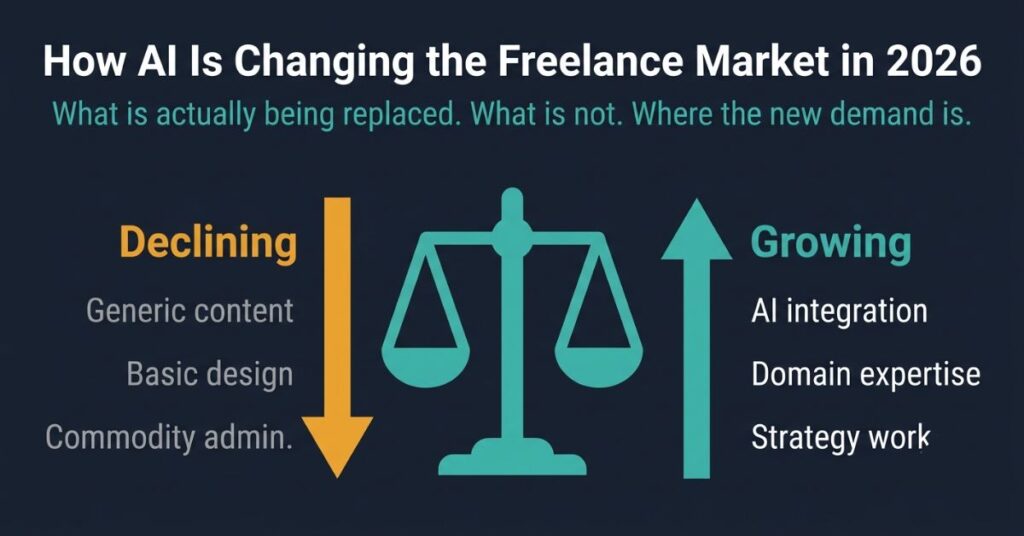
What Is Being Replaced
The commodity end of almost every freelance category.
Generic blog content is the clearest example. The problems AI writing tools create for writers go beyond market pressure. Our honest review of what those tools actually do covers the craft and voice dimension that the market data does not.
The 800 words SEO article on a topic the client found in a keyword tool, written to a standard brief, requiring no specialist knowledge and no distinctive perspective. That work has been under severe pressure since late 2023 and the pressure has not eased. Fiverr’s own Business Trends Index for 2026 shows writing and translation project volume down 28 percent year over year. That decline is real and it is concentrated in exactly this category.
Basic graphic design has followed a similar pattern. Canva templates and AI image generation tools have compressed the market for simple, non-specialist design work. A small business owner who previously hired a freelancer for a social media graphic set is now often doing it themselves with Canva’s AI features. The market for this kind of work has not disappeared but it has shrunk and the rates have fallen with it.
Transcription and data entry were always the most automatable tasks in the freelance market. They were being automated before AI became mainstream. The current acceleration just made a direction that was already clear move faster.
Basic translation has similarly contracted. Machine translation has improved enough that clients who needed rough translation for internal use are increasingly handling it themselves. Professional translation for legal, medical or literary purposes is holding up. Commodity translation is not.
Administrative virtual assistance is under real pressure too. Scheduling, inbox management, basic research and data formatting. AI tools are taking meaningful portions of these tasks. VAs who have repositioned around higher-judgment work, client relationship management, operational decision support are doing fine. Those still competing on basic admin volume are not.
The connecting thread across all of these is the same: work that could be described in a simple brief, that required competence but not specialisation, that produced an output indistinguishable from what anyone else with basic skills would produce. That is the category under pressure. The work that required a specific person with specific knowledge in a specific context is a different story.
What Is Not Being Replaced
Strategy is holding up, the ability to look at a client’s situation and determine what they should be doing. Not just execute what they have decided to do, remains firmly in human territory. AI tools can generate options and analyze data. They cannot replace the judgment that comes from having seen similar situations fail in similar ways.
Relationships are holding up as a client does not hire an account manager because they need someone to send emails. They hire one because they need someone they trust to represent their interests. And read situations that require human interpretation which AI can not do this.
Domain expertise combined with communication skill is holding up. A freelance writer who understands financial regulation deeply enough to write about it accurately and accessibly is not competing with ChatGPT. A developer who can architect a system for a complex use case and explain the tradeoffs to a non-technical founder is not competing with GitHub Copilot. The combination of deep knowledge and the ability to communicate it to a specific audience is genuinely hard to replicate and the market for it reflects that.
Original creative work with a distinct voice is holding up. The newsletter writers, the essayists, the copywriters whose work sounds like them specifically are not being replaced by tools that produce the most average version of good writing. The market for generic creative output is shrinking but the market for distinctive creative output is not.
High-stakes deliverables are holding up. When the output matters enough that being wrong is costly, clients want a human accountable for the work. Legal documents, medical content, financial analysis, crisis communications. AI assists in these areas but the accountability layer remains human and clients are willing to pay for it.
Research requiring real world access is holding up. Journalists, investigators, qualitative researchers, user experience researchers. The work that requires being in a room, building trust with a source, conducting an interview and interpreting what was said and unsaid but AI cannot do fieldwork.
Where New Demand Is Growing
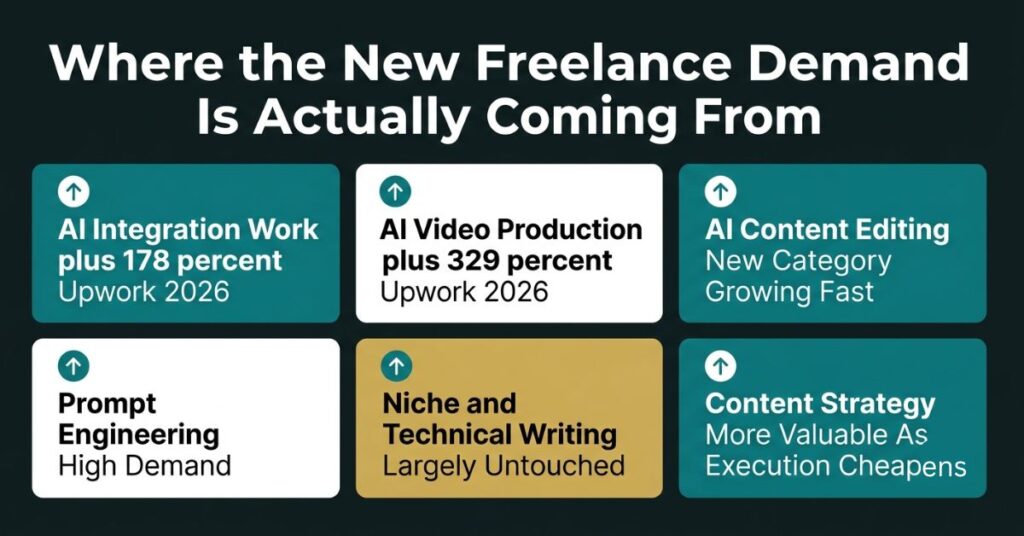
AI integration work is growing at 178 percent year over year on Upwork according to their 2026 In-Demand Skills report. Businesses want to embed AI into their operations and most of them cannot do it themselves. Freelance developers and technical consultants who can build these integrations are in genuine demand at rates significantly above average freelance pay.
We broke down the full Upwork and Fiverr data on which freelance skills are growing fastest in a separate piece that goes deeper on the specific numbers.
AI content editing and humanizing is a genuinely new category. There is real and growing demand for freelancers who can take AI-generated drafts and make them genuinely good. Not light editing but deep editorial work that adds the voice, the specific detail, the analytical layer that the AI missed. Three years ago this work did not exist but now it is paying real rates.
Prompt engineering and AI workflow design is filling a gap most businesses did not know they had. Businesses that have adopted AI tools often do not know how to use them effectively. Freelancers who understand how to design AI workflows, write effective prompts for specific business use cases. And train teams to use tools productively are finding real work in this area.
AI video production is one of the fastest-growing categories on both Upwork and Fiverr. Someone who can work with raw AI-generated footage. And turn it into something professional is competing in a market with high demand and relatively low supply of people who can do both. The 329 percent growth figure from Upwork’s report is not a rounding error.
Content strategy above the execution layer is becoming more valuable as execution becomes cheaper. The strategic decisions about what to create, for whom, why and how to measure whether it worked matter more when the execution can be done quickly and cheaply. Freelance strategists who help clients make these decisions are doing well.
Niche and technical writing is largely untouched. The more specialised the knowledge required, the less AI threatens the market. Medical device documentation, cybersecurity content, actuarial reports, regulatory filings. These require expertise AI cannot fake convincingly and clients in these sectors know it.
Rate Pressure And What Is Actually Happening
AI has put real downward pressure on rates in several freelance categories and that pressure is not going away. Generic content writing rates have dropped significantly since 2022. Clients who were paying $200 for an 800 words article are now expecting the same article for $80 or producing it themselves. That is a real shift and freelancers in this category who have not repositioned are feeling it.
But the rate pressure is concentrated at the commodity end. Upwork data shows rates for specialized writing in technical, legal and financial categories are holding or growing. Rates for AI integration work are at the high end of the platform. Rates for experienced strategy and consulting work have not materially changed.
I know freelancers who have not felt this at all and freelancers who have felt it sharply. The difference is almost always where they sit on the skill and specialisation spectrum, not which platform they use or how long they have been freelancing.
The Positioning Shift
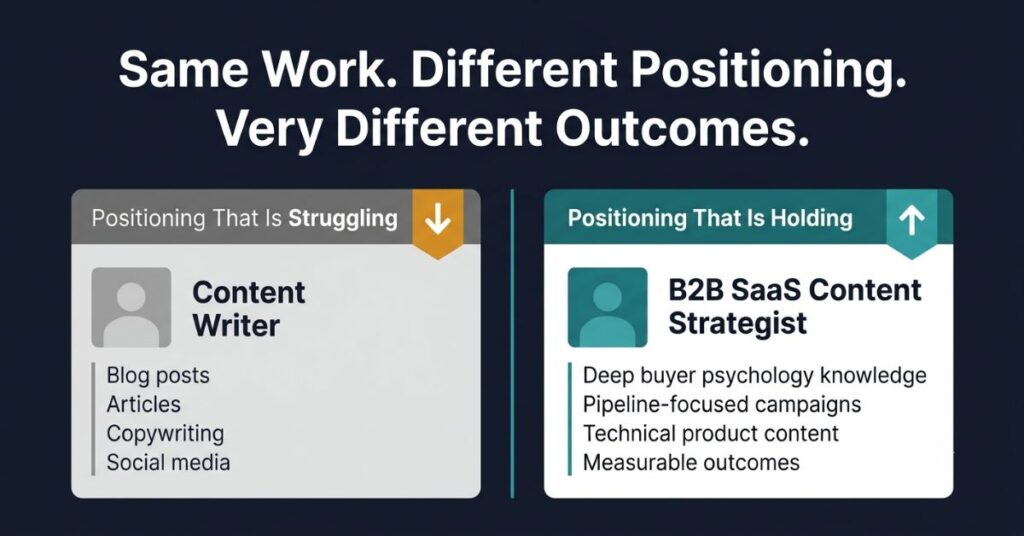
The freelancers doing well in this environment share one characteristic. They have moved their positioning away from describing what they do and toward describing what they know and what they can figure out.
A content writer who positions as a content writer is competing in a category where AI has changed the value equation. A content strategist who positions around deep knowledge of B2B SaaS buyer psychology. And a track record of campaigns that changed pipeline numbers is competing in a category where the value equation has not changed much.
The work might overlap as the writing is still happening in both cases. But the positioning communicates different value and attracts a different kind of client. The B2B SaaS positioning client is not shopping on price. They are shopping on whether this person understands their specific problem deeply enough to solve it.
Repositioning is only half the work. Knowing how to communicate and charge for that new positioning to existing and new clients is covered in our freelance rates guide.
This shift is uncomfortable because it requires making claims about expertise rather than just demonstrating capability. It requires knowing enough about a specific domain to say something genuinely specific about it. That is harder than listing skills and it is also much more defensible against a market that has made the execution of generic skills cheaper.
What Probably Happens Next
Predictions in this area feel risky given how fast things are moving. But a few directions seem clear enough to say out loud.
The commodity end of the freelance market will keep contracting. The tools will keep improving. Clients who are already comfortable using AI for execution will not go back. The volume of low rate, low differentiation work available to freelancers will decline further in the next two years.
The World Economic Forum’s Future of Jobs Report projects that the roles most at risk from automation are precisely the task-based. Repeatable work categories that have defined the commodity freelance market for the past decade.
The specialist and strategy end will hold and in some areas grow. The same forces that reduce demand for commodity work increase the value of the human judgment layer above it. As clients become more sophisticated about what AI can and cannot do, they get clearer about what they need humans for and they pay accordingly.
New categories will keep appearing. AI video, AI integration, AI workflow design and AI content editing are real and growing right now. There will be categories in two years that do not yet have clear names. The freelancers who stay close to what is actually happening in AI development rather than waiting for mainstream coverage to catch up. They will see those categories earlier and build track records in them before they become crowded.
What to Do With This
If your current freelance income is primarily from work that AI can replicate, start repositioning now rather than when the pressure becomes urgent. Not because your current work will disappear immediately but because repositioning takes time. Starting from financial pressure is significantly harder than starting from a position of stability.
Find the intersection of what you know deeply and what clients need that AI cannot reliably provide. That intersection is where your positioning should live. If it feels narrow, that is useful information, it means there is skill building or niche development work to do.
Stay close to what AI tools can actually do in your category right now not in theory but in practice. Freelancers who overestimate what AI can do in their area will undervalue their own contribution. Those who underestimate it will be caught off guard when clients figure it out before they do. Both are bad positions.
Pay attention to the new categories. The fastest path to income growth in this environment is probably not defending an existing position but moving toward one of the emerging categories where demand is outpacing supply. That requires learning and it requires being honest with yourself about whether what you are learning is genuinely useful or just interesting.
The change is real, most of it has moved in a direction that rewards depth and judgment over volume and execution speed. For freelancers who are good at what they do and clear about what makes them specifically useful, that is actually a reasonable environment to be working in.
Frequently Asked Questions
Is it too late to enter the freelance market as a beginner in 2026?
No, but the entry strategy is different from what it was three years ago. Starting with generic writing or basic design is harder because the commodity market is more crowded and lower-paying than it used to be. Starting with a specific niche, a specific audience, and a clear angle on what you know that is genuinely useful to clients in that niche is a more viable path in 2026 than starting broad and narrowing later. The market is harder to enter at the commodity level. It is not harder to enter at the specialist level if you have real knowledge to offer.
My rates have dropped significantly. Is this AI or something else?
Probably some of both. AI has put real downward pressure on commodity freelance rates, particularly in content writing and basic design. But rate pressure also comes from increased global competition on platforms, from clients who have become more price-sensitive, and from some categories simply being overcrowded independent of AI. The diagnostic question is whether clients are specifically telling you they are using AI instead or just offering less money. If the former, repositioning is the clearest response. If the latter, the pressure may be addressable through better positioning, better client selection or moving to channels where your target clients are less price-focused.
I am a writer should I be worried?
It depends on what kind of writing you do. If your work is generic, undifferentiated, and could have been written by anyone with basic competence, the pressure is real and will continue. If your writing requires specialist knowledge, a distinctive voice or strategic judgment about what to say and to whom, the market for that work is holding up. Most writers are somewhere between those two poles, which means the answer is probably partially. The question worth sitting with is which parts of your writing work are genuinely differentiated and which parts are not.
Which platforms are holding up best for freelancers right now?
Platforms that serve specialist and high-value work are doing better than those that compete primarily on price. Upwork is showing strong growth in technical and AI-adjacent categories while lower-tier work has thinned out. Specialised platforms, niche job boards, and direct client relationships are outperforming general commodity platforms in most skill categories. The platform question is secondary to the positioning question though. A well-positioned freelancer will find work across multiple channels. A poorly positioned one will struggle on all of them.
How do I know if my skills are at risk?
Ask yourself honestly whether a motivated person could produce something close to what you produce in a day using AI tools and a modest amount of domain knowledge. If the answer is yes or probably yes, your current positioning is at risk even if the work itself has not dried up yet. If the answer is no or not really, you are in a more defensible position than most of the coverage suggests. The test is not whether AI can do your job at all. It is whether AI can do it well enough that the average client would not notice the difference.

Johnson Alaekezie is a freelancer and digital content creator with several years of experience working across writing, content strategy, and digital services. He founded IncomeGigAI to share honest, practical information about building income online without the hype that dominates most of this space. Johnson has worked with clients in the US, UK and beyond, and writes from direct experience rather than theory. He is based in Nigeria and covers the digital income topics he has personally navigated as a working freelancer.