
In my second year of freelancing I hit a wall I did not recognize as burnout at the time. I thought I was just tired. I took a week off and came back feeling exactly the same. I thought I needed better clients. I replaced one difficult client with a slightly less difficult one and nothing shifted. It took me an embarrassingly long time to understand what was actually happening.
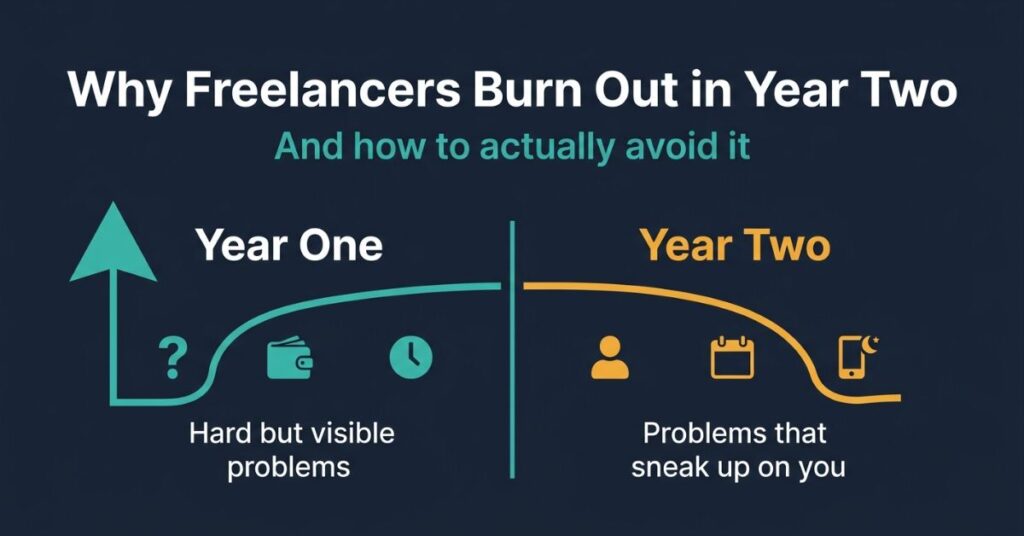
Year one is hard in ways you can see and name. You are figuring out how to find clients, how to price work, how to manage time without a manager. The problems are external and you can work on them directly.
Year two is harder in a different way and a lot of people do not see it coming. By then most freelancers have solved the year one problems well enough to keep going. They have clients and the income is more predictable. From the outside it looks like things are working. From the inside something is starting to feel wrong and they cannot always name what it is.
Why Year Two Specifically
Starting something new generates its own momentum. The novelty, the possibility, the sense of building something that did not exist before. That energy carries people through the difficulties of the first year in ways they do not fully appreciate until it is gone.
By year two the novelty has worn off. Freelancing is no longer the exciting alternative to your old job. It is just your job. The clients who seemed interesting in year one have become familiar. The work that felt like an adventure is now a routine. And the problems that got papered over by excitement in year one such as the isolation, the boundary issues, the inconsistent income, the absence of any external structure are fully visible now without anything softening them.
This is not unique to freelancing. It is roughly what happens in most pursuits around the two year mark when the initial energy fades and the real shape of the thing becomes clear. But freelancing has specific features that make this transition harder than in most jobs.
The Isolation Nobody Talks About Honestly
Remote work content is full of articles about productivity and routines and the best desk setups. What it is mostly quiet about is how lonely the work can be.
In a traditional job, even a job you dislike, you have colleagues. People to eat lunch with, to complain to, to notice when you seem off. There is a social fabric built into the structure of employment that most people do not notice until it is gone.
Freelancing removes that fabric and replaces it with nothing by default. Client relationships are professional not personal. Online communities exist but they are not the same as someone sitting across a desk from you. Family and friends who are not freelancers often do not understand what you do or why some days are harder than others and explaining it gets tiring.
By year two, many freelancers are spending forty or more hours a week in a room by themselves. They may have gone days without a meaningful in-person conversation. They have learned to function this way. But functioning is not the same as thriving and the cumulative effect of sustained isolation is something that shows up in ways that can look like burnout even when the work itself is fine.
I did not make a deliberate social plan for the first two years of my freelancing career and I felt the effects of that more than I admitted to myself at the time. I was productive on paper and also spending weekends recovering from a kind of social depletion that I had not even registered was building up.
The Boundary Problem
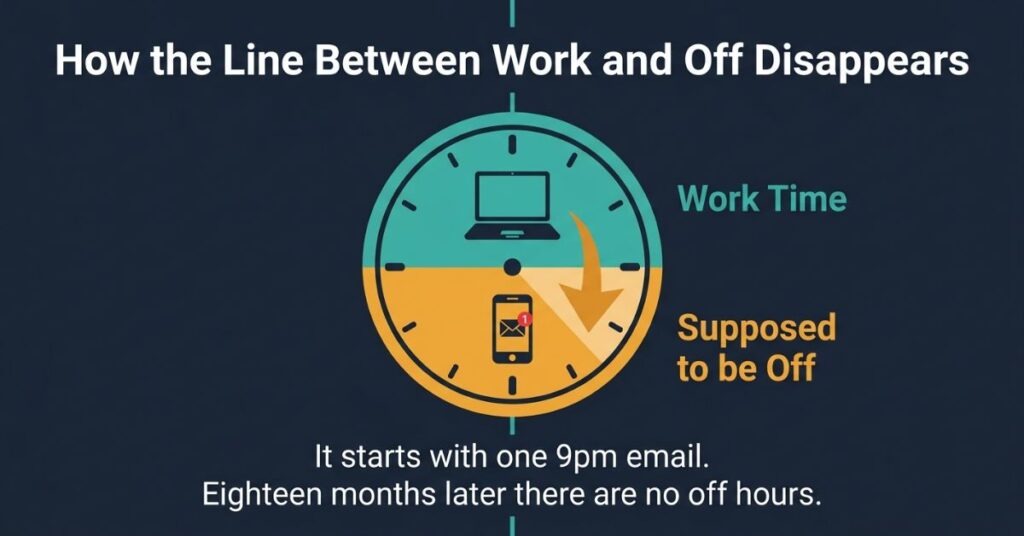
Freelancers who are good at their work and who care about their clients tend to develop a specific problem over time. The gradual erosion of the line between working time and not-working time.
It starts with small things. Answering a client email at 9pm because it is quick and you are already at your laptop. Taking a call on a Saturday morning because the client has a deadline and it only takes thirty minutes. Checking messages during what was supposed to be a day off because not checking creates more anxiety than checking.
Each individual decision seems reasonable. Cumulatively they train both you and your clients that you are always available. Clients stop thinking about when is a reasonable time to contact you because they have learned that you respond whenever they reach out. You stop having time that is actually yours because there is always a reason to work a little more.
By year two this erosion is usually well established. The freelancer who did not set clear working hours in year one now has no working hours. Just a continuous low-level state of being potentially on call that follows them into evenings and weekends and holidays.
This is genuinely exhausting in a way that is hard to explain to someone who has not experienced it. It is not the exhaustion of working too many hours, though that may also be happening. It is the exhaustion of never being fully off. Of having a part of your brain perpetually monitoring for client messages even when you are technically doing something else.
A freelance designer I spoke to described it as never being able to finish a meal without checking her phone. She had not decided to become that person. It had just happened incrementally over about eighteen months. She told me it was only when she went on a family holiday and had poor signal for four days that she realised how long it had been since she had actually been present for an evening.
The Income Anxiety That Does Not Go Away
In year one, income anxiety makes sense. You are building something from nothing and the money is genuinely unpredictable.
In year two, many freelancers have more stable income but the anxiety has not reduced proportionally. They have enough clients and enough work to cover their needs and yet the financial worry persists. Sometimes it gets worse not better, as the income grows and the fear of losing it grows with it.
Part of what feeds the financial anxiety is the unpredictability of when money arrives even when the total is sufficient. Our guide to getting paid on time covers the system that reduces that timing gap.
This is one of the underreported psychological dimensions of freelancing and it took me a long time to understand it clearly. The problem is structural. In employment, your income is largely outside your control because someone else decides your salary and if they keep paying you, it continues. In freelancing, your income is entirely dependent on your own actions and relationships and the continuation of client contracts that could end at any time.
That control is often cited as one of freelancing’s advantages and in some ways it is. But control also means responsibility and carrying full responsibility for your own income. Month after month with no safety net, creates a baseline level of financial vigilance that does not switch off when the money is actually fine. It becomes a habit of mind. A low-grade hum of monitoring and worry that runs in the background even on good months.
By year two this hum is just part of the texture of being a freelancer and most people have stopped noticing it consciously. But it is expensive in terms of mental energy and it contributes significantly to the depletion that presents as burnout.
What Burnout Actually Feels Like From the Inside
I want to describe this specifically because the way burnout gets described in general wellness content is often unrecognisable to people who are actually experiencing it.
The popular image of burnout is dramatic. Complete collapse, unable to get out of bed or crying at your desk. Some people experience it that way but many do not.
For most freelancers I have spoken to, burnout in year two looks quieter and more confusing. You can still work and still meeting deadlines. From the outside your business looks fine but the quality of your attention has changed. Work that used to feel interesting now feels like going through motions. You are doing the thing but you are not really present for it. A client messages with an exciting new project and you feel nothing or worse, a low-grade dread.
Creative work suffers first because you used to have ideas. Now you have to force them and the forced ones feel hollow. Writing that came quickly starts taking twice as long for half the quality. Design choices that used to feel intuitive now feel arbitrary.
Mind, the UK mental health charity has a clear guide to recognizing stress and burnout symptoms that is worth reading if you are unsure whether what you are experiencing qualifies.
You start avoiding things. Emails sit longer before being answered, proposals get put off, networking conversations that would take twenty minutes get delayed indefinitely. You tell yourself you are busy but the honest version is that you have less capacity for things that require energy you no longer have a surplus of.
For me it showed up as a persistent low-level irritation with work I had previously enjoyed. Clients I had liked became sources of mild resentment that I could not entirely justify. I was doing the work but I had quietly stopped caring about it, which is a specific and uncomfortable feeling when your livelihood depends on caring.
What Actually Helps
Rest more, exercise, set boundaries. These are not wrong but they are not specific enough to be useful. Here is what actually changed things for me and what I have seen work for other freelancers who went through similar periods.
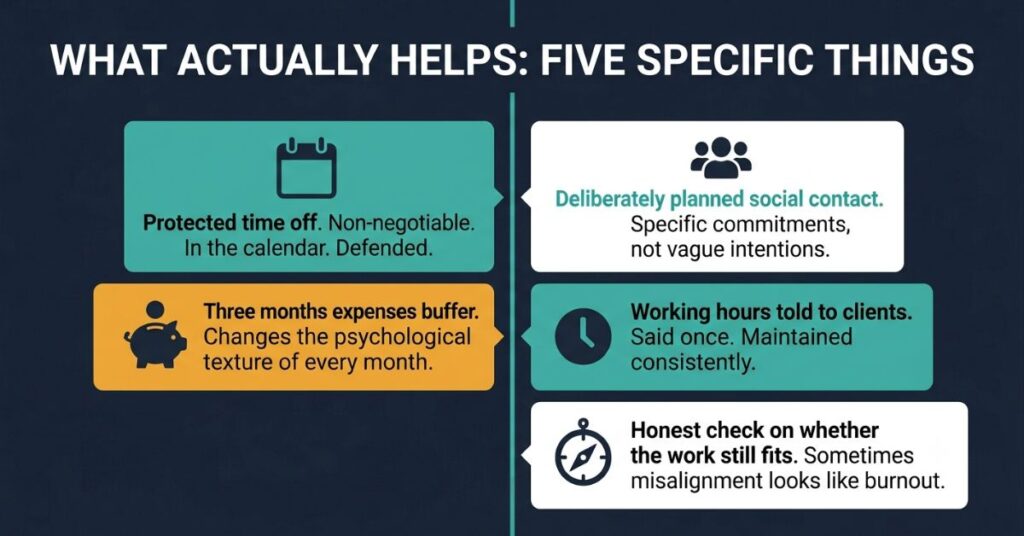
Scheduled time off that is actually protected. Not aspirational days off that get cancelled when something urgent comes up. Specific days that are treated like client commitments, non-negotiable, in the calendar, defended. I block two full days off every week and one week completely clear every quarter. Not because I always have the luxury of doing this, but because I have made it a structural part of how my business works rather than something I fit in when there is nothing more urgent.
Social contact that is deliberately planned. Not hoping to feel less isolated but actually booking something. A coworking day once a week, a regular call with another freelancer, a commitment to meet someone in person once a fortnight. Vague intentions to be more social do not work. Specific commitments in the calendar do.
A financial buffer that is genuinely adequate. The income anxiety that contributes to burnout is significantly reduced not eliminated, but reduced when there is a real cash cushion. Three months of expenses in a separate account that does not get touched for ordinary spending. Getting to that point takes time but it changes the psychological texture of every month in a way that is hard to appreciate until you have it.
Building a three month buffer requires earning enough to save while still covering your needs our freelance rates guide covers the calculation that most freelancers have never actually done.
Working hours that are communicated and maintained. Not just set privately but told to clients explicitly in onboarding conversations. “I work Monday to Friday, 9 to 6 and I respond to messages within those hours.” Said once, maintained consistently and not undermined by the occasional Saturday email. The occasional Saturday email undoes months of boundary-setting in a client’s mind.
And being honest with yourself about whether the work itself still fits. Sometimes what looks like burnout is actually a genuine misalignment between the work you are doing and what you actually want to be doing. Freelancers who started out doing one type of work because it paid well and have been doing it for two years without ever choosing it are not burned out from overwork. They are exhausted from sustained misalignment. Those are different problems with different solutions.
The Part Nobody Talks About
I told people freelancing was going great when some months it genuinely was not. I performed confidence about my work and my direction when privately I was questioning both. That performance cost energy I could not afford to spend.
The freelancing content landscape is heavily weighted toward growth and income and productivity optimisation. Admitting that you are struggling psychologically feels like admitting you are not cut out for independence, which is a vulnerability most people are not comfortable with in professional contexts. I was not comfortable with it for a long time.
What helped was finding other freelancers who were willing to be honest about the same things. Not to complain or be negative but to acknowledge the real shape of the work. Including the parts that are hard, without framing every difficulty as a temporary obstacle on the way to success.
The Freelancers Union maintains a resource library covering the business and wellbeing sides of independent work that is worth bookmarking if you are building a more sustainable freelance practice.
One of the underrated benefits of platforms like Mentorcruise is the mentorship relationship itself having an experienced freelancer you can be honest with about how things are going is worth more than most people realize when they sign up.
If you do not have those conversations in your current freelance community, finding or building them is worth treating as a priority rather than a nice-to-have. The loneliness of freelancing is not inevitable. It is a structural problem that has structural solutions and most of them require deciding to prioritise social connection the same way you would prioritise finding a new client.
Frequently Asked Questions
How do I know if what I am experiencing is burnout or just a difficult period?
The most useful distinction I have found is duration and trajectory. A difficult period has an identifiable cause for example a difficult client, a heavy workload, a personal situation outside work and it tends to ease when the cause resolves. Burnout does not resolve when the cause is removed. You finish the difficult project and the relief is brief and then the flatness returns. You take a week off and come back feeling the same. You make a change you thought would help and it does not. If the depletion is persisting across changes in your external circumstances, that is a stronger signal that something structural needs to change rather than just waiting for the current difficulty to pass.
I cannot afford to take time off. What can I realistically do?
The financial constraint on rest is real and I do not want to dismiss it. A few things that cost nothing or close to it: ending work at a specific time every day and not starting again, even if you are not busy. Taking your lunch break away from your desk and your phone. Choosing one evening per week that is genuinely off and protecting it. These are not substitutes for adequate rest but they are not nothing either. They begin to rebuild the habit of having time that is actually yours, which makes the larger structural changes easier to make when the financial situation allows. The other thing worth saying: sustained burnout is itself a financial risk. The reduced capacity, the slower work, the avoidance of business development, these have real income consequences that often exceed the short-term cost of taking time off sooner.
Should I talk to a therapist or counsellor about freelance burnout?
If what you are experiencing is affecting your work, your relationships, or your daily functioning in significant ways, yes. A therapist who has experience with self-employed clients or with work related stress can offer something that a business coach or productivity system cannot. A space to understand the psychological patterns that are contributing to the situation, not just the external ones. In the UK, BACP has a therapist directory. In the US, Psychology Today has a searchable database. Online therapy through platforms like BetterHelp is more accessible and affordable than in-person therapy for many people. The freelance community is not good at normalizing this kind of support. It is worth seeking regardless.
I think I burned out but I am still working. Is that possible?
Yes and it is probably the most common version of it among freelancers. Functional burnout where you are still meeting your obligations but running significantly below your actual capacity is different from the complete collapse version but it is still burnout and it still needs addressing. The risk with functional burnout is that because you are still performing at a level that looks acceptable from the outside, the internal cost becomes invisible and the situation continues for much longer than it should. If you are working but the work has stopped meaning anything to you, if you are getting through the days without any sense of engagement or investment in what you are doing, that is worth taking seriously even if nothing has visibly broken yet.
What is the single most important thing to change if I am already in burnout?
Reduce the load before you try to fix anything else. Not permanently, just enough to create some space. Drop a client if you can, decline a project or push a deadline. Create a gap somewhere in the schedule that is not immediately filled with something else. Burnout recovery in the middle of a full workload is extremely difficult because recovery requires resources like rest, social connection, reflection, perspective that are hard to access when the week is already fully committed. The changes described in this article all require some margin to implement. Creating that margin, even a small amount, is usually where the process of getting better actually starts.

Johnson Alaekezie is a freelancer and digital content creator with several years of experience working across writing, content strategy, and digital services. He founded IncomeGigAI to share honest, practical information about building income online without the hype that dominates most of this space. Johnson has worked with clients in the US, UK and beyond, and writes from direct experience rather than theory. He is based in Nigeria and covers the digital income topics he has personally navigated as a working freelancer.