
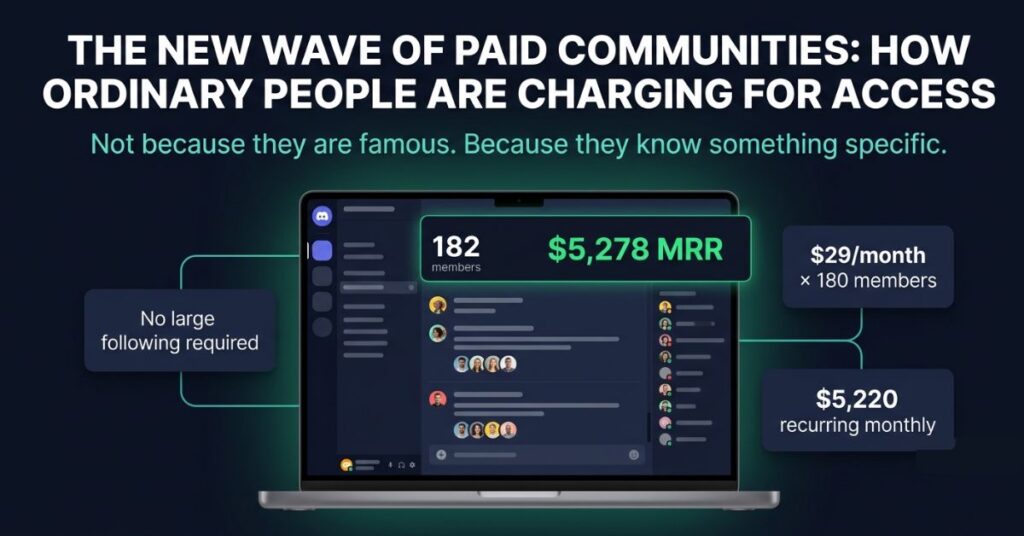
Someone I follow online runs a paid Discord community for freelance copywriters. It costs $29 per month and has around 180 members.
Do that math quickly, that is $5,220 per month from a Discord server. Just over $62,000 a year.
He has maybe 4,000 followers on Twitter it’s not that famous and not even verified. Not a household name in any circle beyond the people who have been paying attention to his work for a few years. What he has is a specific expertise in freelance copywriting, a track record that people can point to and a willingness to show up in the server every week and be genuinely useful to the people who joined.
I spent some time looking at what separated his community from the others in the same category that had launched and quietly died within a few months. The answer was simpler than I expected. His members were not paying for content, they were paying for access. Access to him, to each other and to a space where a specific kind of question would get a specific kind of answer from people who had genuinely been through the same thing.
That distinction is the thing most explanations of paid communities skip over. Content is abundant and mostly free. Access is scarce but the scarcity is intentional, because that is the entire business model.
The global creator economy reached roughly $200 billion in 2025 and is projected to grow at 22.7% compound annually, on track to surpass $800 billion by the early 2030s. A meaningful and growing share of that expansion is happening inside community platforms rather than on social networks. Circle alone now supports over 18,000 active communities. For many of the people running them, the community is not a side project, it is the primary business.
Circle’s 2026 creator economy data shows that recurring community-based revenue now sits at the center of creator business models, with memberships and recurring access offers providing the income predictability that social platforms cannot.
The Course Model Started Breaking Around 2021
The online course market dominated for the better part of a decade. Build a curriculum, record videos, sell access. The income arrived when someone enrolled. It was a clean model.
The structural problem with courses is that they are one-directional by design. The creator teaches while the student consumes. When the content ends the relationship ends. A student who finishes the course and still has questions or hits a practical obstacle that the curriculum did not cover or wants to discuss what they learned with someone in the same situation, has nowhere inside the product to go. The course does not solve that problem because it was never built to.
The accountability problem is the other one. Course completion rates sit between 5% and 15% across most platforms. Most people who buy courses do not finish them. They buy with genuine intention and the course sits in a folder while the intention fades. The creator earned the sale but the student did not get the outcome. That transaction, repeated at scale, erodes something in how people think about online learning. It produces buyer hesitation on the next purchase.
Communities do not have either of these problems, at least not in the same way. They are ongoing rather than finite, a member who hits an obstacle in month four can ask about it in month four. The accountability that comes from being in a space with other people working through similar challenges is structural rather than optional.
And according to research on community retention, 67% of community members stay because of shared identity and values, not because an algorithm surfaced something in their feed. That is a retention driver that no course completion rate can match.
Newsletter income models that operate on similar recurring economics are worth comparing to communities before choosing which structure fits your content and audience best.
The market has been noticing. 56% of creators launched their community in the last couple of years. That is not a trend. That is a structural shift in how online businesses think about recurring income. 44% of active communities have between 1 and 100 members, meaning most of this growth is happening at small scale on purpose, as in intentionally small. Prioritizing retention and genuine value over subscriber counts.
Choosing a Platform Before You Need to Switch
The choice of platform matters more than most guides admit, mostly because switching platforms after you have 150 paying members is painful in ways that are hard to anticipate before you have to do it.
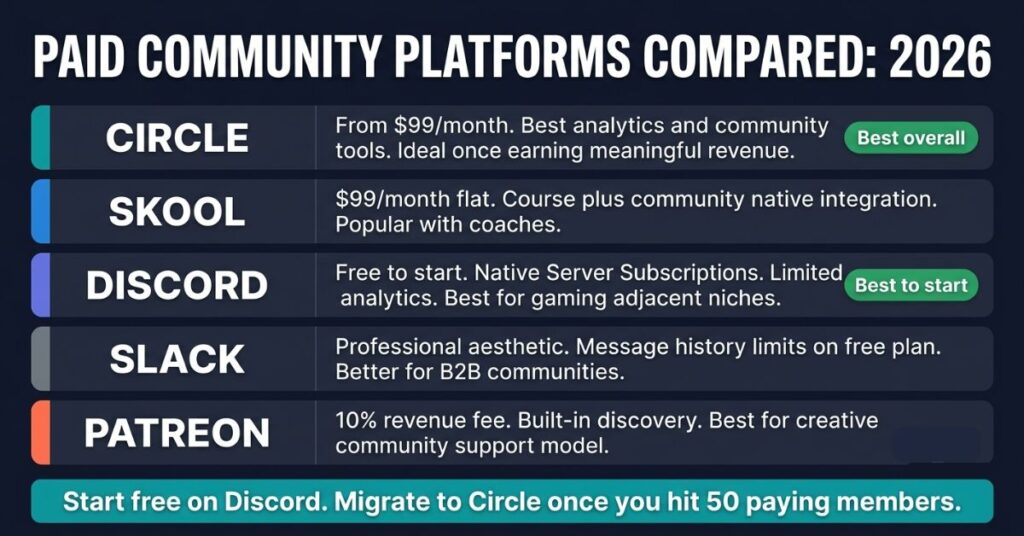
Circle is the most purpose-built option for a serious community business. An independent platform analysis from CustomerHub confirms Circle leads for creators who need structured discussion, courses, events and analytics in a single interface.
Discussion forums, direct messaging, events, courses and member management in a single interface. Native payment processing and clean subscription management.
Most communities built on Circle charge between $26 and $50 per month and the platform is built around that pricing model. The platform fee starts at $99 per month, which makes it the right choice once the community is generating meaningful revenue. Starting on Circle before you have paying members means paying $99 per month to host conversations with yourself.
Skool launched later but grew quickly, particularly with coaches and educators. The fee is a flat $99 per month regardless of community size or revenue. The course and community elements are natively integrated rather than patched together, which matters when structured learning is part of what you are offering. Skool’s growth rate in 2025 suggests it will be a serious competitor to Circle for that specific creator type within the next two years.
Discord is where most people start because the barrier is essentially zero and free to use. Most people already have accounts. The familiarity reduces onboarding friction for new members. A community with 200 members at $29 per month generates $5,800 in monthly recurring revenue through Discord’s Server Subscriptions feature. At $79 per month with 100 members the number is $7,900. The trade-off is that Discord lacks Circle’s analytics and structured content features and the free plan limits message history in ways that become a real problem once the server has been running for a year.
Slack works for professional communities with a B2B orientation. The interface communicates professional context in a way Discord does not, which matters to certain types of members who would find Discord’s gaming-adjacent aesthetic slightly off. The cost becomes significant at scale: Superpath, a content marketing community, faced the possibility of losing over 800,000 messages from 23,000 members unless they upgraded to an enterprise Slack plan at $26,000 per month. That is an extreme case. But it is the kind of thing worth knowing before you build your community documentation inside Slack’s free tier.
Patreon is still useful for communities built around creative work, where the membership framing is about supporting a creator rather than accessing professional expertise. The fee is percentage based rather than flat, the Pro tier takes 10% of income earned on the platform. That percentage makes it less efficient than Circle or Discord for communities generating significant recurring revenue, but the model is familiar to buyers in creative spaces and the platform provides its own discovery mechanism.
What Keeps Members Paying Month After Month
The communities that retain members for years and the ones that see half their founding cohort leave by month four share one visible difference. Which is whether the founder treated the community as a product that required maintenance or as an income stream that ran itself.
The communities worth paying for consistently have a specific, outcome oriented niche rather than a broad topic. Not a community for freelancers. A community for freelance UX designers trying to move from $60 to $100 per hour in the next twelve months. The specificity determines how useful members can be to each other. How relevant every discussion feels to everyone in the space and how quickly a prospective member can decide whether this is genuinely for them.
Active, consistent founder presence is the second thing. Members in paid communities are not paying for a database of archived conversations. They are paying for access to something alive, a server where the founder posts thoughtfully each week. Where genuine questions get genuine responses, where the engagement does not feel templated, retains members. A server where the founder is visibly absent for two weeks every time something else comes up loses them quietly and steadily.
The third thing is peer-to-peer value. When members answer each other’s questions, share work for critique, make connections that exist outside the platform. And refer clients to each other, the community becomes sticky in a way no amount of founder content can replicate alone. The founder’s job shifts from being the only source of value to creating conditions where value generation becomes distributed. Structured introductions, member spotlights, accountability pairing and collaboration channels all serve this function. Communities that build this habit in the first three months retain significantly better than ones where all value flows through the founder.
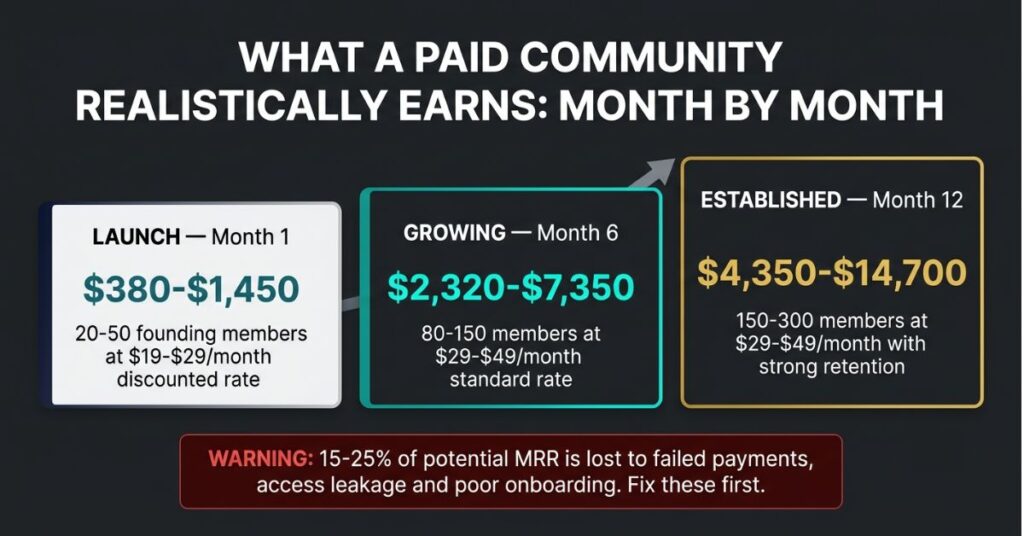
One operational point that almost no community advice covers honestly: about 9% of subscription revenue is at risk each month from failed card payments. Cancelled members who have not been removed from the server inflate the apparent member count while generating zero income and sometimes degrading the community culture. New members who had a mediocre first week cancel before month two at rates that are almost entirely preventable with better onboarding. Together these leaks typically represent 15 to 25% of potential monthly recurring revenue in communities that have not addressed them. The first week experience for a new member is probably the highest-leverage thing to get right early.
The Income Numbers Without the Headline Cases
The extraordinary cases get most of the coverage. Creator X made $500,000. Community Y reached $1 million in annual recurring revenue. These are real outcomes for specific people with specific circumstances. They are not useful benchmarks for someone building their first community.
The highest-earning niche consistently is trading and finance, where members pay for access to signals, analysis and discussion. Communities of 200 to 500 members in that category commonly reach $15,000 to $80,000 in monthly recurring revenue at prices of $49 to $299 per month. Fitness communities with genuine coaching access of 100 to 300 members commonly reach $3,000 to $15,000 per month at $29 to $79.
For most people building a first professional or learning-oriented community, the realistic trajectory looks more like this. At launch with a founding member discount, 20 to 50 members at $19 to $29 per month, generating $380 to $1,450 monthly. At six months with some reputation and word of mouth, 80 to 150 members at $29 to $49 per month, generating $2,320 to $7,350. At twelve months with strong retention, 150 to 300 members at $29 to $49 per month, generating $4,350 to $14,700.
These are the ranges that appear in documented case studies from professional niche communities with genuine expertise behind them and consistent operation throughout. The ones that do not reach these ranges typically failed. Because the niche was too broad to attract motivated buyers. The ongoing value delivery dropped after the launch energy faded or the founder did not account for how much the weekly rhythm of running a community actually costs in time and attention.
Starting Without a Large Following
The assumption that stops most people from attempting this is the belief that the audience has to come first. That you need thousands of followers before a paid community is viable because you need enough people to fill it.
That assumption collapses when you do the arithmetic. Fifty members at $29 per month is $1,450. One hundred members at $49 per month is $4,900. Neither of those numbers requires a large following. They require a specific enough offering that a motivated niche of people will pay for it, and a way of reaching those people that does not depend on algorithmic distribution.
The first members almost always come from existing relationships. People who already know your work. People who said your advice was useful to them. People who followed your thinking for a while and trust your judgment enough to pay monthly for more direct access. Every conversation you have had where someone said this was exactly what I needed is a potential founding member conversation.
The word-of-mouth that sustains growth beyond the founding cohort comes from specificity. When the community is positioned precisely enough that members can describe it clearly to someone else who would benefit, referrals happen without the founder prompting them. A member who found exactly what they expected when they joined has a much easier time recommending it than one who found something vaguely useful but hard to describe.
The founding member offer is the standard mechanism for the early launch period. A discounted rate, typically 30 to 50% below the standard rate, for the first cohort who join before a specific date. The discount rewards early commitment. The benefit to the founder is initial revenue, early retention data and genuine testimonials from people who have been inside long enough to have a real opinion.
Running It After the Launch Excitement Fades
The communities that make it past month six are almost uniformly the ones where the founder built the operational rhythm into their week before launch rather than figuring it out on the fly after people had already paid.
What that rhythm actually involves is posting in the community consistently, not just when inspiration strikes. Responding to questions from actual engagement rather than scheduling canned responses. Noticing when activity is dropping and addressing it before members start leaving. Running the office hour or Q&A or member spotlight that was mentioned in the sales page. Onboarding the two new members who joined this week with the same care as the fifty who joined at launch.
None of this is heavy at 50 to 100 members if it is built into the schedule. All of it is exhausting if it is treated as discretionary extra work on top of everything else. AI tools to reduce the weekly operational load of running a community, from drafting discussion prompts to summarising member feedback, are worth building into the workflow early.
The honest framing is that this is a recurring revenue model rather than a passive income model. For the honest version of passive income versus recurring income and why the distinction matters before you commit to a model, this article covers the difference clearly. The income is predictable and the work is ongoing. The ratio of income to effort is often significantly better than client work once the community reaches a stable size. But calling it passive would be wrong and believing it is passive before you start is the setup for the kind of founder abandonment that kills communities in month three.
Frequently Asked Questions
How do I handle someone who joins, downloads everything they can find and then immediately requests a refund?
This is a real pattern in information-based communities and worth having a policy for before it happens. Most community builders use a combination of a short refund window (7 days rather than 30) and a minimum engagement threshold for refund eligibility. Some withhold refunds for members who have downloaded a significant number of resources, citing the consumption of value as evidence the purchase served its purpose. The practical approach is to make the community valuable in ways that are not simply downloadable: ongoing discussions, live events, relationships and access to your thinking in real time. A community whose primary value is static content is more vulnerable to this pattern than one whose value is inherently ongoing.
My community grew quickly in the first two months and then growth stopped completely. What usually causes this?
Two distinct problems look identical from the outside but have different solutions. The first is a distribution problem where you exhausted your existing network and have not built a channel for reaching new people who do not already know you. The solution is developing an organic traffic source, consistent LinkedIn or newsletter content in your niche, that brings new potential members into your orbit regularly. The second is a retention and referral problem: existing members are not staying long enough or engaging deeply enough to refer others. This usually means the ongoing value delivery has softened since launch. Check your retention rate first. If members who joined in month one are still there in month four, the product is working and the issue is distribution. If they are not, fix the retention before spending energy on growth.
Is it better to charge monthly or annually?
Both structures work and serve different business goals. Monthly pricing lowers the commitment threshold for new members and makes it easier to attract people who are uncertain whether the community is right for them. Annual pricing provides better revenue predictability, reduces churn (members who paid for a year are less likely to cancel in month three than monthly subscribers) and often generates better unit economics because the total payment is larger. Many successful communities offer both, with the annual option priced at 10 to 20% below the cost of twelve monthly payments. The discount is modest enough that monthly subscribers who like the community have a real incentive to switch, but not so large that it significantly undercuts monthly revenue.
How do I know when my community is ready to raise its prices?
Three signals together rather than any one in isolation. First, your retention rate has been stable or improving for at least three months, meaning people are finding sustained value at the current price. Second, your waitlist or new member inquiry rate is consistently higher than your capacity to onboard members well, meaning demand exceeds comfortable supply. Third, existing members, when surveyed or asked directly, describe the community as clearly worth more than they are currently paying. Raising prices for a founding cohort who joined at a specific rate requires careful handling. Grandfathering them at their original rate or giving significant advance notice is standard practice. The reputation damage from retroactively raising prices on founding members without warning is not worth whatever revenue the increase generates.
What is the minimum viable community size before I should consider it a real business?
There is no universal answer but a useful personal threshold is the point at which the community income covers its own operational costs plus your time at a rate you would consider fair for equivalent work. For most professional communities, that threshold is somewhere between 30 and 60 members depending on pricing and platform costs. Below that threshold, treat it as a product in development: learn from the members you have, improve the experience based on what you observe and resist the temptation to optimize for growth before the core value is solid. A community of 40 members who are genuinely engaged and staying month after month is a better foundation than one of 150 who joined during a launch promotion and mostly went quiet.

Johnson Alaekezie is a freelancer and digital content creator with several years of experience working across writing, content strategy, and digital services. He founded IncomeGigAI to share honest, practical information about building income online without the hype that dominates most of this space. Johnson has worked with clients in the US, UK and beyond, and writes from direct experience rather than theory. He is based in Nigeria and covers the digital income topics he has personally navigated as a working freelancer.