
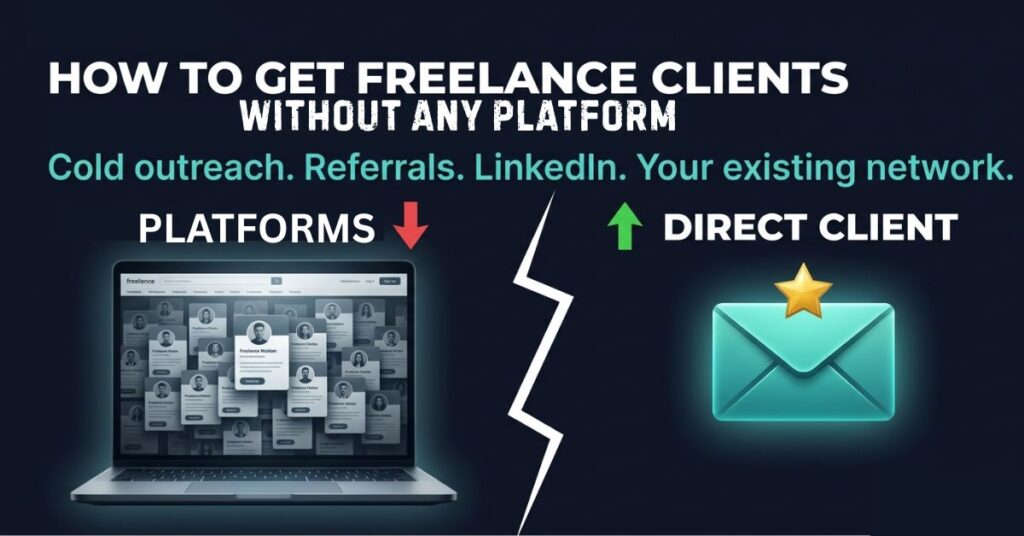
The month I realized platforms were not the whole game was when two emails arrived five days apart.
The first was from a client I had done a single project for on Upwork about four months earlier. He had found someone else cheaper after that first job and I had not heard from him since. Now he was back, messaging me directly, completely outside the platform. His team had grown and the content needs had grown with it. He wanted to know if I had capacity for something ongoing.
The second email came through a mutual contact. A company was looking for a content strategist. My former colleague had mentioned my name. The project was larger than anything I had picked up through proposals. The rate was almost triple what I had been charging on Upwork. In the entire first conversation the client never asked about my profile score or my reviews. They already trusted me because someone they trusted had vouched for me.
I had been freelancing for three years at that point, grinding through proposals every week, winning some and losing most, doing solid work and waiting for the platform to reward it with more visibility. The income was consistent enough but that month I understood something I had been missing. I had been building someone else’s infrastructure rather than my own.
The clients who pay the most, last the longest and require the least selling almost never find you through a search algorithm. They find you through someone who knows you, a piece of writing that made them think, a message you sent that showed you understood their specific situation or a reputation built over months in the spaces where they spend their professional time. None of that happens on a platform, it happens around one.
What Platforms Actually Cost You
The service fee is the price you see. The leverage you give up is the one that compounds.
Every client relationship built inside a platform exists on that platform’s terms. The client discovered you through their search function. The payment ran through their escrow and the review they left lives on their servers. If Upwork changes its search algorithm, adjusts it’s fee structure, decides your niche is oversupplied or simply stops working well one day, your entire client acquisition system absorbs that impact. You had no say in the decision and no warning before it happened.
I watched this happen to a writer I knew in 2023 when Upwork adjusted how it weighted profile completion scores. Her profile had been performing well for two years. Overnight her proposal visibility dropped and her enquiry rate fell with it. Nothing about her work had changed. Something about the platform had and her business felt it directly.
Beyond the structural fragility, platforms create a comparison problem that is hard to escape. A buyer searching for a content writer in 2026 sees your profile sitting next to forty or fifty others. Price becomes the most visible differentiator in that environment. The pull toward competitive pricing, toward being the reasonable option rather than the expensive expert, is relentless. Not because you cannot resist it. Because the market structure of a platform makes it structurally difficult to.
Off-platform, none of that comparison shopping happens. A client who found you through a referral is not weighing you against forty alternatives. They are weighing whether to hire you or not. That is a completely different decision and it has completely different pricing dynamics.
Turning Referrals Into Something Reliable
I used to think referrals were things that happened to you when you were lucky. A client mentioned you to a colleague, someone brought up your name at the right moment. Nice when it occurred but impossible to plan for.
The freelancers generating consistent referral income have a different relationship with this. They did not wait, they built the conditions that make referrals possible and then asked for them at the right moment in the right way.
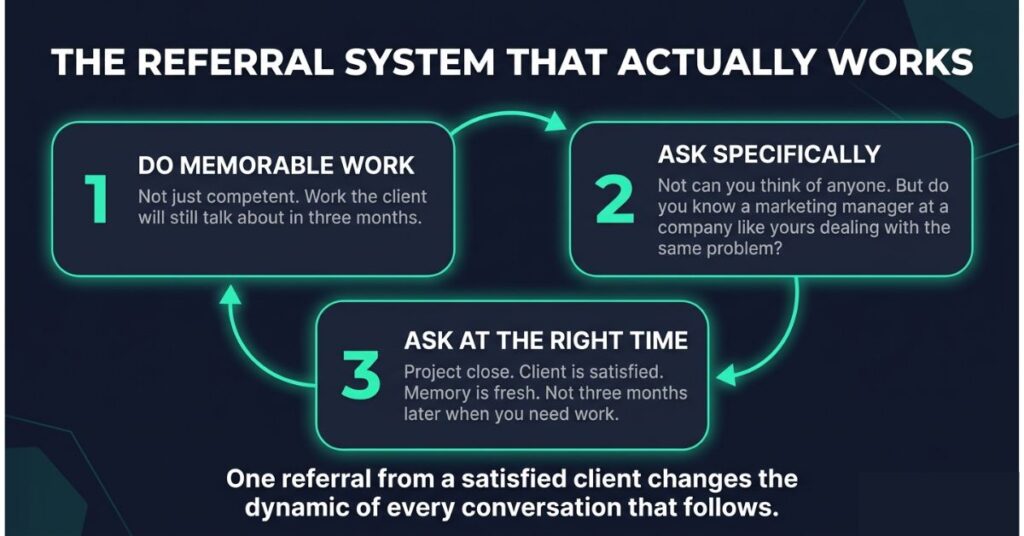
The conditions start with the quality of the work itself, but not in the way most people think. The question is not whether the work was good. The question is whether the client will remember it. Most freelancers deliver work that meets the brief. A much smaller number deliver work that makes the client feel like something shifted, like they now have something they did not have before and would not have got the same way from anyone else. That is the work that gets talked about. Meeting the brief does not generate referrals but exceeding expectations in a specific, memorable way is the way.
The second part is the ask itself. Most freelancers who do ask for referrals ask badly. Something like: if you know anyone who needs what I do, please send them my way. That asks the client to do significant mental work on your behalf with no guidance. They have to survey their entire network, filter for anyone who might need a freelancer, consider whether that person would be a good fit for you and decide whether to make the introduction. Most people do not do all of that unprompted, even when they like you and would be happy to help.
A specific ask does most of that work for them. Something closer to: do you work with any marketing managers at companies similar to yours who deal with the same content production challenges you had before we started working together? That question points the client at a specific type of person in a specific context. The mental load drops dramatically. The referrals that come from that kind of ask are also better qualified because you helped define what you were looking for.
Niching down to make off-platform outreach more effective is the lever that changes how referrals spread. A specialist is easier to refer than a generalist because the person making the referral knows exactly who to send you to.
Timing is the third factor and the most commonly ignored one. The right moment to ask is immediately after a successful delivery, when the client is most satisfied and the quality of the work is most fresh in their mind. Not three months later in a follow-up email sent because you need work, that version feels transactional. The version that comes naturally out of a project close conversation feels like something else entirely.
Why Most Cold Outreach Fails and What Changes When It Does Not
There is a specific feeling that comes with sending a cold message into someone’s inbox, most people feel it. It is the low-grade awareness that what you are sending is almost certainly going to be ignored and that the person receiving it is going to find it slightly annoying.
That feeling is usually accurate, because most cold outreach deserves to be ignored.
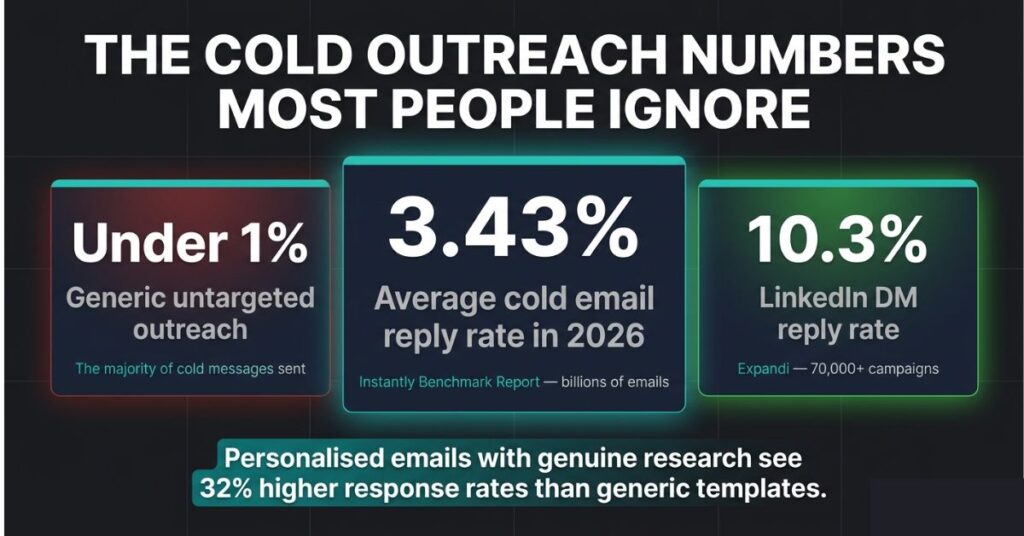
Instantly’s 2026 Cold Email Benchmark Report, which analyzed billions of outbound sends across thousands of workspaces, puts the average cold email reply rate at 3.43%. Top performers consistently exceed 10% on the same channel. That number is being dragged down by the vast majority of senders who send the same template to five hundred people and wonder why nobody replies. Campaigns with genuine, specific personalization in every message produce reply rates around 18%. That is five times the average, from the same channel, just used differently.
The difference is research. Before writing to anyone, spend ten minutes on them specifically. Their website, recent content they have published, their LinkedIn activity. Any news about their company from the last three months. Look for something specific that connects what you do to something they are visibly dealing with. A blog section that has not been updated in eight months, a job posting that suggests a gap in their current team, a product launch announcement that clearly implies a content or marketing need they did not have before.
AI tools that help with research, proposal drafting and follow-up can compress the time cost of personalized outreach significantly without reducing the specificity that makes it work.
Then write a message built around that observation not a message about yourself. A message that shows you looked at their actual situation and have a thought about it that might be worth two minutes of their time.
I tested this over about six months during a period when I was actively trying to build direct clients. Emails sent to generic contact addresses, almost no responses. Emails sent to a named person at a specific company after ten minutes of research, responses around 15% of the time. LinkedIn messages to second-degree connections where I could reference a mutual contact closer to 30%. Same time investment per message but completely different results.
Expandi’s LinkedIn outreach benchmark data, analyzed across 13.2 million data points, confirms a platform-wide LinkedIn message reply rate of 10.4%, roughly three times the cold email average, with meaningful variation by industry and targeting quality.
LinkedIn messages work particularly well right now for a structural reason. Most senior decision-makers receive dozens of cold emails every day and a fraction of that volume in LinkedIn messages. Your profile is visible before they read a single word you wrote, which means some of the trust-building work happens before the message is even opened.
The structure that tends to produce responses is short. Reference something specific from their world in the first sentence. Connect it to what you do in the second. Make one clear, low-friction ask in the third. A fifteen minute call is a better ask than a full brief or a commitment to work together. The smaller the ask, the lower the friction, the higher the chance of a yes.
LinkedIn as Something More Than an Outreach Tool
Most freelancers use LinkedIn to send messages. The ones getting the most from it are also using it to make messages unnecessary.
When you publish content on LinkedIn that demonstrates specific, genuine expertise in a domain your ideal clients care about, people in that domain encounter it. Some of them are the kind of people who hire. If your profile clearly describes what you do and who you do it for and if the content you publish regularly reinforces that positioning, the path from encountering your thinking to reaching out to you is short.
The content that generates this is not posts about your services or announcements that you have availability. It is content that makes your ideal client feel understood. A specific observation about a mistake that is common in their industry. A contrarian take on something the conventional wisdom in their field accepts without question. A short case for approaching a familiar problem differently.
I started posting on LinkedIn consistently about content strategy for B2B companies during a period when I was trying to move away from platform dependence. For the first two months almost nothing happened. Third month, a comment from someone I did not know led to a conversation that led to a project. By month five I had two inbound enquiries in the same week from people who had seen something I wrote and decided to reach out.
The realistic timeline for LinkedIn content to start generating inbound interest is three to six months. That is not a reason to avoid it. It is a reason to start earlier than feels necessary and to treat the first several months as an investment whose returns arrive later rather than as a strategy that should be proving itself by the end of the first week.
The profile underneath the content matters more than most people treat it. A headline that describes who you help and what changes for them attracts a completely different kind of attention than one that lists a job title. An about section that opens with the problem you solve rather than your career history signals relevance before the reader has to dig for it.
The Network You Are Probably Not Using
Almost everyone reading this has a personal and professional network that contains people who either need what they do or know people who do. Most freelancers have not specifically told those people what they are looking for in terms concrete enough to generate a useful introduction.
An hour spent auditing existing contacts, going through email history, phone contacts and LinkedIn connections, usually reveals more potential than people expect. For each person worth contacting, ask whether they work somewhere that could use your services, whether they know people in industries you are trying to reach or whether they have mentioned a problem you can solve.
The message to those contacts does not need to be a pitch. It can be a direct and honest update. Something like: I have been doing freelance content strategy work for software companies and I am looking to take on two or three new clients over the next few months. If you know anyone dealing with that kind of challenge, an introduction would mean a lot.
That is not aggressive. Most people who like you and think well of your work will either make an introduction immediately, keep you in mind when the right moment comes or simply say they cannot think of anyone right now. The relationship survives all three outcomes. The introduction that might come from the first two outcomes could generate work that a hundred platform proposals would not.
Where Clients Are Actually Having Conversations
Clients do not browse freelance platforms for fun. They do browse professional communities, Slack groups, Discord servers, LinkedIn feeds and industry forums where their professional peers are talking through challenges.
Being consistently present and genuinely helpful in those spaces, not selling, just contributing, creates a reputation that generates enquiries without any direct selling required. When someone in a marketing community asks if anyone knows a good content strategist for fintech companies and you have been thoughtfully contributing to that community for four months, several people will think of you.
The client who finds you this way is already warmer than any cold prospect you could reach directly. They have some sense of who you are before the first conversation. The call is not a sales call, it is a continuation of interactions they have already observed.
The communities worth your time are the ones where clients are talking, not where freelancers are talking other freelancers cannot hire you. The communities worth finding are the ones organized around your target clients’ industries, tools, challenges or roles.
Running Both at the Same Time
The transition from platform-dependent to platform-free is not a dramatic decision. It is a ratio that shifts gradually.
Keep the platform work running. It pays the bills while the new channels are being built. But start deliberately spending time each week on the off-platform work. LinkedIn posts, direct outreach, community engagement and referral asks after project closes. These activities compound differently from proposal writing, a proposal wins or loses and the result is binary, a LinkedIn post exists indefinitely, a community relationship deepens over time. A referral system gets more reliable as your client base grows.
When off-platform work starts arriving consistently, the balance shifts. You take fewer low-rate platform projects because you no longer need them. You become more selective about what you accept. Eventually the platform becomes something you use occasionally rather than something your income depends on.
The freelancers who make this transition successfully share one thing. They did not wait until the off-platform work was generating enough to make the switch. They started building before they needed it. Because the six-month build period for LinkedIn or community reputation cannot be compressed. It has to be lived through and the only way to have lived through it is to have started it.
Frequently Asked Questions
How do I write a cold outreach message without it sounding like a template?
Read it back out loud before you send it and ask one question: does this sound like something I would say to this specific person or does it sound like something I could send to anyone? If it is the second, it needs more work. Templates are detectable not just because of specific phrases but because of the order of information: compliment, pitch, ask. Breaking that order helps. Starting with the observation about their specific situation rather than a compliment about their company works much better. The message should make the recipient think you looked at their actual work not that you ran their name through a mail merge.
What do I do when someone says they will keep me in mind but nothing comes of it?
Follow up once, three to four weeks later, with something of value rather than a check-in. Share something relevant to their business: an article, a resource, an observation about something in their industry. The follow-up that adds value rather than asks for something resets the conversation without the awkwardness of a bare check-in. If there is still nothing after two contacts, let it rest. Some connections generate referrals six months later when the timing finally aligns which others never do. The effort is worth making twice. After that it is not worth pursuing.
Is it worth paying for LinkedIn Premium to reach people outside my network?
For outreach specifically, LinkedIn Premium gives you InMail credits to message people you are not connected to. The response rate on InMail to people you have no connection to is generally lower than messages to second-degree connections. A better use of the same time and money is building second-degree connections through mutual contacts before reaching out, so your message arrives with some existing context. If you are reaching out at scale and need volume, InMail has a role. For targeted, specific outreach to a small number of carefully chosen prospects, the free connection request with a short personalised note often works just as well.
How do I handle a referral where the person recommending me has oversold my capabilities?
This happens. A well meaning contact describes you as more experienced or more specialized than you actually are and the client arrives with expectations you cannot fully meet. The right move is to address it early in the first conversation rather than discovering the gap mid-project. Something like: my contact was generous in how they described me and I want to make sure we are aligned on what I actually do before we go further. That honesty almost always goes down better than the alternative, which is taking the project and underperforming against inflated expectations.
I have been freelancing for less than a year. Is it too early to start building off-platform?
No, the earlier you start, the less of a transition it becomes later. The risk of starting early is that your portfolio and track record are thinner, which makes some off-platform outreach harder to convert. The way around that is focusing more on community engagement and LinkedIn content early on, since those build reputation without requiring a strong portfolio upfront, and shifting more toward direct outreach as the body of work grows. Waiting until you have two years of platform history before building anything else just means spending two years building someone else’s asset instead of your own.
If you have not yet earned your first freelance income before building an off-platform system, start there first. This guide covers the fastest path to that milestone.

Johnson Alaekezie is a freelancer and digital content creator with several years of experience working across writing, content strategy, and digital services. He founded IncomeGigAI to share honest, practical information about building income online without the hype that dominates most of this space. Johnson has worked with clients in the US, UK and beyond, and writes from direct experience rather than theory. He is based in Nigeria and covers the digital income topics he has personally navigated as a working freelancer.